




CXO guide to building customer relevance through continuity starts with one hard truth: customers do not experience your org chart. They experience whether you remember them.
Here’s the quick overview:
- Continuity means every touchpoint carries forward context so the customer never repeats themselves.
- Relevance grows when that memory turns into timely, useful action instead of generic offers.
- CXOs own the system that makes both happen across marketing, product, service, and ops.
- Without it, even strong individual interactions feel fragmented and trust erodes.
- Done right, it lifts retention, lifetime value, and competitive edge in 2026 markets.
Most leadership teams still treat customer experience as a collection of polished moments. The website works. Support answers fast. The email sequence looks sharp. Then the customer switches channels or returns six months later and the whole story resets. That’s the gap.
In my experience, the companies that pull ahead treat continuity as infrastructure, not a nice-to-have. They build organizational memory so every interaction starts from what the customer already told them, already did, and already cares about. Relevance is the payoff. Continuity is the delivery system.
Why continuity drives customer relevance for CXOs
Customers form opinions in the gaps between your touchpoints. When those gaps feel like amnesia, relevance dies. When the next interaction picks up exactly where the last one left off, the brand feels intelligent and trustworthy.
Think of it like a long conversation with a sharp colleague. You never re-explain the project. You just keep going. That is the standard customers now hold brands to—especially in the United States, where competition is dense and switching costs are low.
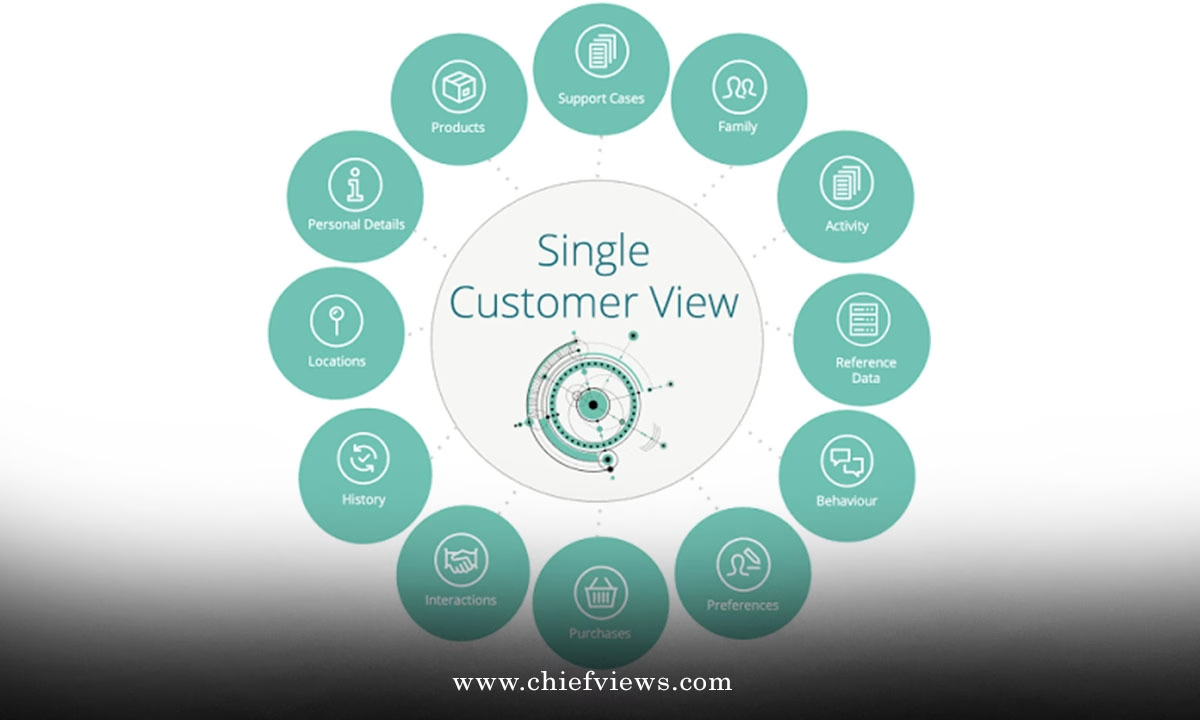
What usually happens is this: marketing collects data, service collects different data, product sees usage signals, and none of it travels cleanly. The CXO sits in the middle of that mess. Your job is to force the single view and the shared accountability that turns raw data into continuous relevance.


CXO guide to building customer relevance through continuity: the core operating model
You need three connected pieces.
First, a persistent customer identity and case record that survives channel switches. One ID. One status. One context store that shows what the customer is trying to achieve, what already failed, and what has been promised.
Second, cross-functional ownership of journeys rather than departmental ownership of channels. Marketing does not “own” the email. Service does not “own” the ticket. The journey owner owns the outcome the customer is after.
Third, feedback loops that close fast enough to keep the memory fresh. Post-interaction signals, product usage, and open comments must update the shared record in near real time.
Here’s the thing. Technology alone will not save you. A CDP without governance is just expensive storage. The operating model decides whether the data actually travels and gets used.
Building the memory spine
Start with one high-friction journey. Onboarding, a claim, a renewal, a dispute—pick the one that already generates the most repeat contacts. Map every handoff. Baseline the metrics that matter: repeat contact rate, time to resolution, customer effort, and whether the customer had to re-explain their situation.
Then install the minimum viable spine: persistent case ID, shared status visible to every team, and a context layer that captures intent and history. Expand from there.
In practice, this is where most efforts stall. Teams argue about the perfect platform instead of shipping the first working version. Ship the spine. Perfect later.
Step-by-step action plan for CXOs new to continuity
If you are still early, here is the sequence I recommend.
- Pick the journey and the metrics. Choose one high-volume, high-pain path. Define success as fewer repeats, faster resolution, and higher relevance scores on the next interaction.
- Force a single customer view for that journey. Pull the existing systems into one readable record even if the full CDP is months away.
- Name a journey owner with real authority. Someone who can call marketing, product, and service into the same room and change the process.
- Instrument the handoffs. Every time a customer switches channel or team, log whether context traveled. Fix the breaks first.
- Close the loop weekly. Review the metrics and the actual customer language. Adjust the playbook in the same meeting.
- Scale only after the first journey runs clean. Then move to the next high-value path with the same operating model.
What I’d do if I walked into a mid-size company tomorrow: lock the first journey in 30 days, prove the reduction in repeat contacts, and use that win to fund the broader data foundation.
Common mistakes and how to fix them
Mistake one: treating continuity as a technology project. You buy the platform and assume relevance will follow. Fix: lead with the operating model and the journey owner. Technology supports the model.
Mistake two: measuring only departmental KPIs. Marketing celebrates open rates. Service celebrates handle time. Nobody owns the end-to-end experience. Fix: add journey-level outcomes that no single team can move alone—end-to-end resolution time, effort score across the full path, retention after the journey.
Mistake three: ignoring the human handoff. AI and chatbots handle volume, then dump the customer into a human who has zero context. Fix: design the AI to carry the full case forward and surface the history automatically. The human should never ask the customer to start over.
Mistake four: building memory without consent and privacy controls. Relevance dies the moment customers feel watched instead of helped. Fix: make consent and data minimization part of the spine from day one.
Comparison of continuity approaches
| Approach | Speed to Value | Cost Profile | Risk of Fragmentation | Best For |
|---|---|---|---|---|
| Channel-by-channel optimization | Fast early wins | Medium, recurring | High | Teams still proving the concept |
| Full CDP + journey redesign | 6–12 months | High upfront | Low once live | Mature organizations with budget |
| Minimum viable spine on one journey | 30–60 days | Low to medium | Controlled | Most CXOs starting in 2026 |
| Pure AI personalization without shared record | Quick pilots | Variable | Very high | High risk of “creepy” rather than relevant |
The middle path—minimum viable spine—usually delivers the best risk-adjusted return. You prove the model before you scale the spend.
For deeper reading on unifying customer data and outcomes, see Salesforce’s practical guidance on building a customer-centric culture. For the financial case linking CX partnership to retention and growth, review the Forrester-backed analysis on CFO-CXO alignment published by Forbes. And for the foundational elements of cross-functional collaboration in experience management, IBM’s overview of customer experience strategy remains a solid reference.
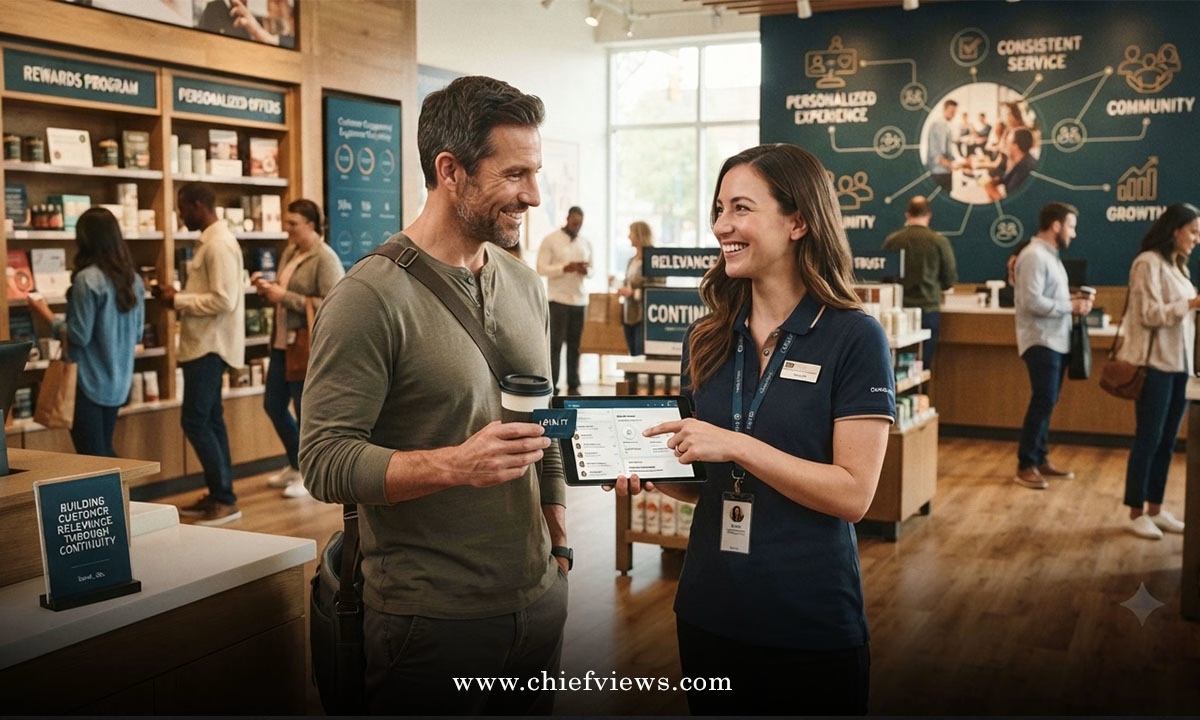
CXO guide to building customer relevance through continuity in practice
Once the spine exists, relevance becomes a daily discipline. Product teams see the same open cases that service sees. Marketing stops sending campaigns that ignore a recent support interaction. Leadership reviews include the actual customer language, not just the dashboard averages.
The kicker is cultural. Continuity only sticks when leaders model it. Open meetings with a recent customer story that shows either a clean handoff or a painful break. Reward teams for reducing customer effort across the full journey, not just inside their silo.
Ask yourself this: when a customer returns after three months, does the next agent or system already know the open issues and the preferred channel? If the answer is no, relevance is still accidental.
Key Takeaways
- Continuity is organizational memory that travels with the customer across every channel and team.
- Relevance is the result of that memory turning into timely, useful action.
- Start with one high-friction journey and a minimum viable spine rather than a multi-year platform project.
- Name journey owners with real cross-functional authority.
- Measure end-to-end outcomes, not just departmental scores.
- Design AI and human handoffs so context never resets.
- Protect privacy and consent as part of the same system that creates relevance.
- Model the behavior from the top; culture follows attention.
Build the memory system and the relevance follows. Customers notice when you stop making them start over. That is the competitive edge available to any CXO willing to treat continuity as infrastructure instead of an afterthought. Pick the first journey this quarter, install the spine, and measure the drop in repeat contacts. Everything else scales from that proof point.
FAQs
How does a CXO guide to building customer relevance through continuity differ from a standard CX program?
A standard program often optimizes individual touchpoints. This approach treats the entire relationship as one continuous conversation and builds the data and ownership systems that keep context alive between those touchpoints.
What is the fastest way to start applying a CXO guide to building customer relevance through continuity?
Select one painful journey, force a shared record for it, name a single owner, and track repeat contacts and customer effort for 30 days. Use the early win to expand.
Can smaller organizations follow the same CXO guide to building customer relevance through continuity?
Yes. The minimum viable spine requires far less technology than a full enterprise CDP. Focus on process, ownership, and the shared record first. Scale tools later.