









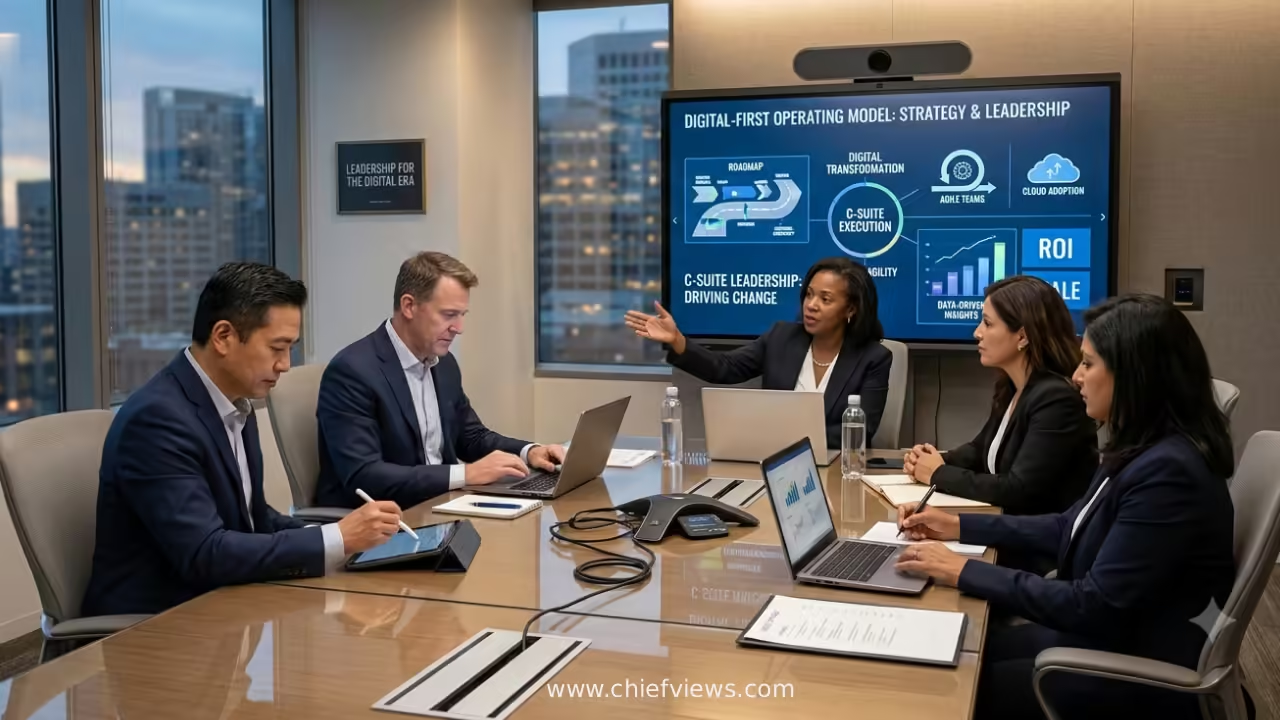
Digital-first operating model C-suite leadership is no longer optional for U.S. companies that want to stay competitive in 2026. It is the practical system that turns digital strategy into daily execution—how the CEO, CIO, COO, CFO, and emerging roles like Chief AI Officer align structure, decision rights, talent, and technology so the business runs on digital rails instead of bolting tech onto old processes.
Here’s the quick view of what it means and why it matters right now:
- It rewires how value gets created by organizing work around products, platforms, and customer journeys rather than traditional functional silos.
- C-suite leaders stop treating technology as a support function and start co-owning outcomes across the enterprise.
- Companies that get this right move faster, scale AI and automation more effectively, and close the gap between digital ambition and real results.
- Most organizations still run fragmented tech leadership; the winners integrate it and redesign the operating model every 12–18 months.
- For beginners and intermediate leaders, the payoff is clearer accountability, fewer stalled initiatives, and measurable speed in decision-making and delivery.
In my experience working with leadership teams, the ones that treat digital-first as a pure technology project almost always stall. The ones that treat it as a full operating model redesign—with the C-suite in the driver’s seat—pull ahead.
What Digital-first Operating Model C-suite Leadership Really Looks Like
A digital-first operating model is the complete set of structures, processes, governance, talent systems, and culture that lets an organization deliver value at the speed of digital. It answers three simple questions: What work needs to get done? How and where does it get done? Who (or what—human or AI agent) does it?
C-suite leadership sits at the center. The old model had the CIO or CTO owning “digital” while the rest of the executive team focused on their functional lanes. That model is breaking. Deloitte’s 2026 Global Technology Leadership Study found that 75% of technology executives say their operating model will need to change in the next 12 to 18 months just to sustain AI progress. At the same time, 71% of those organizations already have five or more C-suite technology leaders. Fragmentation is the norm. Integration is the edge.
Think of it like rebuilding the cockpit of a plane while it is flying. You cannot just upgrade the engines. You have to redesign how the pilots talk to each other, who owns which controls, and how decisions get made in real time.

The practical shift looks like this: product and platform teams that own end-to-end outcomes, decision rights pushed closer to the work, funding models that move with value rather than annual budgets, and a C-suite that treats technology fluency as a core leadership skill rather than a specialist competency.
Why Traditional C-suite Structures Struggle with Digital-first Operating Models
Most U.S. companies still operate with legacy decision rights. Annual planning cycles. Functional budgets. Separate “run the business” and “change the business” teams. That structure worked when technology was a supporting actor. It fails when technology is the main stage.
What usually happens is predictable. The CIO launches digital initiatives. Business unit leaders protect their territory. The CFO asks for ROI that the old metrics cannot capture. Projects multiply. Value leaks. Momentum dies.
IBM research in 2026 showed that 76% of organizations now have a Chief AI Officer, up sharply from the year before. That title explosion is a symptom. Companies are adding roles because the old structure cannot absorb the new work. Without a coherent digital-first operating model, those new titles just create more coordination tax.
The kicker is that the companies capturing real digital value do not just add titles. They redesign how the entire C-suite works together. McKinsey and others have long shown that integrated technology operating models—bringing digital and traditional IT under one coherent approach—are becoming the standard for companies that want speed without chaos.
The Core Roles in Digital-first Operating Model C-suite Leadership
No single org chart fits every company. Context matters. But certain patterns keep showing up among the teams that execute well.
| Role | Primary Focus in a Digital-first Model | Key Shift from Traditional Approach |
|---|---|---|
| CEO | Sets the operating model ambition and protects the redesign | From strategy owner to systems architect of human + AI work |
| CIO / CTO | Owns platforms, data, and engineering excellence | From service provider to co-owner of business outcomes |
| COO | Redesigns workflows and orchestrates human-AI work | From efficiency enforcer to operating model designer |
| CFO | Builds dynamic funding and value tracking | From annual budget gatekeeper to real-time investment partner |
| CAIO / Emerging Tech Lead | Scales AI agents and governance | New role focused on orchestration rather than pure technology delivery |
| CHRO | Builds digital fluency and new talent models | From people processes to capability engine for hybrid workforces |
Notice the pattern. Every role expands beyond its historical lane. The successful teams treat these expansions as shared rather than competitive. In practice, the strongest setups often feature a tight triad—tech leader, CFO, and strategy or COO—working as a unit with direct CEO sponsorship.
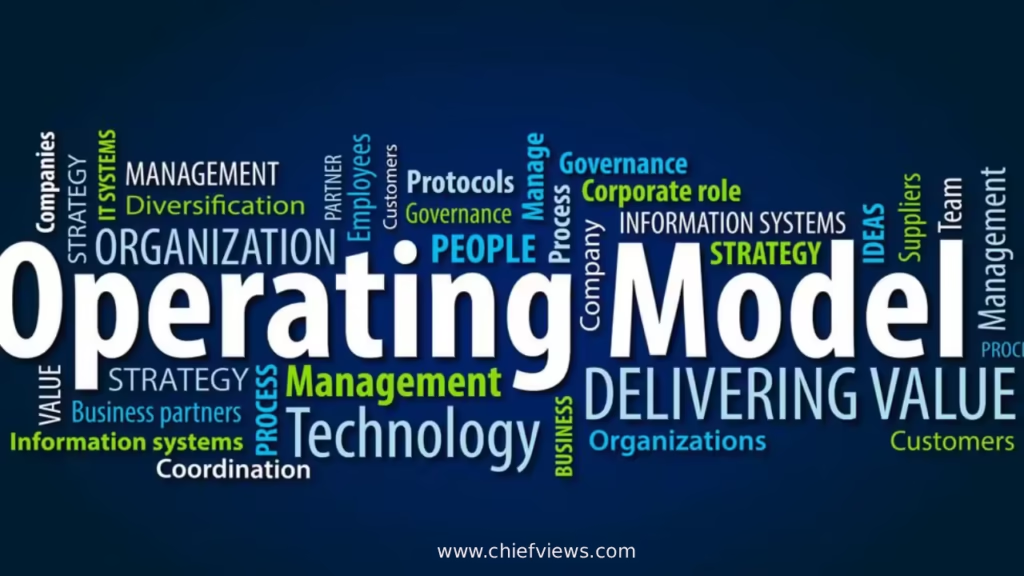
Step-by-Step Action Plan for Building Digital-first Operating Model C-suite Leadership
If you are a beginner or intermediate leader looking to move from theory to execution, start here. This is the sequence I have seen work most cleanly.
- Diagnose the current operating model honestly. Map how decisions actually get made today, not how the org chart says they should. Identify where digital initiatives die—budget cycles, risk committees, handoff points between functions. Do this with the full C-suite in the room.
- Define the target operating principles. Agree on a short list: product over project, outcome over activity, platform over point solution, real-time over annual. These become the non-negotiables.
- Clarify primary digital ownership and reporting. Deloitte research consistently shows higher success rates when the primary digital owner reports to the CEO rather than another C-suite executive. Decide who owns the overall digital agenda and make the reporting line clear.
- Reorganize work around products and platforms. Move from functional teams to cross-functional product teams that own customer or internal journeys end-to-end. Pair each product with a supporting platform team that provides shared capabilities (data, identity, AI services, etc.).
- Reset decision rights and funding. Push day-to-day decisions to the product teams. Keep strategic prioritization and major investment decisions at the C-suite level but make those decisions more frequent and lighter-weight. Shift from pure project funding to a mix of platform investment and product value funding.
- Build the measurement system. Track leading indicators—cycle time, decision velocity, platform reuse, AI agent adoption—alongside traditional financial metrics. Review them in the same C-suite forums that review financial performance.
- Run a 90-day pilot on one high-value journey. Pick something concrete—customer onboarding, claims, order-to-cash, or a core internal process. Redesign it under the new model. Use the pilot to surface the real friction points before scaling.
- Institutionalize the redesign cadence. Treat the operating model as a living system. Schedule formal reviews every 12–18 months. The companies treating this as a one-time project fall behind those that treat it as continuous architecture work.
Common Mistakes & How to Fix Them
Mistake 1: Treating digital-first as an IT project.
Fix: Make the CEO the public sponsor and require every C-suite member to own a piece of the redesign. Technology is necessary but never sufficient.
Mistake 2: Adding new C-suite titles without redesigning the interfaces between them.
Fix: Explicitly map decision rights and collaboration mechanisms between the new and existing roles. More titles without clearer handoffs just multiplies meetings.
Mistake 3: Launching agile teams inside an unchanged hierarchy and budget process.
Fix: Change the funding and governance first. Agile teams inside traditional stage-gate and annual budget systems eventually revert to old behaviors.
Mistake 4: Measuring only technology outputs (number of AI models, percentage of cloud migration).
Fix: Tie every major initiative to a business outcome metric that the relevant business leader already cares about. Then add the operational metrics that show the operating model is actually changing.
Mistake 5: Under-investing in the talent and culture side.
Fix: Pair every structural change with a deliberate capability build for the C-suite and the next layer down. Digital fluency is now a leadership requirement, not a specialist skill.
Key Takeaways
- Digital-first operating model C-suite leadership is the practical system that turns digital strategy into execution by redesigning structure, decision rights, and work itself.
- Most organizations still run fragmented tech leadership; the winners integrate it and treat the operating model as a living system.
- C-suite roles are expanding—every executive needs greater technology fluency and shared ownership of outcomes.
- Start with diagnosis, clear principles, and a focused pilot rather than a big-bang reorganization.
- Reporting lines matter: digital ownership that sits with or reports to the CEO correlates with stronger results.
- Funding, governance, and measurement systems must change in parallel with team structures.
- The biggest risk is treating this as a technology initiative instead of a full operating model redesign.
- In 2026 the competitive gap is widening between companies that rewire how they work and those that simply add more digital tools to the old model.
The companies that treat digital-first operating model C-suite leadership as a core leadership discipline—not a technology side project—are the ones pulling away. The work is hard because it forces trade-offs and exposes old power structures. That is exactly why it creates durable advantage.
If you are leading or advising a team right now, pick one high-value journey this quarter, run the diagnosis with the full executive team in the room, and force the conversation about decision rights and funding. That single move surfaces more truth than another strategy deck ever will.
FAQs
What does digital-first operating model C-suite leadership mean in practice for a mid-sized U.S. company?
It means the CEO and senior team actively redesign how work gets organized, decided, and funded so digital capabilities become the default way the business runs rather than an add-on. For a mid-sized firm this often starts with product teams around the most important customer journeys and a clearer ownership model for platforms and data.
How is digital-first operating model C-suite leadership different from traditional digital transformation?
Traditional transformation often focuses on technology projects and change programs. Digital-first operating model work focuses on the permanent system of structures, decision rights, talent models, and governance that lets the organization keep delivering value at digital speed after the initial projects end.
Who should lead digital-first operating model C-suite leadership efforts?
The CEO must sponsor it. Day-to-day leadership usually sits with a combination of the CIO/CTO and the COO, with the CFO as a full partner on funding and value tracking. Emerging roles such as Chief AI Officer can own specific domains, but the overall model redesign belongs to the full executive team.

