









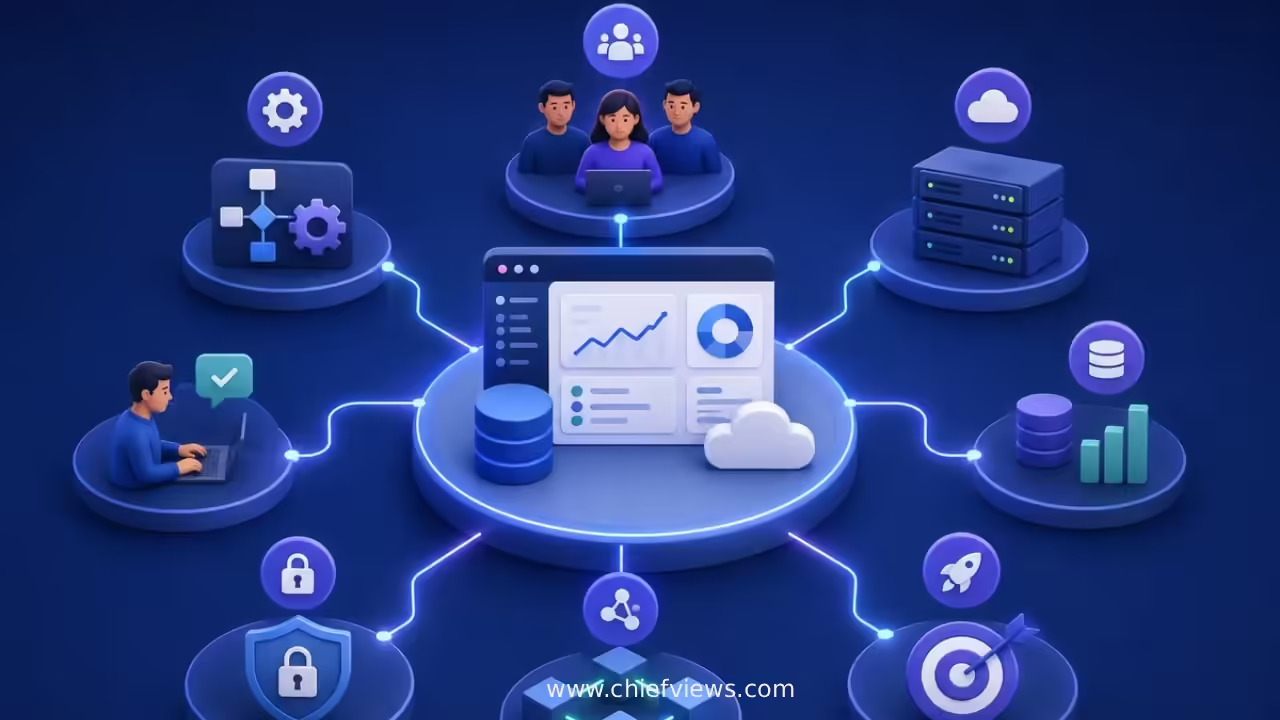
Product and platform operating models give technology and business teams a practical way to deliver value at speed instead of drowning in projects that never quite finish. These models organize work around persistent product teams that own customer or employee experiences and platform teams that build the shared capabilities those products rely on. The result is faster delivery, higher reuse, clearer accountability, and stronger alignment between technology investment and business outcomes.
Here’s the short version of why product and platform operating models matter in 2026:
- They replace temporary project teams with durable, cross-functional groups that own outcomes end-to-end.
- Product teams focus on user-facing value; platform teams focus on reusable services, data, and infrastructure that many products share.
- Companies that mature this model show meaningfully better time-to-market, lower defect rates, higher operating margins, and stronger total shareholder returns.
- The model forces better prioritization, funding discipline, and C-suite collaboration.
- It forms a core building block of broader Digital-first operating model C-suite leadership by translating strategy into how work actually gets done.
In my experience, most organizations that struggle with digital initiatives are still running a project factory. They fund initiatives, assemble temporary teams, ship something, then disband the team and start over. Product and platform operating models break that cycle.
What Product and Platform Operating Models Actually Are
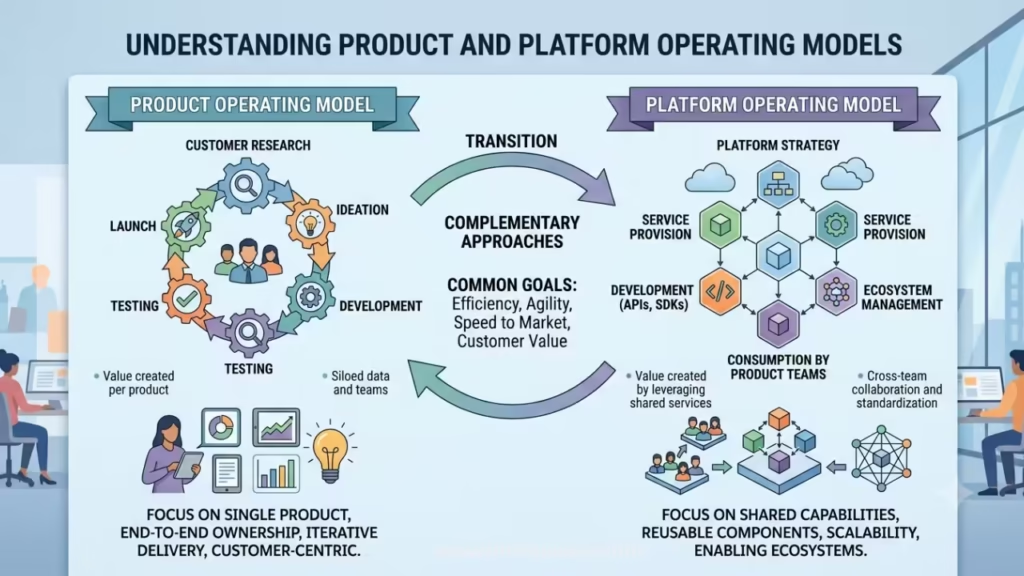
A product is a technology-enabled offering that lets customers or employees complete valuable activities. Think of a retailer’s search experience, a bank’s mobile onboarding flow, or an internal claims-processing tool. The product team owns the full experience, the roadmap, the metrics, and the continuous improvement of that offering.
A platform is the set of shared, reusable capabilities that multiple products depend on—identity services, data platforms, payment rails, AI model infrastructure, security tooling, or core transaction systems. Platform teams treat these capabilities as products in their own right, with their own users (the product teams), service levels, and evolution roadmaps.
McKinsey’s work on the topic has been consistent for years: companies that organize technology around products and the platforms that enable them remove the old divide between “digital” teams and traditional IT. The integrated model produces clearer accountability and better business alignment.


The philosophical shift is simple but profound. Projects end. Products evolve. Platforms compound.
Why the Old Project Model Breaks Down
Traditional project structures create predictable problems. Teams form around a temporary scope, optimize for delivery dates rather than long-term value, and leave behind technical debt and knowledge that walks out the door when the project ends. Funding is episodic. Prioritization fights happen in annual planning cycles. Business and technology stay in separate lanes until a crisis forces them together.
Product and platform operating models flip the incentives. Stable teams stay with the same value stream for years. They build institutional knowledge. They face the consequences of their own technical choices. They compete for limited platform capacity rather than inventing one-off solutions. The C-suite gains a clearer view of where investment is actually creating (or destroying) value.
This structure sits squarely inside effective Digital-first operating model C-suite leadership. Without product and platform discipline, digital strategy remains a set of initiatives rather than a new way of running the company.
How Product and Platform Teams Differ in Practice
| Dimension | Product Teams | Platform Teams |
|---|---|---|
| Primary focus | User-facing experiences and business outcomes | Shared, reusable capabilities and scale |
| Key customers | End customers or employees | Internal product teams |
| Success metrics | Adoption, conversion, revenue impact, experience scores | Reuse rate, reliability, time-to-provision, cost-to-serve |
| Funding approach | Often tied to business value or product P&L | Mix of central investment and chargeback/usage |
| Team composition | Product manager, designers, engineers, data, ops, domain experts | Platform product managers, architects, SREs, security, data engineers |
| Typical lifespan | Multi-year ownership of a value stream | Multi-year ownership of a capability domain |
The two types of teams must work in close partnership. Platform teams that ignore product needs become bureaucratic. Product teams that ignore platform standards create expensive fragmentation. The best organizations put explicit collaboration mechanisms and shared OKRs in place so both sides stay aligned.
Step-by-Step Action Plan to Move Toward Product and Platform Operating Models
- Map your current technology and value streams. Identify the major user journeys and the underlying systems that support them. Separate what is truly product-facing from what should be treated as shared platform capability.
- Define a short list of priority products. Start with three to five high-value journeys rather than trying to reorganize everything at once. Assign clear product owners with end-to-end accountability.
- Identify the critical platforms those products need. Common candidates include customer data platforms, identity and access, core transaction systems, AI/ML infrastructure, and developer self-service tooling.
- Stand up persistent cross-functional teams. Each product and platform gets a stable team with the right mix of business, product, engineering, and operations talent. Avoid temporary “squad” theater that still reports into old functional hierarchies.
- Reset funding and prioritization. Move away from pure project funding toward a combination of product value funding and platform investment. Create a lightweight but rigorous prioritization process that the C-suite can actually use.
- Establish governance that enables rather than slows. Product teams need autonomy within clear guardrails. Platform teams need authority to set standards and enforce reuse. A small digital-delivery or technology leadership office usually helps balance the two.
- Instrument everything. Track cycle time, deployment frequency, change failure rate, platform adoption, and business outcome metrics in the same forums where financial results are reviewed.
- Run a focused pilot and expand deliberately. Prove the model on one or two value streams, capture the lessons, then scale. Most failed attempts try to flip the entire organization in a single big-bang redesign.
Deloitte’s product operating model framework emphasizes value streams, clear OKRs, integrated shared services, and delivery KPIs as foundational elements. Those pillars remain practical starting points in 2026.
Common Mistakes and How to Fix Them
Mistake: Calling every team a “product team” without changing funding, incentives, or decision rights.
Fix: Give teams real ownership of outcomes and the budget authority to match. Cosmetic renaming changes nothing.
Mistake: Building platforms in isolation from product needs.
Fix: Treat product teams as the primary customers of platforms. Require platform teams to maintain service-level agreements and adoption metrics just like any external product.
Mistake: Under-investing in product management talent.
Fix: Elevate product management as a core discipline. The strongest models put experienced product leaders in the room with engineering and business counterparts as equals.
Mistake: Ignoring the engineering practices that make the model work.
Fix: Invest in modern software engineering—continuous delivery, automated testing, observability, and platform engineering tooling. Structure without technical excellence just creates faster ways to produce mediocre software.
Mistake: Treating the shift as a technology reorganization only.
Fix: Bring the full C-suite into the design. Funding models, performance management, and risk governance all need to evolve together.
Key Takeaways
- Product and platform operating models organize technology around durable value streams rather than temporary projects.
- Product teams own user-facing outcomes; platform teams own the reusable capabilities that make those outcomes scalable and consistent.
- The model improves speed, quality, reuse, and business alignment when executed with real ownership and modern engineering practices.
- It is a foundational element of Digital-first operating model C-suite leadership because it turns strategy into concrete ways of working.
- Start with a small number of high-value products and the platforms they depend on rather than a full enterprise redesign.
- Funding, governance, talent, and metrics must change in parallel with team structures.
- Companies that mature this model consistently show stronger financial and operational performance than those stuck in project mode.
- The biggest risk is surface-level adoption—new titles and team names without the underlying changes in decision rights and incentives.
Product and platform operating models are not a silver bullet. They are a disciplined way of matching how work is organized to how value is actually created. Organizations that treat them as a one-time structural change miss the point. The winners treat the model as a living system that they continuously refine.
If your technology organization still runs primarily on projects, the next useful step is straightforward: pick one high-impact customer or employee journey, map the product and platform elements required to improve it, and put a real cross-functional team in charge with multi-year ownership. That single move reveals more about your readiness than another strategy workshop.
FAQs
What is the difference between a product operating model and a product and platform operating model?
A pure product model focuses on teams that own user-facing offerings. Adding the platform layer explicitly recognizes that many products depend on shared capabilities. Managing those capabilities as products themselves prevents duplication and improves scale and reliability.
How do product and platform operating models support Digital-first operating model C-suite leadership?
They give C-suite leaders a concrete structure for aligning technology investment with strategy. Instead of funding a portfolio of projects, executives fund durable products and platforms with clear outcome ownership, making digital execution visible and manageable at the top table.
How long does it typically take to shift to a product and platform operating model?
Meaningful progress on a few priority value streams can happen in 6–12 months. Full enterprise maturity usually takes several years because it requires changes to funding, talent models, governance, and engineering practices in parallel. Starting focused and expanding deliberately produces better results than attempting a complete flip at once.

