




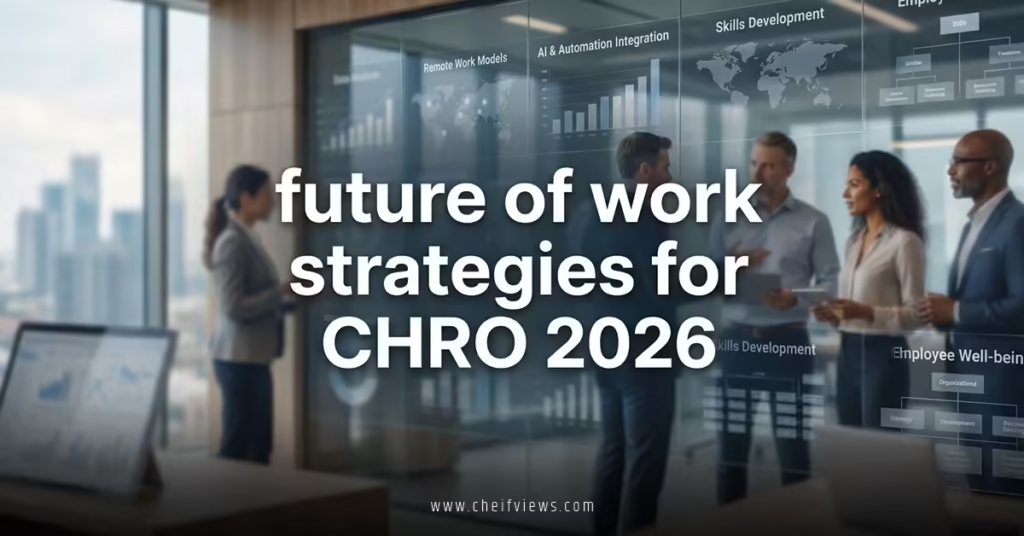
Future of work strategies for CHRO 2026 center on blending human judgment with AI power while keeping talent engaged in a hybrid world. CHROs who get this right will turn uncertainty into advantage. Those who don’t risk watching competitors pull ahead with more agile, productive teams.
Here’s what stands out right now:
- AI as teammate: Move beyond pilots to embed AI that handles drudgery and frees people for high-value work.
- Skills over jobs: Shift planning from rigid roles to fluid, outcome-focused capabilities.
- Culture that sticks: Combat “culture atrophy” in distributed setups by embedding values into daily processes.
- Leader readiness: Prepare managers for human-AI teams amid economic swings.
- Talent ecosystems: Build flexible networks including contractors, gig workers, and internal upskill pipelines.
These strategies matter because business moves faster than ever. Organizations that treat the future of work as a people-first redesign will see stronger retention, innovation, and results.
Why Future of Work Strategies for CHRO 2026 Demand Immediate Action
The ground shifted. AI adoption accelerated. Hybrid arrangements stabilized but grew complex. Workforce expectations evolved around flexibility, purpose, and growth.
In my experience, CHROs who wait for perfect clarity get left behind. What usually happens is this: leaders talk big about transformation but cling to old org charts and processes. The result? Frustrated employees and stalled productivity.
Here’s the thing: 2026 rewards CHROs who act with imperfect information. They redesign work around outcomes, not seats. They partner tightly with CIOs and CFOs. And they treat culture as a performance lever, not a nice-to-have.


Core Priorities Shaping Future of Work Strategies for CHRO 2026
Gartner’s research with hundreds of CHROs highlights four big bets: harnessing AI for HR transformation, shaping work in the human-machine era, mobilizing leaders for uncertain times, and fighting culture atrophy.
Deloitte’s 2026 Global Human Capital Trends echo this, stressing adaptability and the “human advantage” where people plus intelligent machines create multiplier effects.
| Priority | Key Challenge | Opportunity | Estimated Impact |
|---|---|---|---|
| AI-Driven HR | Integration friction | Automate routine tasks | Up to 29% productivity gain in HR ops |
| Human-Machine Workforce | Role ambiguity | Redesign jobs around judgment | Higher innovation velocity |
| Leadership Agility | Uncertainty fatigue | Targeted development | Better decision speed |
| Culture Embedding | Distributed dilution | Daily process integration | Up to 34% performance boost |
This table isn’t theory. It’s what separates organizations gaining ground from those treading water.
Building Future of Work Strategies for CHRO 2026: A Step-by-Step Action Plan
Beginners and intermediate CHROs, start here. No fluff—just what I’d do if stepping into a new role tomorrow.
Step 1: Assess your current state. Run a skills audit and AI maturity scan. Talk to 50 employees across levels about pain points. Skip the generic survey—use targeted conversations.
Step 2: Define your north star. Align with business goals. Ask: What does winning look like in 18 months? How does work need to change to get there?
Step 3: Pilot ruthlessly. Pick one high-friction process—like onboarding or performance reviews—and test AI tools. Measure effort saved, not just time.
Step 4: Redesign roles. Move to skills-based frameworks. Identify outcomes first, then figure out who (or what) delivers them—human, AI, or combo.
Step 5: Equip leaders. Run workshops on managing hybrid human-AI teams. Focus on judgment calls, not just tech training.
Step 6: Embed culture. Translate values into behaviors visible in meetings, tools, and feedback loops. Don’t let remote work erode connection.
Step 7: Measure and iterate. Track leading indicators like employee effort scores alongside lagging ones like turnover.
This plan scales. Start small, prove value, then expand.
Hybrid Models and AI: The New Normal in Future of Work Strategies for CHRO 2026
Hybrid isn’t going away. Gallup data shows most remote-capable workers want it. The challenge? Making it productive instead of fragmented.
Future of work strategies for CHRO 2026 treat hybrid as default. Offices become collaboration hubs. AI handles coordination—scheduling, knowledge retrieval, even personalized learning paths.
What I’d do: Invest in orchestration platforms that reduce tool sprawl. Train managers on asynchronous leadership. And create “anchor days” that feel intentional, not mandatory.
Rhetorical question: If your people feel more drained after hybrid meetings than before, are you really leveraging the model?
Common Mistakes & How to Fix Them
Even seasoned CHROs trip up.
Mistake 1: Treating AI as a cost-cutter only. This breeds fear and resistance. Fix: Frame it as effort-saver. Communicate how it frees capacity for creative work.
Mistake 2: Ignoring middle managers. They make or break implementation. Fix: Give them real tools and authority, not just new expectations.
Mistake 3: One-size-fits-all upskilling. Generic courses flop. Fix: Tie learning to specific career pathways and business needs.
Mistake 4: Letting culture drift. Distributed teams lose shared identity fast. Fix: Integrate values into rituals and recognition systems.
Mistake 5: Slow decision-making. While you deliberate, talent walks. Fix: Set 90-day sprints with clear owners.
Learn from these. Adjust fast.
Measuring Success in Future of Work Strategies for CHRO 2026
Look beyond engagement scores. Track productivity per effort, internal mobility rates, innovation output, and manager effectiveness.
Partner with finance for hard ROI on people investments. Use skills intelligence platforms for real-time visibility.
Key Takeaways
- Future of work strategies for CHRO 2026 put humans at the center while intelligently deploying AI.
- Skills-based approaches beat rigid job descriptions for agility.
- Culture requires active embedding, not hoping it sticks.
- Hybrid success hinges on intentional design and tech support.
- Leaders need new capabilities for human-AI collaboration.
- Start with quick pilots to build momentum and credibility.
- Measure what matters: effort reduction and business outcomes.
- Adaptability separates winners in uncertain times.
The organizations thriving in 2026 won’t have perfect forecasts. They’ll have CHROs who moved decisively, kept people front and center, and turned disruption into capability.
Your next step? Schedule that cross-functional workshop with IT and finance this month. Map one process for AI augmentation. Momentum beats perfection every time.
FAQs
What are the biggest risks in implementing future of work strategies for CHRO 2026?
Over-automation without human oversight tops the list. It leads to quality issues and disengagement. Balance with strong governance and employee input. Also watch for talent gaps in AI-adjacent skills.
How do small to mid-sized companies approach future of work strategies for CHRO 2026 without big budgets?
Focus on high-impact, low-cost moves. Leverage open-source or affordable AI tools for specific pain points. Prioritize skills development through internal mentoring and targeted partnerships. Culture work costs almost nothing but delivers outsized returns.
How does employee well-being fit into future of work strategies for CHRO 2026?
It’s non-negotiable. AI-driven workloads can increase pressure. Build in mental fitness support, clear boundaries for hybrid work, and recognition systems that celebrate sustainable performance, not just output.