





How C-level Roles Are Evolving with AI in 2026 hits every executive team hard right now. Traditional silos crack under pressure from tools that analyze markets in seconds, draft strategies overnight, and force leaders to rethink what “oversight” even means. In the USA, companies race to stay competitive while navigating ethics, talent shortages, and board expectations. The result? Roles once focused on steady operations now demand hands-on AI fluency.
- AI forces new accountability. Executives own outcomes from systems they don’t fully code themselves.
- Decision speed skyrockets. Real-time insights replace quarterly reviews.
- Hybrid skills win. Tech literacy meets business strategy at the top table.
- New titles emerge. Chief AI Officers sit alongside traditional C-suite players.
- Talent gaps widen. Nearly half of leaders flag AI as their biggest development need.
This shift matters because companies ignoring it lose ground fast. Those leaning in see measurable ROI on everything from operations to innovation.
The Big Picture Shift
How C-level Roles Are Evolving with AI in 2026:Executives no longer delegate AI to IT. They live it daily. CEOs now treat AI as core strategy, not a side project. What usually happens is the old “set it and forget it” approach collapses. Boards demand proof that investments deliver.
Here’s the thing: AI doesn’t just automate tasks. It reshapes power dynamics inside the C-suite. A CIO might now co-own revenue targets. A CMO spends more time auditing AI-generated campaigns than briefing agencies. The kicker? This evolution favors leaders who experiment boldly but govern wisely.
How C-level Roles Are Evolving with AI in 2026 shows up clearest in the rise of dedicated AI leadership. IBM’s research nails it: 76% of organizations now have a Chief AI Officer, exploding from just 26% the year before.
Why Traditional Roles Feel the Heat
CEOs face pressure to deliver AI-driven growth while managing risks like data privacy and job displacement. CFOs model scenarios at machine speed but must explain black-box outputs to stakeholders. COOs orchestrate human-AI teams that blur department lines.


The change feels relentless. One week you’re optimizing supply chains. The next, you’re debating whether agentic AI systems should make low-stakes decisions autonomously.
How C-level Roles Are Evolving with AI: Role by Role
CEO: From Visionary to AI Orchestrator
How C-level Roles Are Evolving with AI in 2026:CEOs set the tone. They can’t hide behind buzzwords anymore. Many now champion “AI-first” thinking across the enterprise. They push functional leaders to become technology experts in their domains.
Imagine running simulations for market entry in hours instead of months. The best CEOs use this to stress-test ideas faster than competitors. But they also shoulder new accountability for ethical AI use.
CIO and CTO: Strategic Powerhouses
No longer just infrastructure keepers, these roles drive transformation. CIOs lead AI pilots that scale into core operations. CTOs focus on integration and sovereignty—keeping data under control amid geopolitical tensions.
Their influence grows. Closer CEO-CIO partnerships emerge as AI urgency mounts.
The New Player: Chief AI Officer
This role exploded for good reason. CAIOs handle strategy, ethics, ROI tracking, and cross-functional adoption. They sit at the executive table because AI touches everything from product development to customer trust.
| Role | Traditional Focus | 2026 AI-Evolved Focus | Key Skill Shift |
|---|---|---|---|
| CEO | Overall strategy & growth | AI accountability & enterprise transformation | From intuition to data-augmented foresight |
| CFO | Financial reporting | AI-driven forecasting & risk modeling | Interpreting AI outputs + governance |
| CIO | IT infrastructure | AI scaling & tech-business alignment | Cross-functional leadership |
| CAIO (New) | N/A | Ethical AI deployment & value realization | Balancing innovation with controls |
| CMO | Brand & campaigns | AI personalization at scale | Auditing generative content |
This table highlights the practical gaps leaders close today.
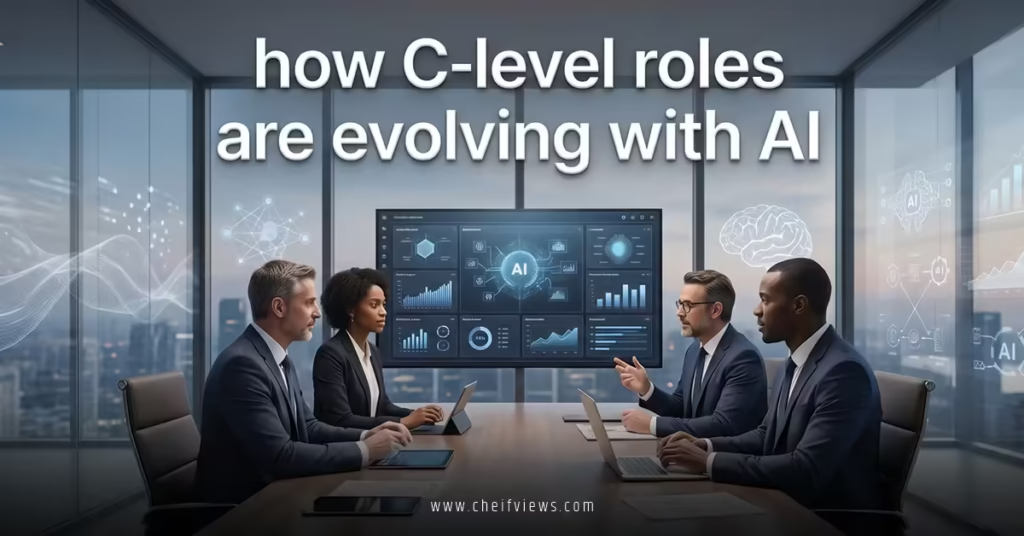
How C-level Roles Are Evolving with AI in Daily Operations
How C-level Roles Are Evolving with AI in 2026 Leaders now embed AI into workflows instead of bolting it on. Marketing teams use it for hyper-personalized content. Finance runs predictive models continuously. HR matches skills to emerging needs at pace.
One fresh analogy: Think of the C-suite as a pit crew in a Formula 1 race. AI is the high-tech car—faster, smarter, but it still needs expert drivers who know when to pit, when to push, and how to avoid crashes. Human judgment steers the machine.
What happens when leaders get this right? Productivity climbs. Decision quality improves. Teams move from reactive to proactive.
Step-by-Step Action Plan for Beginners and Intermediate Leaders
Ready to adapt? Start here:
- Assess your baseline. Audit current AI usage in your function. Map quick wins versus long-term bets. Talk to your team—what tools are they already sneaking in?
- Build literacy fast. Dedicate time weekly to hands-on tools. No need to code. Focus on prompting, output validation, and spotting hallucinations.
- Pilot with purpose. Pick one high-impact process. Set clear metrics. Involve cross-functional folks early.
- Establish guardrails. Create simple guidelines for ethical use, data privacy, and transparency. Share them loudly.
- Measure and iterate. Track time saved, revenue influenced, risks avoided. Adjust quarterly.
- Collaborate upward. Brief your CEO or board on learnings. Position yourself as the translator between tech and business value.
Follow this and you’ll move from observer to driver within months.
Common Mistakes & How to Fix Them
Leaders trip over the same wires repeatedly.
- Treating AI as a cost center. Fix: Tie every initiative to business outcomes. Demand ROI frameworks like capital projects.
- Over-delegating to IT. Fix: Own the vision yourself. Force functional ownership.
- Ignoring talent realities. Fix: Invest in upskilling now. Partner with platforms focused on executive AI fluency.
- Chasing shiny tools. Fix: Start with problems, not solutions. Validate against strategy first.
- Underestimating culture. Fix: Model curiosity and transparency. Celebrate smart experiments—even failures that teach.
Spot these early and correct course.
For deeper context on ethical frameworks, see resources from IBM Institute for Business Value. On scaling practices, McKinsey’s AI insights offer proven playbooks. Governance details shine in Deloitte’s State of AI reports.
Key Takeaways
- AI pushes C-level roles from oversight to active orchestration.
- New titles like CAIO reflect the strategic weight technology now carries.
- Success demands hybrid skills—business acumen plus tech fluency.
- Measurement and governance separate winners from also-rans.
- Early movers gain speed and talent advantages.
- Human judgment remains irreplaceable for high-stakes calls.
- Adaptation is non-negotiable in the USA’s competitive market.
- Start small, scale smart, and communicate relentlessly.
Bottom line: How C-level roles are evolving with AI rewards the bold and prepared. Leaders who treat this as an opportunity—not a threat—build resilient, high-velocity organizations. Pick one initiative this week. Test it. Learn from it. Your next move compounds faster than you think.
FAQs
How quickly are how C-level roles are evolving with AI across US companies?
Most organizations see noticeable shifts within 12-18 months of serious adoption. The jump in CAIO appointments from 26% to 76% in one year shows the pace.
What skills matter most as how C-level roles are evolving with AI?
Strategic thinking, ethical judgment, AI literacy, and change leadership top the list. Technical depth helps but cross-functional translation skills win.
Can smaller companies keep up with how C-level roles are evolving with AI?
Absolutely. Fractional CAIOs and accessible tools level the field. Focus on targeted use cases that drive immediate ROI rather than enterprise-wide overhauls.