





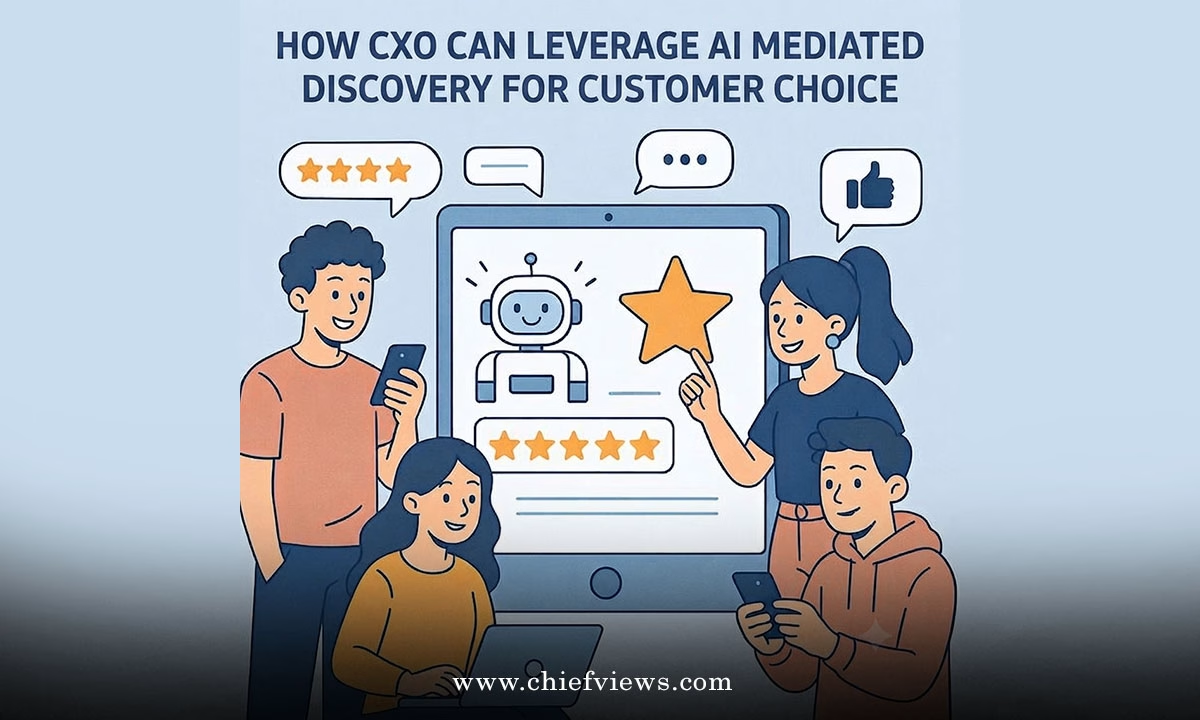
How CXO can leverage AI mediated discovery for customer choice starts with one hard truth: your next customer may never visit your website. They’ll ask an AI assistant, get a shortlist of three options, and move on. If you’re not on that list, the conversation ends before it begins.
Here’s the quick overview of what this shift means:
- AI tools now act as the first filter for product and vendor research across consumer and B2B buyers
- Visibility in traditional search no longer guarantees presence in AI answers
- Structured data, third-party signals, and real customer experience now decide which brands get recommended
- CXOs who treat discovery as a cross-functional priority protect revenue that would otherwise vanish upstream
- The window to adapt is open in 2026—but it won’t stay that way forever
The old playbook of ranking high on Google and waiting for traffic is breaking. Bain research shows 44% of U.S. online buyers already start their journey in an LLM or split time between AI tools and traditional search. McKinsey projects $750 billion in U.S. revenue will flow through AI-powered search by 2028. That’s not a future problem. It’s a current one.
Why AI Mediated Discovery Changes the Rules for Customer Choice
Customers no longer browse ten tabs. They ask one question and expect a reasoned shortlist. Independent AI assistants—ChatGPT, Gemini, Claude, Perplexity—handle comparison across sellers. Platform-owned tools then help finish the deal. The competitive fight has moved upstream into the discovery layer.
What usually happens is this: a buyer types a natural-language prompt. The model builds a consideration set based on semantic fit, constraints (price, features, use case), and authority signals. Only then does it rank. Miss the first filter and no amount of ad spend saves you.
In my experience working with leadership teams, the brands that surface consistently share three traits. Clean, structured product data. Consistent third-party mentions and reviews. And customer experiences strong enough that AI systems treat the brand as trustworthy.



CXOs own the leverage here. Marketing can’t fix data quality alone. Product can’t control review volume. Customer experience can’t force structured feeds. Only the C-suite can force the alignment.
How CXO Can Leverage AI Mediated Discovery for Customer Choice: The Practical Playbook
Think of AI discovery like a new shelf space that changes every day. You don’t control the shelf. You influence what gets stocked by making your products easy for the algorithm to understand and recommend.
Step-by-Step Action Plan for Getting Started
- Audit your current AI visibility. Open ChatGPT, Gemini, and Perplexity. Ask category-level questions that real buyers ask. Record which competitors appear and which claims the models make about you. Do this monthly. Treat it like competitive intelligence, not a vanity check.
- Map the decision filters. List the constraints customers actually use—price bands, certifications, specific features, use-case fit. Then check whether your public data clearly addresses each one. Most gaps live here.
- Fix the data foundation. Product catalogs, specs, pricing, availability, and policies must be machine-readable. Schema markup, clean merchant feeds, and consistent entity information across your site and major platforms matter more than polished marketing copy.
- Strengthen third-party signals. AI models pull heavily from reviews, expert sites, news mentions, and forums. Invest in genuine customer feedback volume and response quality. One strong pattern I’ve seen: brands that treat review management as a CX function—not a marketing afterthought—climb faster in recommendations.
- Align discovery with conversion readiness. Once an AI surfaces you, the next step needs to be frictionless. Fast quote tools, clear next actions, and accurate inventory prevent the “found but not chosen” problem.
- Measure what matters. Track share of AI answers in your category, referral traffic quality from AI sources, and conversion rates from those sessions. Traditional organic rankings still matter, but they are no longer the primary scoreboard.
How CXO Can Leverage AI Mediated Discovery for Customer Choice Through Cross-Functional Ownership
The real work sits between departments. Marketing owns content and entity signals. Product and data teams own catalog quality. CX owns the sentiment and service consistency that AI systems read as trust. Sales and commercial teams own the proof points that close the loop after recommendation.
What I’d do if I were stepping into a new CXO role tomorrow: form a small discovery working group that meets bi-weekly for the first quarter. Give it a clear mandate—raise AI shortlist presence in two priority categories by a measurable percentage—and protect its time. Without that protection, day-to-day firefighting wins.
Common Mistakes & How to Fix Them
Mistake 1: Treating AI discovery as “just SEO 2.0.”
SEO and generative engine optimization overlap, but they are not the same game. Keyword ranking correlation with AI recommendations is near zero in some analyses. Fix: build a separate measurement framework for AI presence and decision coverage.
Mistake 2: Publishing more content without structuring it.
Long blog posts that ignore decision variables get ignored by models. Fix: rewrite key product and category pages so they answer the exact constraints buyers use. Clear attributes beat clever prose.
Mistake 3: Ignoring customer experience signals.
AI systems parse reviews, response patterns, and service consistency. A brand with strong marketing but weak recovery stories loses. Fix: make public sentiment a standing CX metric and close the gaps that show up in review language.
Mistake 4: Waiting for perfect agentic commerce before acting.
Full autonomous purchasing is still emerging. Discovery and shortlisting are already mainstream. Fix: optimize for the layer that exists today—recommendation—while preparing data APIs for the transaction layer that follows.
Comparison of Traditional Search vs AI Mediated Discovery
| Dimension | Traditional Search | AI Mediated Discovery |
|---|---|---|
| Primary user action | Keyword query + click | Conversational prompt + shortlist |
| Decision timing | After visiting multiple sites | Often before any site visit |
| Ranking factors | Links, keywords, technical SEO | Semantic fit, constraints, authority signals, structured data |
| Typical shortlist size | 10 blue links | 3–8 recommendations |
| Control level for brands | Medium (own site + ads) | Lower (third-party models) |
| Key risk | Ranking drop | Complete absence from answers |
| Winning move | Rank high and convert | Become eligible then preferred |
The table makes the shift concrete. In traditional search you fight for position. In AI discovery you fight first for eligibility, then for preference.
Building the Capability Inside the Organization
Data quality is the non-negotiable foundation. Without accurate, real-time product and service information, every other effort underperforms. In my experience, the organizations that move fastest treat catalog hygiene and entity consistency as board-level risks rather than IT backlogs.
Customer experience becomes a direct input to discoverability. Service recovery quality, review response speed, and consistency across channels feed the same systems that decide recommendations. That changes the CXO’s job. Experience is no longer only about retention. It is also about upstream visibility.
One fresh way to think about it: AI discovery is the new front door, but the house still needs solid foundations and a well-kept garden. The front door decides who notices you. The foundations and garden decide whether they stay and recommend you to others.
How much of your current customer acquisition budget still assumes people will find you the old way? That question alone usually surfaces the gap between strategy decks and operating reality.
Key Takeaways
- AI tools already shape shortlists for a large and growing share of U.S. buyers
- Presence in AI answers requires structured data, clear decision coverage, and strong third-party trust signals
- CXOs must force cross-functional ownership—marketing, product, data, and CX cannot solve this alone
- Audit visibility monthly across major models and treat the findings as competitive intelligence
- Fix eligibility filters before worrying about ranking inside the shortlist
- Measure AI referral quality and conversion, not just traditional organic traffic
- Start with priority categories rather than trying to boil the ocean
- Customer experience quality now directly influences discoverability
The brands that treat AI mediated discovery as a strategic priority in 2026 will own a larger share of customer choice over the next several years. Those that treat it as a marketing experiment will wake up to shrinking pipelines they never saw coming.
Your next move is straightforward. Run the three-model audit this week. Bring the results to your next leadership meeting. Assign clear owners for the biggest gaps. That single sequence turns abstract risk into concrete action.
FAQs
How can a CXO start measuring success with AI mediated discovery for customer choice?
Track three numbers: share of category answers that mention your brand across major models, volume and quality of referral traffic from AI sources, and conversion rates from those sessions. Review them monthly alongside traditional funnel metrics.
What is the biggest risk if CXOs ignore how CXO can leverage AI mediated discovery for customer choice?
You lose customers before they ever reach a channel you control. The shortlist forms upstream. Once you’re off it, recovery is expensive and often impossible for that buying cycle.
Does how CXO can leverage AI mediated discovery for customer choice differ between B2B and B2C?
The core mechanics are the same—eligibility then preference—but B2B cycles still lean harder on demos, reviews, and proof after the initial AI shortlist. Consumer categories move faster toward agent-assisted selection. In both cases, structured data and trust signals remain the foundation.