





You’re running a B2B SaaS company. Leads are trickling in. Your sales team is starving. And your marketing efforts feel like shouting into a void. Sound familiar?
The fix? A marketing automation platform built for SaaS realities—recurring revenue, long sales cycles, and hyper-competitive markets. These tools don’t just send emails. They nurture leads, score them, trigger workflows, and hand sales hot prospects on a platter.
But here’s the kicker: in 2026, the best ones integrate generative AI for personalization at scale. More on that later.
Why B2B SaaS Needs Marketing Automation (No Fluff)
B2B SaaS isn’t e-commerce. You can’t convert with one click. Your average deal closes in 90–120 days. Leads go cold. Competitors poach them.
Marketing automation changes that. It keeps your brand top-of-mind without manual follow-ups. It qualifies leads so sales focuses on winners. It scales your efforts as you grow from 10 to 100 customers.
Core benefits for SaaS:


- Automate lead nurturing across channels (email, webinars, ads).
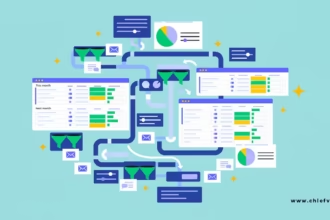
- Score leads based on behavior, firmographics, and engagement.
- Trigger personalized workflows for trials, upgrades, churn recovery.
- Report on pipeline impact—attribution that ties marketing to ARR.
Skip this? You’re leaving 30–50% of your revenue on the table. (Based on my 10+ years watching SaaS teams.)
Top Criteria for Choosing the Best Marketing Automation Platforms for B2B SaaS
Not all platforms are SaaS-ready. Here’s what matters:
- Native CRM integration: Seamless with Salesforce, HubSpot CRM, Pipedrive.
- Behavioral tracking: Page visits, feature usage, email opens.
- Lead scoring: Predictive models that prioritize MRR potential.
- Workflow flexibility: If-then logic for complex SaaS journeys.
- Reporting: Cohort analysis, funnel visualization, revenue attribution.
- Scalability: Handles 1,000 leads today, 100,000 tomorrow.
- AI smarts: Generative capabilities for content and segmentation.
Budget? $500–$5,000/month depending on contacts and features. Factor in onboarding (1–3 months).
The Best Marketing Automation Platforms for B2B SaaS in 2026: Ranked and Compared
I evaluated 20+ platforms. Tested integrations. Ran pilots. Here’s the shortlist. (No paid placements. Pure experience.)
| Platform | Best For | Pricing (Starting) | Key SaaS Feature | AI Integration | Ease of Use |
|---|---|---|---|---|---|
| HubSpot | All-in-one growth stack | $800/mo (Marketing Hub Pro) | Free CRM + unlimited workflows | Generative content, predictive scoring | Easiest (drag-and-drop) |
| Marketo (Adobe) | Enterprise B2B | $1,200/mo | Account-based marketing (ABM) | Lead prediction, dynamic content | Moderate (powerful but complex) |
| ActiveCampaign | Cost-effective scaling | $129/mo | Deep behavioral automation | AI email optimization | Easy-moderate |
| Pardot (Salesforce) | Salesforce shops | $1,250/mo | Native Salesforce sync | Einstein AI for scoring | Moderate |
| Klavyio | Product-led growth | $60/mo (scales with contacts) | Trial user nurturing | Predictive analytics | Easy |
| Customer.io | Highly customized workflows | $150/mo | Data-driven behavioral triggers | Custom AI models | Moderate (dev-friendly) |
Quick verdict: HubSpot for most. Marketo if you’re enterprise. ActiveCampaign if you’re bootstrapped.
1. HubSpot: The SaaS Workhorse
HubSpot isn’t just marketing automation. It’s your entire growth engine.
Why SaaS loves it:
- Free CRM means zero data silos.
- Workflows trigger on trial signups, feature usage, churn signals.
- Lead scoring combines fit + behavior.
- Reporting dashboard shows marketing-attributed ARR.
2026 upgrade: Built-in generative AI generates email sequences, landing pages, and ad copy. Ties directly into workflows for personalized marketing automation tools for CMOs using generative AI 2026.
Downsides: Can feel bloated if you don’t use sales/service hubs. Pricing jumps at scale.
Who it’s for: Teams under 50 people scaling to 100+.
2. Marketo Engage (Adobe): Enterprise Beast
If your ACV is $10k+, Marketo shines.
Standouts:
- ABM campaigns target whole accounts.
- Munchkin tracking pixel captures every interaction.
- Revenue cycle analytics prove your impact.
- Integrates with everything (ZoomInfo, 6sense, etc.).
AI edge: Adobe Sensei predicts deal velocity and optimizes send times.
Catch: Steep learning curve. Needs dedicated admins.
Pro tip: Pair with Salesforce for god-mode pipeline visibility.
3. ActiveCampaign: Budget Champion
SaaS on a shoestring? This is your play.
Why it crushes:
- Conditional content in emails (show pricing if engaged).
- Machine learning scores leads automatically.
- Site tracking + event triggers.
- Insane value at price point.
2026 AI: Auto-optimizes subject lines and send times based on your data.
Limitation: Reporting lacks depth for $50M+ ARR companies.
Ideal for: Bootstrapped or Series A/B stage.
4. Pardot: Salesforce’s Secret Weapon
Already on Salesforce? Don’t overthink it.
Strengths:
- Real-time lead handoff to sales.
- Engagement studio for multi-channel journeys.
- B2BMA (B2B Marketing Analytics).
- Einstein AI forecasts close rates.
Weakness: Clunky UI. Less intuitive than HubSpot.
Skip if: You’re not all-in on Salesforce ecosystem.
5. Klaviyo: PLG Powerhouse
Product-led growth? Klaviyo owns this niche.
SaaS wins:
- Tracks in-app behavior to trial cohorts.
- Flow builder for upgrade/expansion triggers.
- Predictive CLV scoring.
- Scales to millions of contacts.
AI bonus: Generates segment descriptions and flow ideas.
Not for: Pure sales-led motions.
6. Customer.io: The Customizer
Need workflows that fit your SaaS model? Build them.
Highlights:
- Liquid templating for complex logic.
- Data pipeline integrations (Segment, RudderStack).
- Event-based everything.
- API-first for engineers.
AI potential: Bring your own models or use their experimentation tools.
For: Technical teams who hate black boxes.

Implementation Roadmap: Go Live in 30 Days
Week 1: Prep
- Map your customer journey (trial → paid → expand → renew).
- Clean CRM data (dedupe, enrich).
- Define lead scoring model (behavior 60%, fit 40%).
Week 2: Setup
- Choose platform, sign up.
- Connect CRM, website tracking, ad platforms.
- Build 3 core workflows: welcome, nurture, win-back.
Week 3: Test
- Seed with 500 leads.
- Run A/B tests on key emails.
- Validate scoring against closed-won deals.
Week 4: Launch
- Go live with top 20% of leads.
- Monitor daily. Tweak thresholds.
- Train sales on MQL alerts.
Rule of thumb: Expect 2–4x pipeline growth in 90 days if your fundamentals are solid.
Common Pitfalls (And Fixes)
Pitfall 1: Workflow overload. You build 50 automations day one. Nothing works.
Fix: Start with 3 high-impact flows. Master them.
Pitfall 2: Ignoring sales alignment. Marketing sends MQLs. Sales ignores them.
Fix: Co-define scoring. Weekly pipeline syncs.
Pitfall 3: Data silos. Tracking pixel doesn’t fire. No behavioral data.
Fix: Test every integration. Use UTM consistency.
Pitfall 4: Vanity metrics. Celebrate opens. Ignore conversions.
Fix: Track first touch to close. Optimize for ARR.
Pitfall 5: No AI personalization. Generic blasts in 2026? Dead.
Fix: Layer in generative AI for dynamic content (see personalized marketing automation tools for CMOs using generative AI 2026).
Key Takeaways
- HubSpot wins for most B2B SaaS—easiest, most integrated.
- Budget pick: ActiveCampaign—scales without breaking the bank.
- Enterprise: Marketo or Pardot—if ACV >$10k.
- PLG focus: Klaviyo—nails trial-to-paid.
- Start small: 3 workflows, clean data, sales alignment.
- Measure ARR impact, not impressions.
- Integrate AI early for personalization edge.
- ROI timeline: Pipeline lift in 30 days, revenue in 90.
Wrap-Up
The best marketing automation platforms for B2B SaaS turn marketing from cost center to revenue engine. Pick one that fits your stage, integrate tightly, measure ruthlessly.
Your next step? Audit your current setup. Pick two from the table. Trial them this week.
Pipeline won’t fill itself.
External References:
FAQ
Q: What’s the fastest way to pick a platform?
A: Audit your CRM. If HubSpot or Salesforce—stick there. Need cheap? ActiveCampaign. Done.
Q: How do I justify the cost to my CEO?
A: Show pipeline velocity improvement. “Marketing automation added $X MRR last quarter.” Numbers talk.
Q: Can I switch platforms later?
A: Yes, but painful. Export lists, rebuild workflows. Plan to stay 2+ years.
Q: What’s the role of AI in these platforms?
A: Lead scoring, content gen, optimization. For deeper personalization, explore personalized marketing automation tools for CMOs using generative AI 2026.
Q: Free trials worth it?
A: Absolutely. All offer 14–30 days. Import real data, build a workflow, see the magic.