




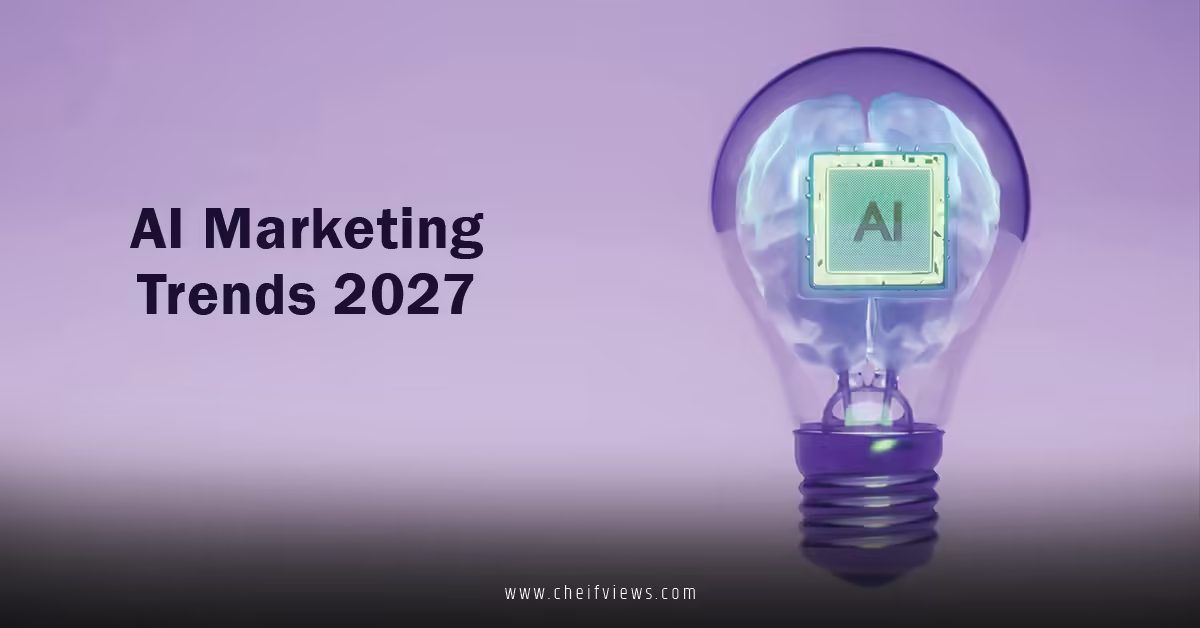
AI marketing trends 2027 shift the game from tools that assist to systems that lead. Expect agentic AI, machine customers, and invisible optimization layers that quietly determine winners and losers.
Marketers who treat these as experiments will fall behind. Those who build them into core operations will dominate attention, revenue, and efficiency.
The landscape rewards speed, trust, and precision. Here’s what’s coming hard and fast.
- Agentic AI takes the wheel — autonomous systems plan, execute, and optimize entire campaigns.
- Machine customers reshape demand — AI agents research and buy on behalf of humans.
- AI-optimized search everywhere — visibility in conversational answers matters more than traditional rankings.
- Hyper-personalization at machine scale — real-time, context-aware experiences become table stakes.
- Human-AI symbiosis and anti-AI differentiation — brands lean into authenticity as a premium signal.
These trends build directly on foundations laid in prior years. For practical ways to turn them into revenue engines, see how CMOs can use AI for growth engine strategies and ROI in 2026.
Why 2027 Marks the Tipping Point for AI-Native Marketing
2026 was about pilots and integration. 2027 is execution at scale. Agentic systems move from experimentation to production. Small, specialized models outperform giant general ones for most marketing tasks.
Gartner predicts that by 2028, 60% of brands will use agentic AI for streamlined one-to-one interactions. The shift is already underway.


What usually happens? Teams chase the latest model while ignoring infrastructure, governance, and measurement. The result? Fragmented efforts and disappointing ROI.
Smart leaders focus on outcomes first. They design workflows where AI agents handle repetitive decisions and humans steer strategy and creativity.
Top AI Marketing Trends 2027
1. Agentic AI Orchestrates End-to-End Campaigns
No more manual handoffs. Agentic systems research audiences, generate assets, test variations, adjust budgets, and report insights autonomously within human-defined guardrails.
They don’t just suggest. They act.
This compounds small gains into massive efficiency lifts. Expect faster campaign velocity and lower execution costs.
Gartner forecasts agentic AI spending will overtake traditional chatbot investments by 2027.
2. Rise of Machine Customers
AI personal assistants will handle research, comparison, and purchases for millions of consumers and businesses.
By 2027, significant portions of procurement—especially routine B2B replenishment—get delegated to agents. Brands must optimize for API-first experiences, structured data, and clear value propositions that machines can parse instantly.
This changes everything about product discovery and sales funnels.
3. Search Everywhere Optimization (AIO)
Traditional SEO evolves into AI Optimization. Brands compete to appear in ChatGPT answers, Google AI Overviews, voice results, and agent recommendations.
Consistency, authority signals, and fresh earned media matter more than ever.
Gartner notes earned media budgets could double by 2027 as AI search relies heavily on credible sources.
The kicker? Silence becomes a liability. Consistent, high-quality publishing builds the trust weights AI systems use to rank recommendations.
4. Hyper-Personalization Meets Privacy Reality
First-party data, clean rooms, and privacy-preserving tech power one-to-one experiences at massive scale.
Real-time behavioral signals trigger dynamic content, offers, and journeys. Yet regulations tighten. Winners balance relevance with trust.
5. Anti-AI Positioning and Human Authenticity
Around 20% of brands will market their deliberate lack of AI in certain areas as a premium feature.
Deepfakes and generic AI slop make human-crafted, transparent content a differentiator. Creator authenticity initiatives capture bigger budget shares.
6. Small Specialized Models Dominate
Gartner predicts organizations will use small, task-specific AI models at least three times more than large general-purpose ones by 2027.
Faster, cheaper, more reliable for creative generation, segmentation, bidding, and analytics.
7. Advanced Measurement and Incremental Lift
Closed-loop systems tie every touchpoint to revenue. Multi-touch attribution matures with AI. Focus shifts to true incremental impact over vanity metrics.
How to Prepare: Actionable Steps for 2027 Readiness
Start where you are. Audit your data foundations. Prioritize use cases with clear revenue ties.
Build cross-functional teams that include technical, creative, and compliance talent. Test agentic pilots on contained workflows—like ad optimization or lead nurturing—before scaling.
Invest in governance early. Define brand safety rails, approval processes, and fallback mechanisms.
Pro tip: Link back to proven playbooks. Many CMOs are extending how CMOs can use AI for growth engine strategies and ROI in 2026 frameworks into full agentic systems for 2027.
| Trend | 2027 Impact Level | Key Preparation Step | Risk if Ignored | Example Tools/Approach |
|---|---|---|---|---|
| Agentic AI Orchestration | High | Pilot multi-step workflows | Slow execution, high costs | Multi-agent platforms |
| Machine Customers | Medium-High | API-first product experiences | Lost automated sales | Structured data + agents |
| AI Search Optimization | Very High | Earned media + authority building | Invisible to AI answers | Consistent publishing |
| Hyper-Personalization | High | First-party data strategy | Irrelevant experiences | Real-time CDP integration |
| Anti-AI Differentiation | Growing | Highlight human craft | Commoditization | Transparency campaigns |
Common Pitfalls to Avoid in 2027
Chasing hype without infrastructure. Many agentic projects fail due to legacy systems and poor data quality.
Over-automating creativity. AI generates volume. Humans provide soul and strategic edge.
Ignoring talent. Companies without people-centric AI strategies risk losing top talent by 2027.
Measuring the wrong things. Absolute performance looks good until you check incremental lift.
Fix these by starting small, measuring rigorously, and keeping humans firmly in the driver’s seat for judgment calls.
Key Takeaways for AI Marketing Trends 2027
- Agentic AI moves from pilot to production and orchestrates complex marketing workflows.
- Optimize for machine customers and conversational AI interfaces now.
- Authority and consistency determine visibility in AI-powered discovery.
- Balance personalization power with privacy and trust.
- Small specialized models deliver better efficiency than chasing ever-larger LLMs.
- Human authenticity becomes a competitive advantage in an AI-saturated world.
- Strong data foundations and governance separate leaders from laggards.
- Incremental revenue measurement proves real business impact.
The gap between AI experimenters and AI-native organizations will widen dramatically in 2027.
Pick one high-impact area—agentic campaign optimization or AI search readiness—and build momentum this quarter. Test, learn, iterate.
The brands that treat AI as their new operating system won’t just keep up. They’ll set the pace.
Where are you starting?
FAQs
What is the biggest AI marketing trend to watch in 2027?
Agentic AI systems that autonomously execute multi-step campaigns and deliver personalized one-to-one interactions at scale. Brands adopting them early gain massive efficiency and relevance advantages.
How should CMOs prepare for machine customers in 2027?
Focus on structured data, clear value propositions, and API-accessible experiences so AI agents can easily discover, evaluate, and transact with your offerings.
How do AI marketing trends 2027 connect to earlier growth strategies?
They extend proven approaches from how CMOs can use AI for growth engine strategies and ROI in 2026 into more autonomous, predictive, and ecosystem-level execution.