





How AI Is Transforming Business Operations in 2026 hits different this year. It’s no longer pilots and PowerPoints. AI sits deep in the guts of daily work—cutting costs, speeding decisions, and rewriting entire workflows. Companies that get it right pull ahead fast. Those that don’t scramble to catch up.
- AI drives measurable efficiency gains across automation, prediction, and personalization.
- Agentic AI handles complex end-to-end processes with less human hand-holding.
- Supply chains, finance, HR, and customer ops see the biggest shifts.
- Chief AI Officers increasingly own the integration to deliver real business value.
- Early movers report revenue lifts, cost drops, and sharper competitive edges.
The Scale of Change Right Now
AI adoption exploded. McKinsey’s latest data shows 88% of organizations use AI in at least one function, with generative AI at 71%. High performers tie it to growth, not just cost-cutting.
Here’s the thing. Most companies still see modest wins. The gap between leaders and laggards widened in 2026. Leaders redesign work around AI. Everyone else automates a few tasks and calls it a day.
PwC predicts more enterprises will run top-down AI programs with clear accountability. CEOs stepped up—nearly three-quarters now own AI strategy directly.
Where AI Hits Hardest in Operations
Supply Chain and Logistics
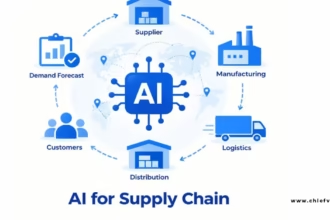


AI forecasts demand, optimizes inventory, and reroutes shipments in real time. Retailers cut inventory costs 15-20% in some cases. Predictive tools spot disruptions before they bite. Amazon and Walmart set the bar years ago—now it’s table stakes for mid-market players too.
Finance and Accounting
Invoice processing, reconciliation, fraud detection, and cash flow forecasting run on autopilot. AI agents handle routine matching and anomaly spotting, freeing finance teams for strategic work like scenario planning and dynamic pricing.
HR and Workforce
Screening, scheduling, performance insights, and even learning paths became smarter. AI reduces administrative drag so people focus on culture, development, and retention.
Customer Service
Intelligent agents manage complex queries with context and history. Response times dropped while satisfaction held or climbed. Hyper-personalization at scale became reality.
Software Development and IT
Coding assistants accelerate building, testing, and deployment. Teams ship faster with fewer bugs.
Side-by-Side Impact Breakdown
| Function | Pre-AI Reality | 2026 AI Reality | Typical Gains |
|---|---|---|---|
| Supply Chain | Manual forecasting, stockouts | Real-time predictive optimization | 15-20% lower inventory costs |
| Finance | Slow reconciliation, errors | Automated processing & anomaly detection | Faster closes, lower risk |
| Customer Ops | High-volume tickets, generic replies | Contextual AI agents | Reduced handle time, higher CSAT |
| HR | Tedious screening & admin | AI-assisted talent & workforce planning | Faster hiring, better retention |
| Overall Efficiency | Siloed tools, reactive decisions | Agentic workflows & data-driven insights | 30-40% productivity lifts (high performers) |

How Emerging C-Suite Roles Like Chief AI Officer and Chief Sustainability Officer Anchor the Transformation
Emerging C-suite roles like Chief AI Officer and Chief Sustainability Officer prove critical here. CAIOs translate tech into tangible operations wins while managing governance and risk. They prevent scattered experiments and push for scaled impact.
Many now link AI initiatives directly to sustainability goals—using AI for better emissions tracking, energy optimization in logistics, and Scope 3 reporting. The overlap creates powerful synergies.
Rhetorical question: Without dedicated leadership, who owns the messy middle where pilots die and ROI evaporates?
Exactly. These roles bridge the gap.
Step-by-Step Action Plan to Get AI Working in Your Operations
- Start with pain points. Pick one high-volume, repetitive process—invoice handling, demand planning, or support tickets.
- Audit your data. Clean, accessible data makes or breaks results. Garbage in, garbage out still rules.
- Run a focused pilot. Choose one agentic or generative tool. Measure baseline vs. post-implementation metrics ruthlessly.
- Redesign the workflow. Don’t just automate—remove steps and shift human effort to higher-value work. This is where 80% of the value hides.
- Build governance early. Ethics, security, compliance. Involve legal and risk teams from day one.
- Scale what works. Train teams, integrate into core systems, and expand.
- Measure and iterate. Track cost, speed, quality, and employee feedback. Adjust fast.
Common Mistakes That Kill Momentum
- Treating AI as a tech project instead of a business redesign.
- Chasing shiny tools without clear ROI targets.
- Under-investing in change management and training.
- Ignoring data quality until results disappoint.
- Going too broad too soon instead of deep in one area.
Fix: Tie every initiative to a specific metric. Get one win, then another. Momentum compounds.
The Human Side and What’s Next
How AI Is Transforming Business Operations in 2026:AI doesn’t replace people—it amplifies them when done right. Workers using these tools often report feeling more productive. Leaders who communicate vision and provide training see better adoption and less resistance.
Look ahead: Multi-agent systems that orchestrate complex processes, deeper integration with sustainability efforts, and tighter feedback loops between operations and strategy.
Key Takeaways
- How AI Is Transforming Business Operations in 2026 centers on moving from experiments to embedded, agentic workflows.
- High performers focus on redesigning work, not just deploying tools.
- Supply chain, finance, and customer operations lead the gains.
- Emerging C-suite roles like Chief AI Officer and Chief Sustainability Officer provide the leadership muscle needed for scale.
- Data quality and governance determine winners.
- Start narrow, measure obsessively, expand deliberately.
- The productivity upside is real for those who commit.
- Companies ignoring structured adoption risk falling behind fast.
AI won’t wait. The operations playbook changed. Smart leaders rewrite theirs now.
How AI Is Transforming Business Operations in 2026:Ready to move? Pick one process dragging your team down today. Map it, baseline it, and test one targeted AI solution this quarter. Results will tell you everything.
FAQs
How much can AI realistically improve operational efficiency in 2026?
High performers see 30-40% productivity gains in targeted areas, with cost reductions of 10-20% in supply chain and finance. Results depend on execution and workflow redesign.
What role does a Chief AI Officer play in transforming business operations?
They align AI initiatives with strategy, drive scaling beyond pilots, manage risks, and ensure measurable business impact across functions.
Is AI transformation only for large enterprises?
No. Mid-sized and even smaller companies benefit from targeted tools in inventory, customer support, or finance. Start small and scale with proven wins.