


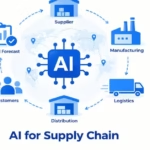



AI Implementation Roadmap for Operations delivers a clear, phased path to integrate artificial intelligence into daily workflows, boosting efficiency, resilience, and decision speed. Operations leaders who follow a structured approach avoid common pitfalls and achieve measurable ROI faster.
- Phase 1: Foundation — Assess readiness, clean data, and align on priorities.
- Phase 2: Pilots — Launch targeted use cases with quick wins.
- Phase 3: Scale — Expand successful initiatives with governance.
- Phase 4: Optimize & Evolve — Embed AI deeply and build continuous learning loops.
- Key Outcome — Turn operations from a cost center into a predictive, adaptive advantage.
This roadmap matters in 2026. Supply chains face nonstop volatility, and companies that treat AI as a bolt-on project fall behind. Those who build it into their operating system pull ahead.
Why Operations Needs an AI Roadmap Now
Operations teams sit on mountains of data but often drown in complexity. AI cuts through the noise. It predicts disruptions, optimizes flows in real time, and frees humans for higher-value work.
Yet here’s the thing: most initiatives stall after flashy pilots. A deliberate roadmap changes that. It connects technology to real business pain and keeps momentum alive.
In my experience, COOs who link their efforts directly to COO role 2026 AI-powered operations and supply chain resilience see the biggest gains. They stop treating AI as a tech experiment and start using it as a core operating muscle.
The kicker? Early movers report 15-30% improvements in key metrics like forecast accuracy and inventory turns. Waiting means playing catch-up.



Core Benefits of a Structured AI Implementation Roadmap for Operations
Done right, AI transforms how work gets done. Demand forecasting sharpens. Predictive maintenance slashes downtime. Dynamic routing cuts logistics costs. Quality control spots defects early.
Teams move from reactive to proactive. Leaders gain visibility across multi-tier supply chains. And resilience improves because systems simulate scenarios before problems hit.
One fresh analogy: Traditional operations resemble driving with a rearview mirror. A solid AI roadmap installs GPS with live traffic, weather alerts, and alternate routes already calculated.
Rhetorical question: Why navigate uncertainty blind when you can see around corners?
Phased AI Implementation Roadmap for Operations
Phase 1: Build the Foundation (Months 1-3)
Start here or fail later. Audit current data quality and systems. Map workflows. Identify high-pain areas with clear KPIs. Secure executive buy-in and cross-functional alignment.
Clean and integrate data sources. Establish governance basics. Assess talent gaps. No strong foundation means AI will amplify existing problems.
Phase 2: Run Targeted Pilots (Months 3-9)
Pick 2-3 focused use cases. Predictive maintenance in manufacturing. Demand sensing in retail. Automated exception handling in logistics.
Measure obsessively: cost savings, speed, accuracy, user adoption. Use human-in-the-loop designs so people trust and refine the outputs. Prove value before scaling.
Phase 3: Scale with Governance (Months 9-18)
Expand what works. Build reusable platforms. Roll out MLOps practices for model monitoring and retraining. Strengthen security, ethics, and compliance.
Create hybrid roles that blend operations expertise with AI fluency. Align incentives around business outcomes, not just tech deployment.
Phase 4: Optimize and Become AI-Native (Month 18+)
Embed AI into core processes. Explore agentic systems that act autonomously within guardrails. Continuously iterate based on performance data. Foster a culture of experimentation.
Link everything back to strategic goals like COO role 2026 AI-powered operations and supply chain resilience.
| Phase | Timeline | Key Actions | Typical Investment Focus | Expected Outcomes |
|---|---|---|---|---|
| 1. Foundation | 1-3 months | Data audit, readiness assessment, priority use cases | Data integration, governance | Solid base, clear roadmap |
| 2. Pilots | 3-9 months | 2-3 targeted deployments, ROI tracking | Pilot tools, training | Quick wins, proven value |
| 3. Scale | 9-18 months | Platform expansion, MLOps, change management | Enterprise platforms, integration | Broader adoption, 15-30% gains |
| 4. Optimize | 18+ months | Agentic AI, continuous improvement | Advanced models, culture | Competitive moat, resilience |

Common Mistakes & How to Fix Them
Mistake 1: Starting with technology instead of problems. Fix: Begin with business pain points that matter to the P&L.
Mistake 2: Poor data quality. Fix: Invest early in cleansing and master data management.
Mistake 3: Neglecting change management. Fix: Involve frontline teams from day one and communicate wins frequently.
Mistake 4: No clear ownership. Fix: Assign business owners, not just IT, for each initiative.
Mistake 5: Scaling too fast. Fix: Perfect the process in one area before copying it everywhere.
Practical Tips from the Trenches
What I’d do if stepping into a new operations leadership role: Spend the first 30 days shadowing teams and mapping data flows. Prioritize one pilot that delivers visible relief within 90 days. Build credibility fast.
Focus relentlessly on measurable outcomes. Celebrate operator wins publicly. And always keep humans in the loop—AI augments judgment; it rarely replaces it entirely.
For broader context on leadership in this space, revisit strategies around the COO role 2026 AI-powered operations and supply chain resilience.
Explore Gartner’s supply chain AI roadmap guidance for additional maturity frameworks.
Key Takeaways
- A phased AI Implementation Roadmap for Operations prevents wasted effort and accelerates value.
- Data foundation and clear business alignment beat fancy tools every time.
- Start small, prove ROI, then scale with strong governance.
- Human-AI collaboration drives the best results.
- Link initiatives to strategic goals like resilience and agility.
- Measure what matters: business outcomes, not just model accuracy.
- Continuous iteration turns pilots into competitive advantage.
- Operations leaders who own this roadmap shape the future of their organizations.
The companies winning in 2026 treat AI as core infrastructure, not a side project. They follow disciplined roadmaps that deliver both quick wins and lasting transformation.
Ready to move? Audit one operational process this week. Identify where better predictions or automation would create immediate impact. Then build your first pilot around it. Momentum starts with action.
FAQs
How long does a typical AI Implementation Roadmap for Operations take?
Most organizations see meaningful results in 6-12 months with focused execution, though full enterprise scale often takes 18-36 months depending on starting maturity and complexity.
What skills do operations teams need for successful AI adoption?
Data literacy, process thinking, and comfort working alongside AI tools top the list. Domain expertise remains essential—train people to interpret outputs and handle exceptions.
How does this roadmap connect to broader COO priorities?
It directly supports the COO role 2026 AI-powered operations and supply chain resilience by turning AI from an experiment into a practical system for predictive, resilient operations that drive strategic advantage.