





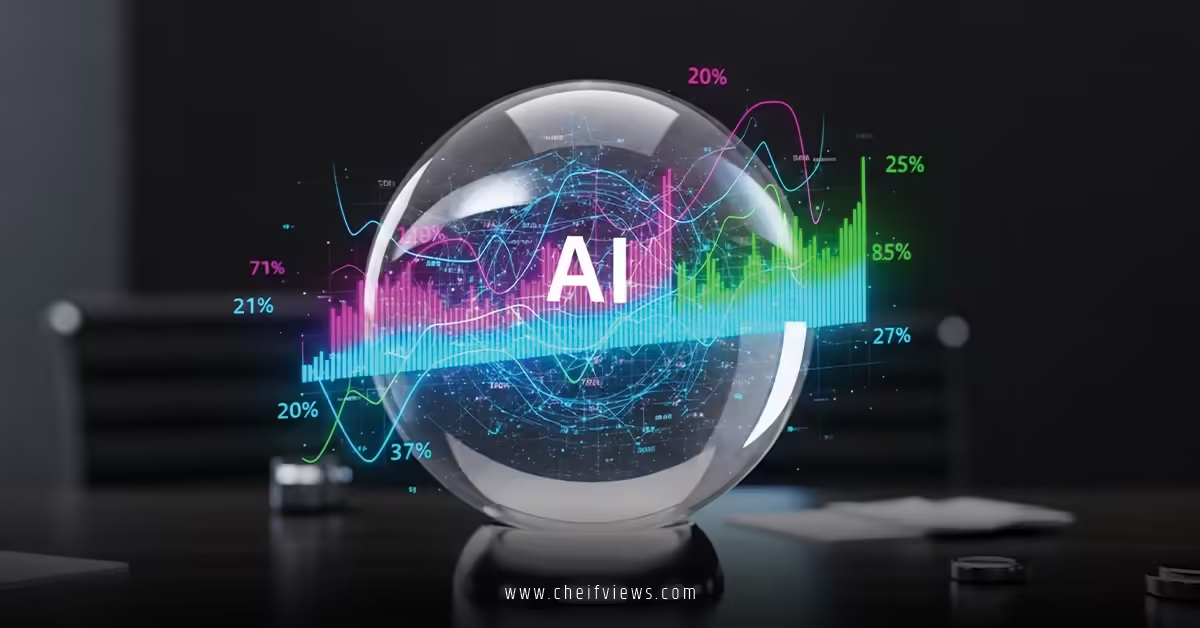
AI Personalization Trends 2026 are rewriting the rules of customer engagement. What started as basic recommendation engines has exploded into real-time, predictive, hyper-personalized experiences that feel almost psychic. Brands nailing this aren’t just selling products. They’re building relationships that stick.
Quick breakdown of what’s hot right now:
- Hyper-personalization at true 1:1 scale using behavioral, contextual, and historical data.
- Predictive journeys that anticipate needs before customers express them.
- Agentic AI systems that dynamically adjust content, offers, and interactions in real time.
- Memory-rich experiences that remember past conversations across channels.
- Privacy-first personalization balancing relevance with trust and consent.
The shift matters because customers now expect it. Generic feels lazy. Tailored wins loyalty and wallets.
Why AI Personalization Trends 2026 Matter for Marketers
Here’s the thing: 91% of consumers are more likely to shop with brands that deliver personalized experiences. AI-powered versions boost conversion rates by up to 202%. Those numbers aren’t hype—they’re table stakes in 2026.
Old-school segmentation? Dead. Today’s AI crunches dozens of signals—location, time of day, past purchases, even mood inferred from browsing patterns—to serve experiences that adapt instantly.
One fresh analogy: Think of traditional personalization like a choose-your-own-adventure book with limited branches. 2026 AI turns it into an immersive, living story that rewrites itself based on every choice you make.


Core AI Personalization Trends Dominating 2026
Hyper-Personalization at Scale
This tops every report. AI now creates dynamic content, product recommendations, emails, and website elements tailored to individuals in real time.
No more “Dear Valued Customer.” Systems generate unique messaging, pricing, or bundles based on predictive intent. McKinsey-level insights show this drives 10-30% marketing optimization.
Predictive and Proactive Journeys
AI doesn’t wait for clicks. It forecasts needs. A fitness app user might get a protein shake offer right after logging a tough workout—before they even think about recovery.
Agentic AI takes it further by executing multi-step actions autonomously while staying on-brand.
Memory-Rich Contextual Experiences
Forget reset conversations. Advanced systems maintain context across sessions and channels. Chat on mobile? Pick up exactly where you left off on desktop with relevant suggestions.
Gartner highlights how brands adopting agentic AI deliver one-to-one interactions that feel fluid and human.
Ethical, Privacy-First Personalization
Trust is the new currency. Leading brands emphasize transparent data use, easy opt-outs, and first-party data strategies. Over-personalization backfires—48% of attempts feel intrusive if mishandled.
| Trend | Key Technology | Business Impact | Implementation Tip |
|---|---|---|---|
| Hyper-Personalization | Generative AI + Real-time Analytics | 202% conversion lift potential | Start with first-party data unification |
| Predictive Journeys | Agentic AI + Forecasting Models | Higher retention, lower churn | Test on high-value segments first |
| Memory-Rich CX | Contextual Knowledge Graphs | Seamless omnichannel experiences | Prioritize data cleaning and integration |
| Privacy-First Approaches | Consent Management Platforms | Stronger brand trust | Build transparency into every touchpoint |
| Dynamic Content Generation | Multimodal AI | Faster creative scaling | Combine human oversight with AI output |
How to Implement AI Personalization Trends 2026: Step-by-Step Action Plan
Ready to move beyond pilots? Here’s what I’d do in your shoes.
- Audit your data house — Map all customer signals. Clean silos. Focus on unified profiles first.
- Pick quick-win use cases — Start with cart abandonment flows or product recommendations. Measure engagement before scaling.
- Choose the right stack — Look for platforms with strong agentic capabilities and easy CRM integration.
- Layer in human guardrails — Set rules for when AI hands off to humans. Test outputs rigorously for tone and accuracy.
- Monitor and iterate weekly — Track sentiment, conversion, and privacy metrics. AI learns fast—your strategy should too.
- Scale ethically — Build customer feedback loops. Adjust based on real perceptions, not just dashboards.
For broader CMO-level context on tying this into overall experience strategy, see how AI is transforming CMO strategies for customer experience in 2026. It connects personalization directly to leadership priorities.
Common Pitfalls and Fixes
Pitfall 1: Creepy over-personalization.
Fix: Always add value. Test for relevance. Give control back to users.
Pitfall 2: Poor data quality.
Fix: Garbage in, garbage out. Invest in cleaning and governance early.
Pitfall 3: Ignoring mobile and omnichannel.
Fix: Design experiences that flow seamlessly across devices and platforms.
Pitfall 4: No measurement framework.
Fix: Tie personalization metrics to revenue and lifetime value, not just clicks.
Key Takeaways
- Hyper-personalization powered by AI is now expected, not exceptional.
- Predictive and agentic systems deliver proactive experiences customers love.
- Memory and context create stickier, more human-feeling interactions.
- Privacy and ethics separate winners from brands that erode trust.
- Quick wins come from focused pilots on high-friction journeys.
- Continuous testing beats one-time implementations.
- Data foundations determine how far you can push personalization.
- The biggest ROI comes from blending AI efficiency with human creativity.
AI Personalization Trends 2026 give smart teams a massive edge. Don’t chase every shiny tool. Pick one journey that’s costing you customers right now. Apply these principles thoughtfully. Then watch the results compound.
Your competitors are already testing this. The question is—will you lead or follow?
FAQs
What are the biggest AI Personalization Trends 2026 marketers should prioritize?
Hyper-personalization at scale, predictive proactive journeys, and agentic systems that maintain memory across touchpoints stand out as the highest-impact areas.
How does agentic AI change personalization compared to previous years?
It moves from reactive recommendations to autonomous, multi-step orchestration that adapts journeys in real time based on evolving customer context.
Can smaller businesses leverage AI Personalization Trends 2026 effectively?
Yes. Cloud tools and first-party data strategies level the playing field. Focus on niche audiences and specific journeys for outsized results without massive budgets.