




Supply Chain Resilience Strategies separate survivors from casualties in 2026. Disruptions hit harder and faster. Tariffs swing, weather events spike, and geopolitical moves rewrite routes overnight.
Finance and operations leaders who build real flexibility protect margins, lock in suppliers, and keep customers happy when chaos strikes. This piece delivers actionable plays for US companies—beginner to intermediate level.
- Core idea: Blend diversification, tech visibility, and financial buffers to absorb shocks without bleeding cash.
- Why now: Tariff volatility remains top of mind, with 73% of leaders expecting to hit absorption walls by year-end.
- Payoff: Faster recovery, steadier cash flow, and competitive edge over rigid rivals.
- Bottom line: Resilience isn’t a cost center—it’s your insurance policy that pays dividends in stable times too.
Supply Chain Resilience Strategies turn uncertainty into managed variables. Here’s how pros do it.
Why Supply Chain Resilience Strategies Matter in 2026
Old-school “just-in-time” died years ago. Today’s game demands “just-in-case” with smart efficiency baked in. Tariffs on key inputs, nearshoring pressures, and extreme weather as the #1 disruption driver force the shift.
The kicker? Companies with strong resilience cut recovery times dramatically and often gain market share during crises. They map multi-tier risks, stress-test scenarios, and tie everything to working capital realities.
Link this directly to deeper financial plays in the CFO guide to managing tariff risk and supply chain finance. Finance can’t sit separate from operations anymore.

Core Pillars of Effective Supply Chain Resilience Strategies
Visibility first. You can’t fix what you can’t see. Multi-tier mapping reveals hidden exposures in Tier 2 and 3 suppliers.
Diversification follows. No single country or supplier owns your fate. Nearshoring to Mexico, friend-shoring with allies, and selective reshoring reduce tariff bites and transit risks.
Flexibility rounds it out. Modular contracts, buffer stocks in strategic spots, and agile logistics let you pivot fast.
One analogy: Your supply chain is like a power grid. Redundancy and smart switches prevent blackouts. Over-rely on one line, and everything goes dark.
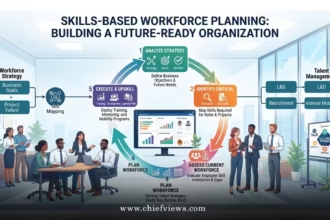
Step-by-Step Action Plan for Building Resilience
Start practical. No massive overhaul needed day one.
- Assess Exposure: Pull 12-24 months of data. Identify critical inputs, single-source dependencies, and tariff-sensitive SKUs. Use CBP tools or basic ERP exports.
- Map the Network: Go beyond Tier 1. Basic spreadsheets work for beginners; scale to platforms for intermediates.
- Diversify Sources: Implement “China +1” or multi-region strategies. Test small volumes with new suppliers in Vietnam, India, or domestic options.
- Boost Visibility Tech: Integrate real-time tracking and predictive alerts. Even mid-sized firms can start with affordable dashboards.
- Stress-Test Scenarios: Model tariff hikes, port delays, or supplier failures. Tie impacts to cash flow and margins quarterly.
- Strengthen Financial Ties: Negotiate flexible terms, secure trade insurance, and explore inventory financing. Cross-reference with tariff-specific tactics in the CFO guide to managing tariff risk and supply chain finance.
What I’d do in a new role? Run a one-day workshop with procurement, ops, and finance in week one. Alignment beats isolated excellence.
Supply Chain Resilience Strategies: Traditional vs Modern Comparison
| Element | Traditional (Lean Only) | Resilient Approach (2026) | Typical Benefit |
|---|---|---|---|
| Sourcing | Single/low-cost focus | Multi-tier, nearshore mix | 15-30% lower disruption risk |
| Inventory | Minimal buffers | Strategic stockpiles + dynamic | Faster recovery, balanced costs |
| Technology | Basic ERP | Real-time visibility + predictive AI | Earlier risk detection |
| Contracts | Rigid, long-term | Flexible with escalation clauses | Better adaptation to tariffs |
| Risk Management | Reactive | Proactive scenarios + insurance | Reduced financial volatility |
Benchmarks drawn from industry reports; results vary by sector.
Common Mistakes & How to Fix Them
Teams often chase pure cost savings and regret it when shocks hit. Over-diversification bloats complexity without focus. Fix: Prioritize critical SKUs first.
Ignoring finance links is another trap. Operations builds buffers; CFOs see working capital strain. Fix: Joint KPIs and regular reviews.
Static plans fail too. Annual reviews miss monthly tariff shifts. Fix: Set weekly monitoring and quarterly deep dives.
Rhetorical question: How fast would your chain recover from a 25% duty spike on core components?
External high-authority resources:
- USITC DataWeb for tariff and trade data.
- Deloitte Supply Chain Insights on resilience frameworks.
- Richmond Fed CFO Survey for real sentiment on tariff impacts.
Key Takeaways
- Multi-tier visibility is non-negotiable in volatile times.
- Diversification beats single-source savings long-term.
- Tie resilience directly to cash flow and margin protection.
- Technology amplifies human decisions—don’t skip the basics.
- Scenario planning turns surprises into prepared moves.
- Cross-functional ownership between ops and finance wins.
- Regular testing keeps strategies sharp.
- Resilience compounds: Strong chains attract better partners and customers.
Master these Supply Chain Resilience Strategies and your operation doesn’t just weather storms—it sails through them stronger. Start with that exposure assessment this month. Small, consistent actions build unshakeable advantage. Link it back to financial mastery in the CFO guide to managing tariff risk and supply chain finance for full impact.
FAQs
What are the most effective Supply Chain Resilience Strategies for US companies facing tariffs in 2026?
Focus on nearshoring, multi-tier mapping, predictive visibility tools, and flexible financing—integrated approaches that protect both operations and cash flow.
How do Supply Chain Resilience Strategies connect to financial planning?
They directly support working capital management and margin stability. Strong resilience reduces unexpected costs, making it easier to apply tactics from the CFO guide to managing tariff risk and supply chain finance.
Can mid-sized businesses implement Supply Chain Resilience Strategies without huge budgets?
Yes. Begin with data mapping, targeted diversification, and basic scenario modeling. Many gains come from better processes and partnerships before heavy tech spends.