


AI talent acquisition strategies 2026 flip the old recruiting game on its head. Speed, precision, and human judgment now work together. CHROs and TA leaders who master this don’t just fill seats faster—they build the exact workforce their organizations need to win with AI.
- AI handles the grind: screening, sourcing, scheduling.
- Humans own the close: relationships, culture fit, final calls.
- Skills beat degrees: dynamic matching over keyword hunts.
- Data drives decisions: predictive insights cut bad hires.
This matters in 2026 because nearly every U.S. hiring manager uses AI in some form, with adoption climbing fast. Companies that get it right slash time-to-hire, improve quality, and stay ahead in the war for talent.
The reality? Most teams still dabble. Here’s how the smart ones do it for real results.
Why AI Talent Acquisition Strategies Matter Now
Gartner highlights four big shifts for 2026: high-volume recruiting goes AI-first, AI reshapes talent assessment, cost pressures force efficiency, and new tools like interview intelligence change everything.
SHRM data shows AI use in HR tasks jumped to 43% in 2026 from 26% in 2024. Korn Ferry and others note TA leaders now advise CHROs directly on workforce transformation.
Here’s the thing: AI isn’t replacing recruiters. It’s freeing them to focus on strategy and connection. Ignore this and your pipeline dries up while competitors pull ahead.
Think of it like upgrading from a flip phone to a smartphone. The old way still works—barely. The new way opens possibilities you didn’t even know existed.
Core AI Talent Acquisition Strategies for 2026
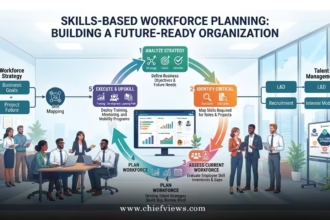
Start with skills-based everything. Ditch rigid requirements. Use AI to map real capabilities against evolving roles.
In my experience, teams that combine AI sourcing with human storytelling win. Automated outreach gets attention. Authentic follow-up seals the deal.
Key pillars:
- Predictive analytics for candidate success.
- Agentic AI for end-to-end workflow support.
- Bias-reduced screening tools.
- Real-time candidate engagement platforms.
For deeper integration with overall people strategy, see how CHRO can build AI ready workforce transformation strategy. It ties acquisition directly to reskilling and retention.
Step-by-Step Action Plan
New to scaling AI in TA? Follow this.
- Audit and Baseline (Weeks 1-4)
Map current processes. Identify bottlenecks. Inventory data quality and compliance risks. - Tool Selection and Pilots (Months 1-3)
Pick 2-3 high-impact tools. Start with resume screening or scheduling. Measure everything. - Team Upskilling (Ongoing from Month 2)
Train recruiters on prompting, interpreting AI outputs, and overriding when needed. - Full Integration and Governance (Months 4-9)
Connect systems. Set ethical guidelines. Build dashboards. - Optimize and Expand
Use insights to refine. Extend to internal mobility and passive talent pools.
| Strategy | Tools/Tech | Time to Value | ROI Metrics | Common Pitfall |
|---|---|---|---|---|
| Smart Sourcing | AI semantic search, Boolean enhancers | 2-4 weeks | 3x more qualified candidates | Over-reliance on volume |
| Intelligent Screening | ML resume parsers, skills inference | 4-8 weeks | 40-60% faster shortlisting | Bias in training data |
| Predictive Assessment | Interview intelligence, success scoring | 2-3 months | 30-50% better hire quality | Ignoring human judgment |
| Candidate Experience | Chatbots, personalized journeys | Immediate | Higher offer acceptance | Generic automation feel |
| Internal Mobility | Skills graphs, opportunity matching | 3-6 months | Reduced external spend | Poor change management |

Common Mistakes & How to Fix Them
Mistake 1: Going all-in on automation. Candidates feel like numbers. Fix: Keep humans in final stages. Use AI to enhance, not replace, connection.
Mistake 2: Ignoring bias risks. Tools amplify old problems. Fix: Regular audits, diverse training data, and transparency reports.
Mistake 3: Poor integration. Tools don’t talk to each other. Fix: Choose platforms with strong APIs. Start with one strong vendor.
Mistake 4: No measurement. Shiny tools, no proof. Fix: Track time-to-hire, quality of hire, diversity metrics, and recruiter productivity.
Mistake 5: Treating it as tech-only. Recruiters disengage. Fix: Involve TA teams early. Position AI as their superpower.
What I’d do? Run a bias audit on day one. Build trust with the team before scaling.
Balancing Tech and the Human Edge
AI talent acquisition strategies 2026 succeed when recruiters become strategists. They interpret data, build relationships, and advise on workforce needs.
Focus on adaptability and AI fluency in candidates. Screen for learning agility alongside technical skills.
One fresh analogy: Recruiting today is like coaching a hybrid team—half human, half AI assistants. The best coaches know when to let the tech run plays and when to step in with instinct.
Build employer brands that highlight human-AI collaboration. Candidates want to know they’ll grow, not get replaced.
Check Korn Ferry’s TA Trends 2026 report for more on the human-AI power couple.
Gartner’s insights on 2026 trends offer sharp tactical guidance.
And Josh Bersin’s work on the talent acquisition revolution nails the shift to precision science.
Key Takeaways
- Skills-first beats everything—use AI to match capabilities, not keywords.
- Hybrid model wins: AI for scale, humans for judgment and trust.
- Data is your edge—measure relentlessly and iterate fast.
- Ethics matter: Bias checks and transparency build long-term advantage.
- Recruiters evolve: From screeners to strategists and advisors.
- Internal talent first: AI-powered mobility reduces external costs.
- Candidate experience is non-negotiable: Personalization at scale.
- Link to broader transformation: Acquisition feeds directly into AI-ready workforce building.
Ready to Transform Your Pipeline?
AI talent acquisition strategies 2026 give leaders who act now a serious edge. Faster hires. Better fits. Stronger employer brand. The organizations winning aren’t just using more AI—they’re using it smarter, with humans firmly in charge.
Your next move? Pick one bottleneck this week. Pilot a targeted AI tool there. Track results. Scale what works.
The talent market waits for no one. Get your strategy dialed in now.
FAQs
What are the most effective AI talent acquisition strategies 2026 for high-volume hiring?
Focus on AI-first screening, predictive scoring, and automated scheduling. Combine with human review for final stages. This cuts time-to-hire dramatically while maintaining quality, according to Gartner trends.
How do AI talent acquisition strategies connect to overall workforce planning?
They feed directly into skills gap analysis and internal mobility. Strong TA strategies support how CHRO can build AI ready workforce transformation strategy by sourcing adaptable talent and enabling faster reskilling pipelines.
What risks should TA leaders watch in 2026 AI recruiting?
Bias amplification, poor candidate experience from over-automation, and compliance issues top the list. Mitigate with regular audits, diverse data practices, and clear human oversight protocols.