



How CHRO can build AI ready workforce transformation strategy comes down to one reality: AI isn’t coming for jobs. It’s already reshaping them. Fast. CHROs who treat this as a people challenge—not just a tech rollout—win. Those who wait get left behind.
- It starts with auditing tasks, not headcount, to spot where humans and AI team up best.
- Build skills fast through targeted reskilling that actually sticks.
- Lead culture shifts that turn fear into momentum.
- Align with business goals so HR sits at the strategy table.
This matters because U.S. firms with strong AI adoption already see productivity gains, while laggards risk talent flight and stalled growth.
The kicker? Most CHROs know they need to act. Few have a clear map. Here’s the practical playbook that works in 2026.
Why AI-Ready Workforce Transformation Can’t Wait
Organizations aren’t just adopting tools. They’re redesigning work itself. Federal Reserve data shows about 18% of firms had adopted AI by late 2025, with employment-weighted figures much higher as larger companies lead. Gallup reports half of U.S. employees now use AI at least occasionally, with daily use climbing.
What usually happens is this: Tech teams deploy models. People struggle. Productivity plateaus. CHROs who own the human side flip the script. They create hybrid workforces where AI handles drudgery and humans drive judgment, creativity, and relationships.
Think of it like upgrading from horses to cars. The vehicle changes everything—roads, skills, even where people live. Same here. Ignore the transformation and your talent model stays stuck in the stable.
Step 1: Assess Your Current State Ruthlessly
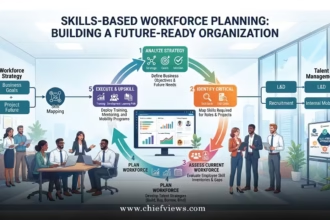
Start with a task-level audit. Don’t guess which roles AI impacts. Map them.
Break every major function into activities. Which ones AI can automate or augment? Which require human edge? Tools like skills inventories and AI impact matrices make this concrete.
In my experience, companies that skip this step waste months on generic training. What I’d do if I were stepping in tomorrow: Form a cross-functional team—HR, IT, business leads—and run a 4-6 week audit. Prioritize high-volume, repetitive tasks first.
Gather data on current skills. Survey AI literacy. Identify champions who already experiment with tools.
Building the Foundation: Skills and Roles
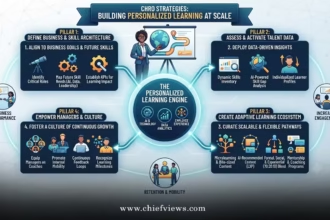
Redesign roles around human-AI collaboration. This isn’t theory. BCG recommends refreshing skills-based workforce plans for each function, assessing AI’s effect on activities and structures.
Focus on foundational skills: prompt engineering, critical evaluation of AI outputs, data literacy. These transfer when tools evolve.
Here’s the thing—tool-specific training fades. Judgment doesn’t.
Launch tiered programs:
- Executives: Strategic implications and governance.
- Managers: Role-specific integration.
- Frontline: Practical application.
Budget 2-4% of payroll initially. Track completion against business outcomes, not just certificates.
How CHRO can build AI ready workforce transformation strategy here means creating visible career paths. Show employees exactly how their role evolves and what new opportunities open.
Step-by-Step Action Plan for Beginners
New to this? Follow this sequence. It delivers quick wins while building toward scale.
- Month 1-2: Secure Leadership Buy-In
Partner with the CEO and CIO. Co-own the narrative. Frame AI as opportunity, not threat. - Month 2-4: Run the Audit and Baseline
Task analysis + skills assessment. Build a workforce data dashboard. - Month 3-6: Pilot and Train
Pick 2-3 high-impact areas. Train champions. Measure productivity lifts. - Month 6-12: Scale and Redesign
Roll out broader programs. Update job descriptions. Establish internal mobility for new roles. - Ongoing: Measure and Iterate
Track adoption, engagement, and business metrics. Adjust quarterly.
This isn’t linear perfection. It’s iterative momentum. Start small, prove value, expand.
| Phase | Key Actions | Timeframe | Expected Outcomes | Metrics to Watch |
|---|---|---|---|---|
| Foundation | Audit tasks, baseline skills, secure C-suite alignment | 0-3 months | Clear gaps identified, initial pilots launched | % roles assessed, AI literacy scores |
| Acceleration | Targeted training, workflow redesign, champion network | 3-9 months | 30-50% adoption in pilot areas | Productivity gains, employee engagement |
| Optimization | Full integration, dynamic skills taxonomy, governance | 9-24 months | Hybrid workforce mature, continuous adaptation | Business KPI impact, retention rates, internal mobility |
| Sustain | Regular refresh, culture embedding | Ongoing | Competitive edge in talent and performance | Annual skills gap closure, innovation output |

Common Mistakes & How to Fix Them
Mistake 1: Focusing only on cost cuts. Employees smell it. Trust evaporates. Fix: Lead with benefits—freeing time for meaningful work. Communicate relentlessly.
Mistake 2: One-size-fits-all training. Bores people. Wastes money. Fix: Role-specific, hands-on learning with real workflows.
Mistake 3: Treating it as an HR-only project. Silos kill progress. Fix: Build tight CHRO-CIO partnerships. Joint ownership drives results.
Mistake 4: Ignoring governance and ethics. Risks compliance headaches and backlash. Fix: Embed responsible AI principles early. Create clear oversight.
Mistake 5: No measurement. Initiatives fizzle. Fix: Tie everything to dashboards showing ROI on skills, productivity, and retention.
What I’d do? Call out resistance early. Address it head-on with transparency.
Culture, Change, and the Human Element
How CHRO can build AI ready workforce transformation strategy succeeds only when culture supports it. Fear is real. Address it by involving employees in redesigning their own roles.
Build AI champions—internal advocates who share wins. Create psychological safety for experimentation. Celebrate learning from failures.
One analogy that sticks: You’re not replacing the orchestra with robots. You’re giving musicians AI instruments that amplify their talent. The music gets better when everyone learns to play the new setup.
Invest in distinctly human capabilities: empathy, complex problem-solving, ethical reasoning. These become your differentiator.
For deeper insights on enterprise-level shifts, see BCG’s work on CHRO reinvention.
World Economic Forum offers solid blueprints on scaling skills and operating models.
And Eightfold’s take on preparing for AI transformation highlights practical HR levers.
Key Takeaways
- Task audits beat role guesses every time—map work granularly before investing.
- Partnerships matter: CHROs who team tightly with CIOs and CEOs move faster.
- Skills are the new currency—build dynamic taxonomies and visible pathways.
- Communication wins trust: Frame change around employee benefits, not headcount reduction.
- Measure relentlessly: Link people metrics to business results.
- Start now, iterate always: Pilots create proof and momentum.
- Human edge remains king: Double down on judgment, creativity, and relationships.
- Governance isn’t optional: Ethics and oversight protect your brand and people.
Ready to Lead?
CHROs who build this AI-ready workforce don’t just survive 2026—they define it. They turn potential disruption into sustained advantage. Talent becomes more engaged. Innovation accelerates. The business wins.
Your next step? Schedule that cross-functional audit kickoff this month. Pick one department. Prove the value. Then scale.
The organizations pulling ahead right now aren’t the ones with the most advanced models. They’re the ones with workforces ready to use them.
FAQs
How long does it take for a CHRO to build an effective AI ready workforce transformation strategy?
Most see meaningful progress in 6-12 months with focused execution. Full maturity takes 18-24 months of iteration. Speed depends on starting audit quality and leadership alignment. Don’t aim for perfect—aim for momentum.
What skills should CHROs prioritize first in an AI ready workforce transformation strategy?
Foundational ones: AI literacy, prompt engineering, critical thinking with outputs, and data basics. Layer role-specific applications next. These transfer across tools and build confidence fast.
How can smaller organizations approach how CHRO can build AI ready workforce transformation strategy without massive budgets?
Start lean. Use free or low-cost pilots in one team. Leverage internal champions heavily. Focus on high-ROI areas like automating admin tasks. Partner with platforms offering scalable training. The principles scale—execution just gets more creative.