





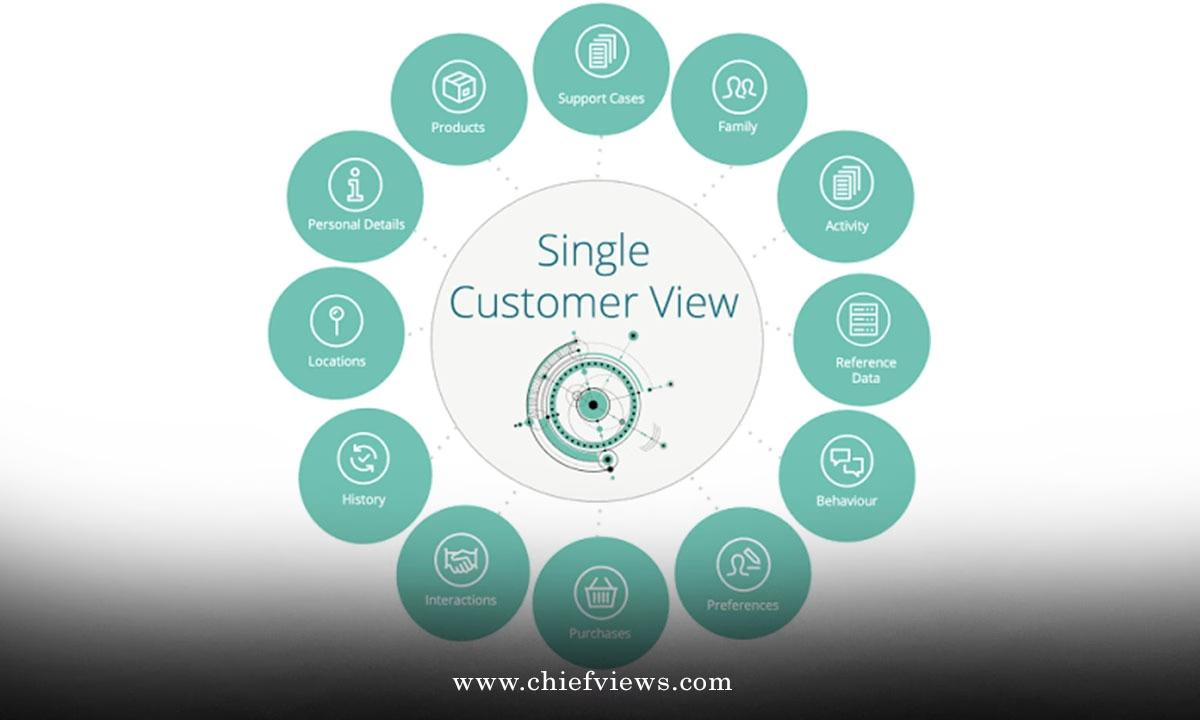
Single Customer View Implementation :
A single customer view (SCV) is the practical backbone that turns scattered data into one usable profile. Without it, every team works from partial information. With it, marketing, service, sales, and product finally see the same customer at the same time.
Here’s the short version:
- An SCV unifies identity, behavior, transactions, and interactions into one record.
- Identity resolution is the hardest and most important technical step.
- Start with a minimum viable profile and one high-value use case, not a multi-year data lake project.
- Governance and clear ownership decide whether the view stays accurate or decays.
- Done well, it directly powers continuity and relevance across the full customer journey.
Most organizations still operate with fragmented customer records. CRM holds one version. Support tickets live elsewhere. Product usage sits in analytics. Billing has its own IDs. The result is familiar: customers repeat themselves, campaigns miss context, and service agents start every conversation from zero.
A properly implemented single customer view fixes that foundation. It is not a dashboard. It is a governed, living record that every system can read from and write to.
This capability sits at the heart of any serious CXO guide to building customer relevance through continuity. Continuity only works when the organization remembers the customer. The SCV is how that memory gets built and maintained.



What a Real Single Customer View Actually Contains
A useful SCV typically includes:
- Persistent unique identifier(s)
- Contact and demographic data
- Transaction and purchase history
- Product usage or engagement signals
- Support and case history
- Marketing consent and preference flags
- Key journey milestones and open issues
The goal is not to collect everything. The goal is to collect the data that changes decisions—what the next offer should be, how a support agent should open the conversation, or when a renewal risk is rising.
Step-by-Step Single Customer View Implementation Plan
1. Inventory every data source
List CRM, marketing automation, support platform, product analytics, billing, loyalty, ecommerce, and any offline sources. Note the primary identifiers each system uses (email, phone, customer ID, device ID, etc.). This map reveals the identity problem before you write a single line of code.
2. Define identity resolution rules in plain language
Decide which identifiers are primary, how conflicts get resolved (most recent wins, source priority, or manual review), and what happens with incomplete matches. Document the rules before any platform configuration. These are business decisions, not purely technical ones.
3. Choose the architecture: CDP, warehouse-first, or hybrid
A Customer Data Platform accelerates ingestion, identity resolution, and activation for most mid-market and enterprise teams. A warehouse-plus-reverse-ETL approach gives more control if you already have strong data engineering. Many organizations now run a hybrid: warehouse as the system of record, CDP for real-time profiles and activation.
4. Build the minimum viable profile first
Select 8–12 fields that matter most for your highest-priority use case (for example, reducing repeat contacts on one journey or improving second-purchase rates). Prove value with clean data on that limited set before expanding the schema.
5. Ingest, cleanse, and resolve identities
Connect sources, apply standardization, run deterministic matching first, then probabilistic where needed. Target an initial match rate above 80–85% on known customers and iterate. Expect to find duplicates and edge cases—budget time for them.
6. Establish ownership and governance
Assign a clear owner for the SCV (often under the CXO, CDO, or a joint marketing-ops/data team). Create a lightweight data dictionary that defines every field, its source of truth, update logic, and consent status. Without this, the view drifts within months.
7. Activate and measure
Push the unified profile into the systems that need it—support console, marketing tools, personalization engines. Track match rate, profile completeness, reduction in duplicate records, and the business metric tied to your first use case.
Comparison of Common Implementation Approaches
| Approach | Time to First Value | Technical Lift | Best Fit | Main Risk |
|---|---|---|---|---|
| Full enterprise CDP | 3–6 months | Medium | Teams needing fast activation | Over-collection of data |
| Warehouse + reverse ETL | 4–9 months | High | Strong data engineering teams | Slower real-time profiles |
| Minimum viable profile on one journey | 30–60 days | Low–Medium | Most organizations starting out | Stalling after the pilot |
| CRM-only expansion | 1–3 months | Low | Simple B2B environments | Still missing behavioral data |
The minimum viable route consistently delivers the best early results. Prove the model on one journey, then expand the data and the use cases.

Common Mistakes That Kill Single Customer View Projects
Treating it as a pure technology buy. Buying a CDP without identity rules and ownership simply creates a more expensive silo. Fix: lock rules and ownership before configuration begins.
Trying to unify everything on day one. Collecting every possible field slows progress and creates quality problems. Fix: start with the fields that change decisions for one priority use case.
Ignoring consent and privacy from the start. Relevance built on shaky consent erodes trust fast. Fix: classify every data element by consent status and build preference management into the profile.
No ongoing data quality process. Profiles decay the moment source systems change or new channels appear. Fix: schedule regular match-rate and completeness reviews; treat data quality as an operating metric.
Leaving activation until the end. A perfect profile that no one uses is worthless. Fix: design the first activation path (support screen or marketing segment) in parallel with the profile build.
How the Single Customer View Powers Continuity and Relevance
Once the SCV exists, continuity becomes operationally possible. An agent sees the open case and the last three interactions. Marketing suppresses a campaign for a customer who just filed a complaint. Product teams spot usage drop-offs that signal churn risk.
That is the practical link to the broader CXO guide to building customer relevance through continuity. The SCV supplies the memory. Continuity is what you do with that memory. Relevance is the customer’s experience of both working together.
In 2026, the organizations pulling ahead are not those with the most data. They are the ones that resolved identity cleanly, governed the profile rigorously, and activated it where decisions actually happen.
Key Takeaways
- A single customer view is a governed, unified record—not just a dashboard or CRM screen.
- Identity resolution rules must be written in business language before any platform work begins.
- Start with a minimum viable profile and one clear use case to prove value quickly.
- Ownership and a living data dictionary prevent the view from decaying.
- Activation into frontline systems is as important as the profile itself.
- Privacy and consent belong in the design from day one.
- The SCV is the technical foundation that makes customer continuity and relevance scalable.
Build the single customer view with discipline and focus. Everything else—personalization, proactive service, journey continuity—gets dramatically easier once the organization finally shares one version of the customer.
FAQs
How long does a typical single customer view implementation take?
A focused minimum viable version on one journey can deliver usable profiles in 30–90 days. Full enterprise coverage usually takes 6–12 months depending on data complexity and existing infrastructure.
Is a CDP required for a single customer view?
No. Many teams achieve a solid SCV with a modern data warehouse and reverse ETL. A CDP simply accelerates identity resolution and real-time activation for most marketing and experience use cases.
What is the biggest barrier to successful single customer view implementation?
Unclear identity rules and lack of ongoing ownership. Technology is rarely the primary failure point—governance and decision rights are.