









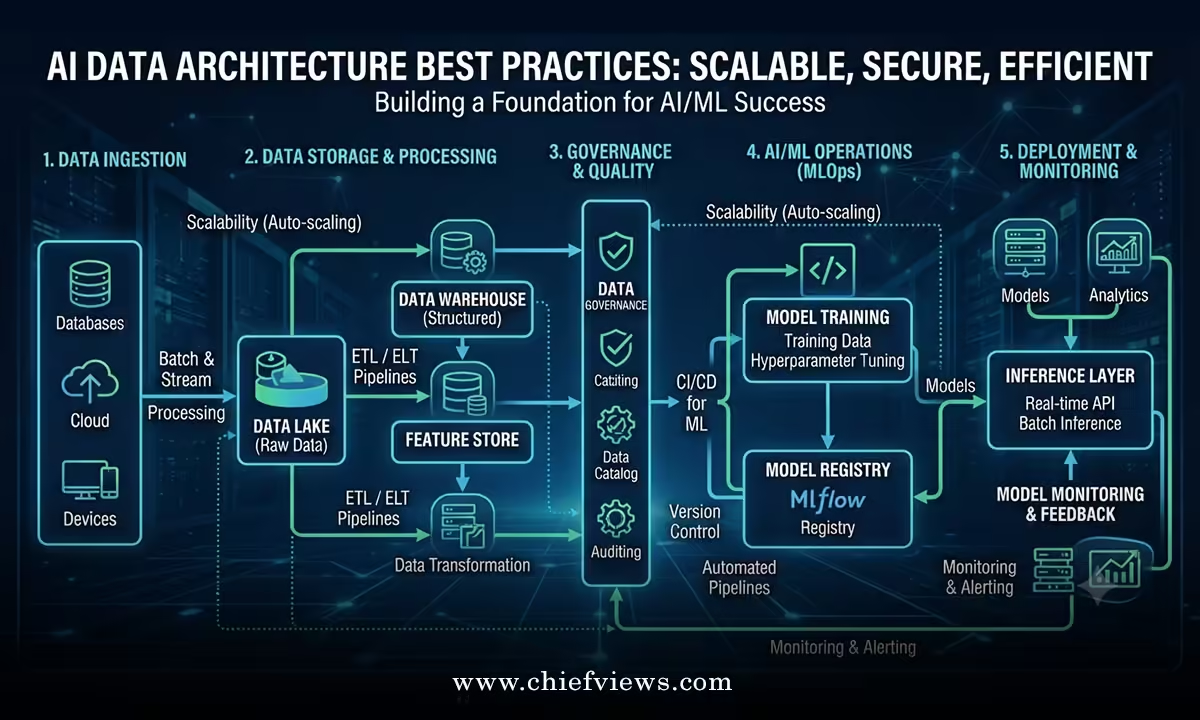
AI data architecture best practices separate the teams that scale agents from the ones stuck in endless pilot mode. In my experience, the single biggest predictor of AI ROI is not the model choice—it’s whether the data layer was designed for retrieval, context, governance, and continuous freshness before the first agent ever went live. Get the architecture right and models become interchangeable. Get it wrong and every new use case reinvents the same brittle pipelines.
Here’s the short version of what actually works in 2026:
- Build one governed foundation that serves analytics, classical ML, and generative/agentic workloads.
- Put a semantic layer and metadata first—models need meaning, not just rows.
- Design for both batch and real-time with open table formats.
- Embed access control, lineage, and cost visibility into the platform itself.
- Treat data products as the unit of delivery, not raw tables.
These practices form the technical backbone of effective CTO strategies for managing AI driven digital transformation. Without them, even the best leadership playbook collapses under data debt.
Why traditional data stacks break under AI load
Most existing warehouses and lakes were built for human analysts running scheduled reports. Agents demand something different. They need complete entity context on demand, low-latency retrieval across structured and unstructured sources, policy enforcement at query time, and the ability to act without creating new copies of data.
Gartner and others have flagged data readiness as a top barrier for years. In practice, what I see is teams creating parallel “AI data” environments that drift from the source of truth within months. Costs climb. Trust evaporates. Agents start hallucinating because the context they receive is incomplete or stale.
The fix is architectural, not incremental tooling.



Core AI data architecture best practices
Start with business outcomes, then design backward. IBM’s modern data architecture principles still hold: clarify the decisions the system must support before engineering pipelines.
Adopt a single foundation. McKinsey’s seven principles for scaling agentic AI emphasize using one data foundation for analytics and AI rather than separate pipelines. Share meaning through common definitions so every model and agent interprets metrics the same way.
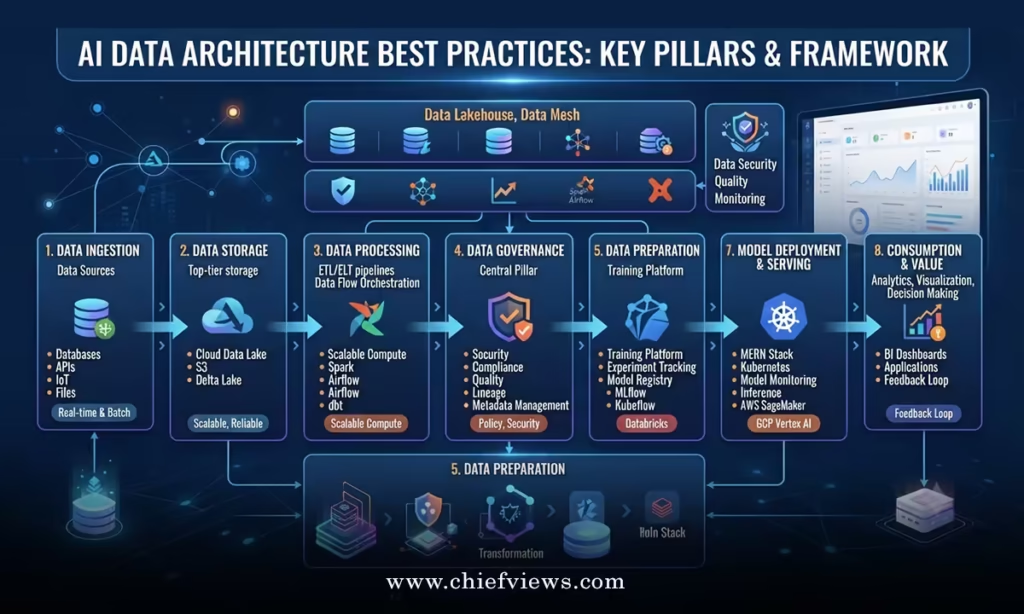
Prefer open table formats—Apache Iceberg, Delta Lake, or equivalent—with time travel. This gives reproducible training sets, auditability, and the ability to roll back bad transformations without rewriting history.
Implement a medallion-style progression (raw → cleaned → curated) but treat the gold layer as versioned data products with explicit owners, SLAs, and freshness contracts. Agents should consume products, not raw tables.
Build the semantic layer early. This is the most commonly skipped and most expensive omission. Business logic scattered across notebooks and dashboards forces every model to invent its own version of truth. A proper semantic layer standardizes definitions once.
Support multimodal ingestion and hybrid retrieval. Structured data, documents, embeddings, and knowledge graphs must live under the same governance umbrella. Vector search alone is rarely enough for reliable agent behavior.
Embed governance and observability by default. Access controls, masking, lineage, quality scores, and cost tracking should travel with the data. Manual reviews after the fact do not scale.
Expose stable interfaces—APIs, tool catalogs, and model endpoints—so product teams can build without re-negotiating security every sprint.
Step-by-step action plan
If I were standing up or modernizing an AI-ready data architecture tomorrow, this is the sequence.
Days 1–14: Inventory and prioritize
Map critical data domains against the highest-value AI use cases. Score each domain on freshness, quality, ownership, and lineage completeness. Identify the three domains that will deliver measurable impact first.
Weeks 3–6: Establish the core platform
Stand up or harden a lakehouse with open table formats. Implement a centralized catalog and basic semantic definitions for the priority domains. Create data product templates that include owner, SLA, quality metrics, and access policy.
Month 2–3: Close the context gap
Add vector and graph capabilities where agents need relationship-aware retrieval. Define retrieval patterns (keyword + semantic + structured) and enforce them through the platform rather than leaving them to individual teams.
Month 4 onward: Operationalize and measure
Instrument pipelines for quality, latency, and cost. Shift from project-based data work to product teams that own domains end-to-end. Review data product health monthly and retire anything that fails its SLA.
This plan keeps intermediate teams from boiling the ocean while giving beginners a clear starting point.
Architecture maturity comparison
| Maturity Level | Storage & Formats | Semantic & Context | Governance | Agent Readiness | Typical Pain Point |
|---|---|---|---|---|---|
| Legacy | Warehouses + files | Scattered definitions | Manual reviews | Low – batch only | Parallel AI copies |
| Modern Lakehouse | Open tables (Iceberg/Delta) | Emerging catalog | Policy as code | Medium – RAG ready | Incomplete entity context |
| AI-Native | Unified multi-modal | Full semantic + graph | Runtime enforcement | High – agent-ready | Cost of continuous freshness |
| Agentic | Entity-centric products | Knowledge + operational state | Continuous audit | Production multi-agent | Coordination across domains |
Most U.S. enterprises sit between Modern Lakehouse and AI-Native. Closing that gap is where the real leverage lives.
Common mistakes and how to fix them
Mistake one: treating AI data as a separate project. Fix it by forcing every new AI initiative to consume existing governed data products or fund the creation of one.
Mistake two: skipping the semantic layer. Fix it by documenting core business definitions before any new model training begins and enforcing them through the platform.
Mistake three: building for batch only. Fix it by adding streaming or change-data-capture for domains that agents will query in near real time.
Mistake four: weak ownership. Fix it by assigning named data product owners with explicit SLAs and making those owners accountable in performance reviews.
Mistake five: discovering cost after the bill arrives. Fix it by instrumenting query and embedding costs at the platform level and setting budgets per data product.
Key Takeaways
- Design the data layer for agents and humans together—one foundation, shared meaning.
- Prioritize semantic consistency and metadata over additional storage volume.
- Use open table formats with time travel for reproducibility and auditability.
- Deliver versioned data products with owners, SLAs, and freshness contracts.
- Embed governance, lineage, and cost controls into the runtime platform.
- Support hybrid retrieval (structured + vector + graph) under unified policy.
- Measure success by agent reliability and business outcome, not pipeline count.
- Treat data architecture as a core prerequisite for any serious AI transformation effort.
Solid AI data architecture best practices turn expensive experiments into repeatable capability. Teams that invest here first move faster, spend less, and sleep better when agents start acting in production.
Audit your highest-value domains this week against freshness, ownership, and semantic coverage. That single exercise usually reveals the highest-ROI next moves.
FAQs
What makes data architecture “AI-ready” in 2026?
It must deliver governed, context-rich, multimodal data products with clear meaning, freshness SLAs, and runtime policy enforcement so both classical models and autonomous agents can operate reliably without creating parallel copies.
How does a strong data architecture support broader CTO strategies for managing AI driven digital transformation?
It removes the primary technical bottleneck that kills scaling efforts, allowing leadership focus to shift from firefighting data quality issues to redesigning workflows and measuring business outcomes.
Should organizations start with a lakehouse or a full data mesh for AI?
Most succeed by beginning with a governed lakehouse core using open formats, then layering domain ownership and data products on top. Pure mesh without strong central standards often increases fragmentation for agent workloads.

