










Data platforms and enterprise IT transformation sit at the center of every serious modernization conversation in 2026. Most organizations still run on a patchwork of on-prem warehouses, brittle ETL jobs, and siloed reporting tools that were never designed for agentic AI, real-time decisions, or multi-cloud reality. The result? Slow insights, ballooning costs, and AI pilots that never leave the lab.
Here’s the quick reality check:
- A modern data platform unifies storage, compute, governance, and AI workloads so the same data serves BI, operational analytics, and machine learning without constant copying.
- Enterprise IT transformation now means treating data as the operating system for the business, not just another infrastructure layer.
- Organizations that get the foundation right move AI from pilot to production far faster and with far less risk.
- Hybrid cloud plus open table formats (Iceberg and friends) have become the default pattern for cost control and flexibility.
- Governance and semantic layers are no longer optional—they’re the difference between trusted agents and expensive hallucinations.
Why data platforms and enterprise IT transformation matter more in 2026
The old model is broken. Nightly batch loads and rigid schemas cannot feed AI agents that need continuous context. Gartner’s 2026 data and analytics trends highlight agentic data streaming and converged platforms as non-negotiable for organizations that want AI to actually execute work rather than just recommend it.
In my experience, the companies that win treat the data platform as the new enterprise nervous system. Everything else—ERP, CRM, custom apps—plugs into it. When that nervous system is fragmented, every AI initiative starts with months of data wrangling. When it’s unified, teams ship value in weeks.
The kicker is cost. Separate systems for analytics, ML feature stores, and vector search create redundant storage and compute bills. A well-designed platform collapses those layers while still letting you scale each workload independently.
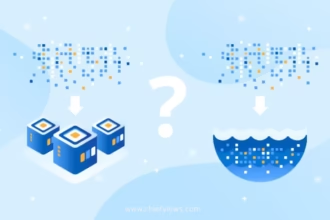


What a modern data platform actually looks like
Data platforms and enterprise IT transformation Think of it like a city’s utility grid. Older setups ran separate pipes for water, electricity, and gas—expensive, hard to maintain, and impossible to expand quickly. Today’s platforms run shared infrastructure with smart metering and on-demand capacity.
Core building blocks in 2026:
- Open table formats (Apache Iceberg leading) so storage stays independent of compute engines.
- Lakehouse architecture that handles structured BI and unstructured AI data on the same foundation.
- Semantic layers and knowledge graphs that give AI agents business meaning instead of raw columns.
- Unified governance covering access, lineage, quality, and cost (FinOps for AI is now table stakes).
- Real-time and batch processing side by side, with streaming becoming essential for agentic use cases.
Major platforms—Snowflake, Databricks, BigQuery, Microsoft Fabric—have all moved toward this converged model. The market consolidated hard in 2025–2026 around fewer vendors built on open standards rather than closed ecosystems.
Step-by-step action plan for getting started
If you’re a beginner or intermediate team staring at a messy estate, do this sequence. Skip steps and you’ll pay later.
- Inventory and score the current state (2–4 weeks)
Map every major data source, pipeline, and consumer. Score each on quality, latency needs, ownership clarity, and AI readiness. What usually happens is teams discover far more shadow IT and undocumented logic than they expected. Capture it now. - Define three business outcomes before touching architecture
Pick concrete targets: cut monthly reporting cycle from 10 days to 2, enable a specific pricing agent, or reduce data-related support tickets by 40 percent. Technology without outcomes becomes a science project. - Choose the target pattern and pilot domain
Most mid-to-large U.S. enterprises land on a lakehouse with selective warehouse strengths. Start with one high-value domain (customer, supply chain, finance) that has clear owners and measurable pain. Run the pilot for 8–12 weeks. - Stand up governance and the semantic layer early
Catalog, lineage, access policies, and metric definitions must exist before the first production load. Retrofitting governance after the fact is painful and expensive. - Migrate in waves and instrument everything
Move domain by domain. Keep parallel runs where risk is high. Track cost per query, data freshness, and time-to-insight from day one. Adjust the platform based on real usage, not the original slide deck. - Operationalize for AI and continuous improvement
Add feature stores, vector capabilities, and agent observability only after the core foundation is stable. Build a lightweight platform team that owns the shared services while domains own their data products.
This sequence keeps risk contained and value visible. I’ve watched teams reverse the order—chasing AI first—and end up with expensive pilots sitting on rotten data.
Comparison of common architecture approaches
| Approach | Best Fit | Typical Timeline | Strengths | Trade-offs |
|---|---|---|---|---|
| Pure Cloud Warehouse | Stable BI & reporting needs | 3–6 months | Fast SQL performance, mature governance | Limited flexibility for ML/AI workloads |
| Lakehouse (Iceberg/Delta) | Mixed BI + AI + streaming | 6–12 months | Unified storage/compute, open formats | Requires stronger platform engineering skills |
| Data Fabric | Complex hybrid/multi-cloud | 9–18 months | Virtual access across sources, strong metadata | Higher initial complexity |
| Data Mesh | Large org with strong domain teams | 12–24 months | Domain ownership, scalable products | Needs mature culture and federated governance |
Data platforms and enterprise IT transformation Most organizations in the USA start with a lakehouse core and layer fabric-style virtualization where needed. Pure mesh remains rarer outside the largest enterprises with dedicated data product teams.
Common mistakes and how to fix them
Mistake 1: Treating modernization as a lift-and-shift.
Moving the same brittle ETL jobs to the cloud just relocates the problem. Fix: redesign for ELT, open formats, and domain ownership during the migration.
Mistake 2: Buying the platform before defining outcomes.
Vendor demos look great until the first production load. Fix: write the success metrics first, then evaluate platforms against those metrics.
Mistake 3: Governance as a Phase 3 activity.
By then the data is already inconsistent and no one trusts the numbers. Fix: stand up the catalog, quality rules, and access model in the pilot itself.
Mistake 4: Ignoring cost visibility.
AI workloads can surprise finance teams. Fix: implement FinOps practices and showback from the first production workload.
Mistake 5: Big-bang cutover.
One weekend switch for the entire estate almost always creates outages and political fallout. Fix: domain-by-domain waves with clear rollback points.
Key Takeaways
- Data platforms and enterprise IT transformation succeed when the foundation supports BI, operational analytics, and AI on the same governed data.
- Open table formats and lakehouse patterns have become the practical default for most U.S. enterprises in 2026.
- Semantic layers and real-time streaming are now required for trustworthy agentic AI.
- Sequence matters: inventory → outcomes → pilot → governance → waves → AI scale.
- Cost control and hybrid flexibility beat pure cloud-first ideology for most organizations.
- Governance early prevents the most expensive failures later.
- Start small, measure hard, expand only what works.
Data platforms and enterprise IT transformation The organizations pulling ahead treat their data platform as strategic infrastructure, not a cost center. They move faster because the data is already trustworthy and accessible. Everyone else keeps restarting AI projects every six months.
Your next step is simple. Pick one painful domain, run the inventory, and define two measurable outcomes this quarter. That single move turns abstract strategy into concrete progress.
FAQs
How does data platforms and enterprise IT transformation differ from traditional data warehouse projects?
Traditional warehouse work focused on structured reporting with fixed schemas. Modern platforms must also support unstructured data, real-time streaming, feature engineering, and agentic workloads on a single foundation with automated governance.
What is the typical investment range for data platforms and enterprise IT transformation in mid-size U.S. companies?
Mid-market efforts (500–2,000 employees) often land between $500K and $1.5M for a focused lakehouse implementation over 6–12 months. Larger or more complex estates scale higher. The real variable is scope discipline—domain-by-domain keeps costs predictable.
Can smaller IT teams successfully execute data platforms and enterprise IT transformation without a large platform engineering group?
Yes, if they choose managed services and start with a single domain. Many teams succeed with 4–8 skilled people plus strong vendor support and clear domain ownership. The key is resisting the urge to build everything custom on day one.

