









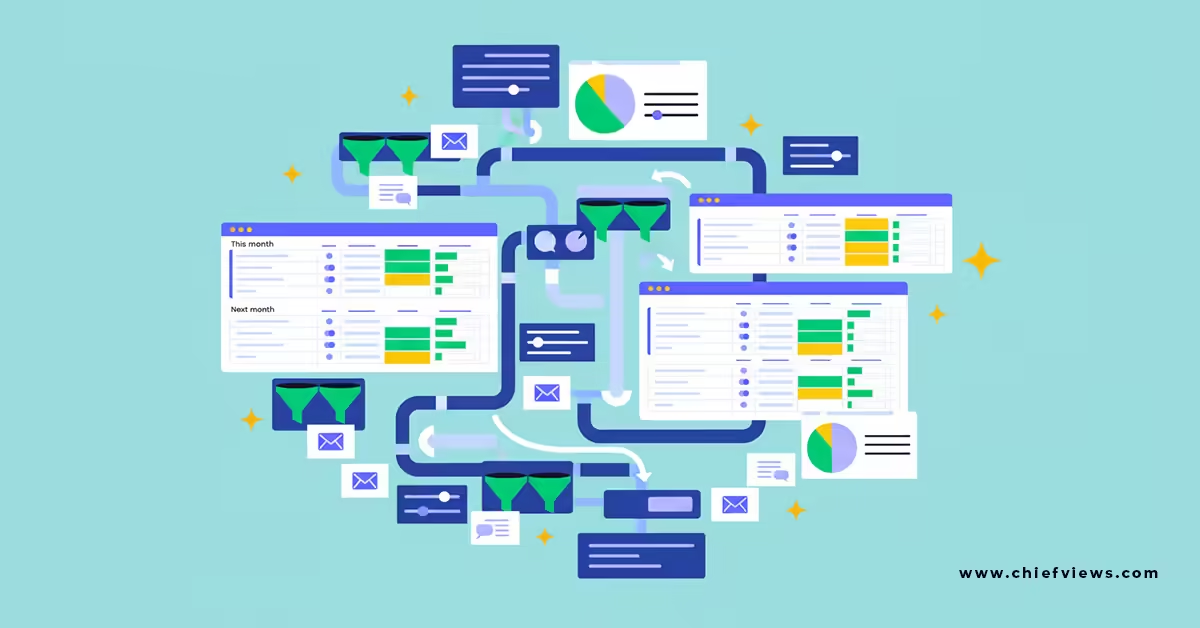
AI customer journey mapping is no longer a nice-to-have visualization exercise. It is the operating system that lets organizations see friction in real time, predict the next move, and decide exactly where automation belongs and where a human still needs to step in.
Done well, it turns static journey maps into living decision engines. Done poorly, it becomes another set of colorful slides that collect dust while customers keep repeating themselves across channels.
Why Traditional Journey Mapping Falls Short
Most teams still build journey maps the old way: workshops, sticky notes, personas based on last year’s survey data, and a few happy-path flows. Those maps go stale the moment a new channel launches or customer behavior shifts.
AI changes the game by continuously ingesting behavioral signals, support transcripts, product usage, and sentiment data. The map updates itself. Gaps appear as numbers instead of opinions. You stop guessing which moments matter most and start measuring them.
Core Components of Effective AI Customer Journey Mapping
Start with these building blocks:


- Real-time data spine — A unified customer profile that pulls identity, interaction history, intent signals, and outcomes into one view. Without this, AI is just guessing.
- Journey stages with decision points — Move beyond “awareness → consideration → purchase.” Identify the actual decisions the customer (and your systems) make at each step.
- Friction scoring — AI scores every stage for effort, drop-off risk, and emotional intensity. High scores become priority redesign targets.
- Agentic handoff rules — Explicit logic that tells the system when it can resolve something autonomously and when it must package full context for a human.
- Feedback loops — Closed systems that learn from every resolved interaction and update the map automatically.
Step-by-Step Process to Build an AI-Powered Journey Map
- Select one high-volume, high-friction journey
Refunds, billing inquiries, or onboarding usually deliver the fastest insight. Resist the urge to map everything at once. - Assemble the data sources that actually matter
CRM, support tickets, product analytics, chat transcripts, and survey comments. Clean the identity fields first. Garbage in still produces garbage out. - Let AI surface the real stages and pain points
Use clustering and sequence analysis to discover the paths customers actually take, not the ones you designed. Highlight moments where customers abandon, repeat information, or escalate. - Score every stage for effort and business impact
Combine customer effort metrics with revenue or retention impact. This prevents teams from optimizing low-value interactions simply because they are easy to automate. - Design decision rights and escalation logic
Write clear rules: “AI can approve refunds under $X with no previous complaints. Anything above that, or any emotional language detected, routes to a human with full context attached.” - Instrument the map and run a controlled pilot
Deploy the new flow on a limited segment. Track resolution rate, recontact rate, customer effort, and agent override frequency. Review failures weekly. - Expand and govern
Once the pilot shows measurable improvement, roll the same method to the next journey. Keep a lightweight cross-functional review so data quality and decision rights stay current.
How This Connects to Broader Leadership Strategy
AI customer journey mapping only creates lasting value when it feeds directly into executive decision-making. That is exactly where the work of how CXO can align customer experience with AI strategies becomes essential. Mapping reveals the friction. Leadership alignment turns those insights into funded priorities, clear ownership, and consistent metrics across the organization.
Without that alignment, even the best map stays trapped inside a single team. With it, the map becomes the shared language that marketing, service, product, and technology use to decide where AI belongs and where humans still create the highest value.
Common Pitfalls and How to Avoid Them
- Mapping every journey at once → Start with one or two high-impact flows and prove the method.
- Treating the map as a one-time project → Build continuous data feeds and monthly review cadences.
- Ignoring the human handoff → Design context packaging so agents never make customers repeat themselves.
- Optimizing only for cost → Balance effort reduction with loyalty and resolution quality metrics.
- Letting IT own the data model alone → CX leaders must stay in the room when identity resolution and decision rules are set.
Measuring Success
Track a short set of leading and lagging indicators:
- Drop in customer effort score on the mapped journey
- Rise in first-contact resolution
- Reduction in recontact rate within 7 days
- Agent override frequency (too high means the rules need work; too low may mean over-automation)
- Incremental impact on retention or average order value linked to the improved journey
Review these numbers in the same forum where broader AI and CX priorities are discussed. That keeps the mapping work connected to business outcomes instead of becoming a side project.
Getting Started This Quarter
Pick the journey that generates the most volume and the most complaints. Pull the last 90 days of interaction data. Ask AI to surface the actual paths and friction scores. Sit with the frontline team for two hours and write the first set of decision rules together. Run a small pilot. Measure. Iterate.
That sequence turns AI customer journey mapping from a theoretical exercise into a practical operating advantage. The organizations that treat the map as a living decision system, rather than a static diagram, will keep finding and removing friction long after the next technology wave arrives.
Key Takeaways
- AI customer journey mapping turns static diagrams into living systems that continuously surface real friction and decision points.
- Start with one high-volume, high-friction journey and a clean data foundation—never try to map everything at once.
- Explicit decision rights and escalation rules are what separate helpful automation from customer frustration.
- Measure customer effort, first-contact resolution, and recontact rate rather than activity metrics alone.
- The map only delivers lasting value when it feeds directly into how CXOs align customer experience with AI strategies across the organization.
- Treat the map as an operating system, not a one-time project: instrument it, review failures weekly, and expand only after results are proven.
Final Thoughts
AI customer journey mapping works when it stays practical and tightly connected to business outcomes. Map the journeys that actually hurt customers, give the system clear rules for what it can resolve, and keep humans in the loop for judgment and empathy. Do that consistently and the map becomes one of the highest-leverage tools a CX leader can use in 2026.
FAQs
What is the first step in AI customer journey mapping?
Select one high-volume, high-friction journey (refunds, billing, or onboarding usually work best), pull the last 90 days of interaction data, and let AI surface the actual paths customers take instead of relying on internal assumptions.
How does AI customer journey mapping support how CXO can align customer experience with AI strategies?
It provides the shared, evidence-based view of friction and decision points that executives need to set clear priorities, assign ownership, and measure outcomes across marketing, service, product, and technology teams.
How often should an AI-powered customer journey map be updated?
The strongest systems update continuously through live data feeds. At minimum, run a formal review every 30 days to adjust decision rules, clean new data gaps, and expand successful patterns to the next journey.

