









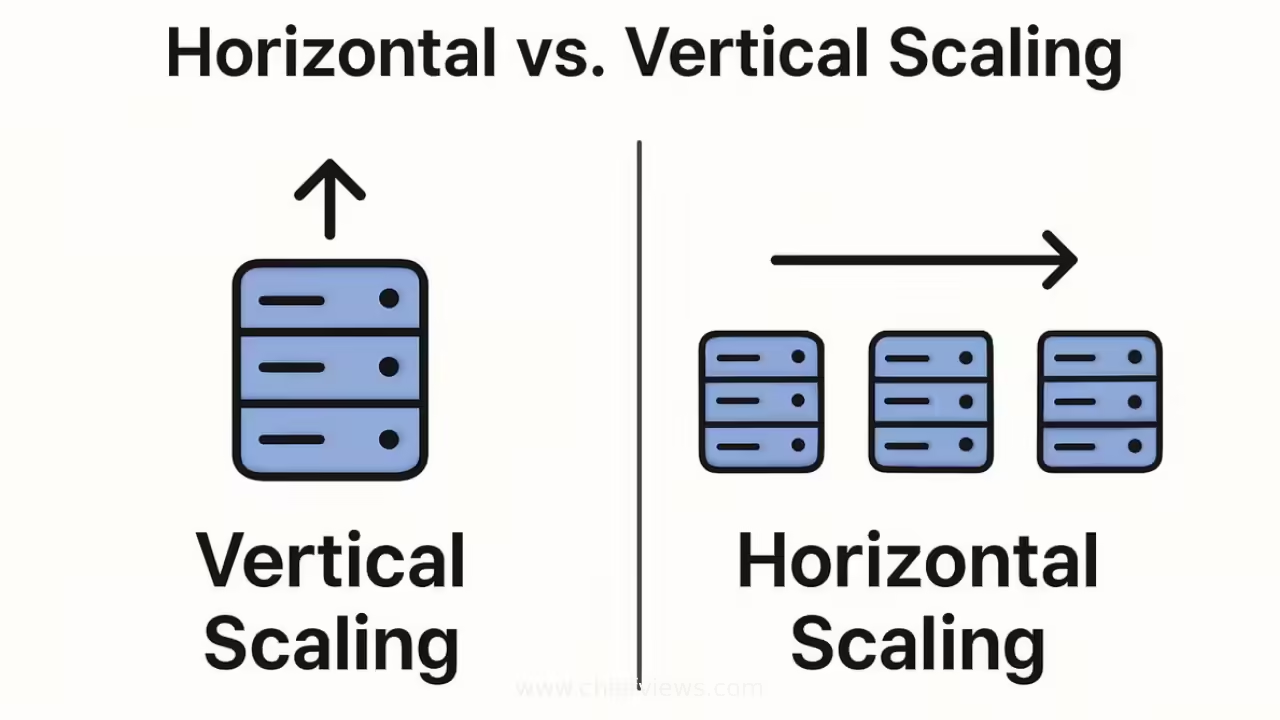
Horizontal vs vertical scaling is the first real fork in the road for any system that needs to grow. One path makes a single machine stronger. The other adds more machines and spreads the work. Get the choice wrong and you either hit a hard ceiling or drown in complexity. Get it right and you build the foundation for real systems scale and performance acceleration.
Here’s the short version:
- Vertical scaling upgrades one server with more CPU, RAM, or storage.
- Horizontal scaling adds more servers behind a load balancer.
- Vertical wins on simplicity and speed early. Horizontal wins on redundancy and long-term headroom.
- Most production systems use both in sequence or combination.
- The decision shapes cost, failure modes, and how hard future performance work becomes.
In my experience the teams that struggle the most treat this as a pure infrastructure question. It’s not. It’s an architecture and workload question first. A stateful database behaves differently from a stateless API layer. Black Friday traffic looks nothing like steady internal tooling load. The wrong move at this stage forces expensive rework later.
What Vertical Scaling Actually Means
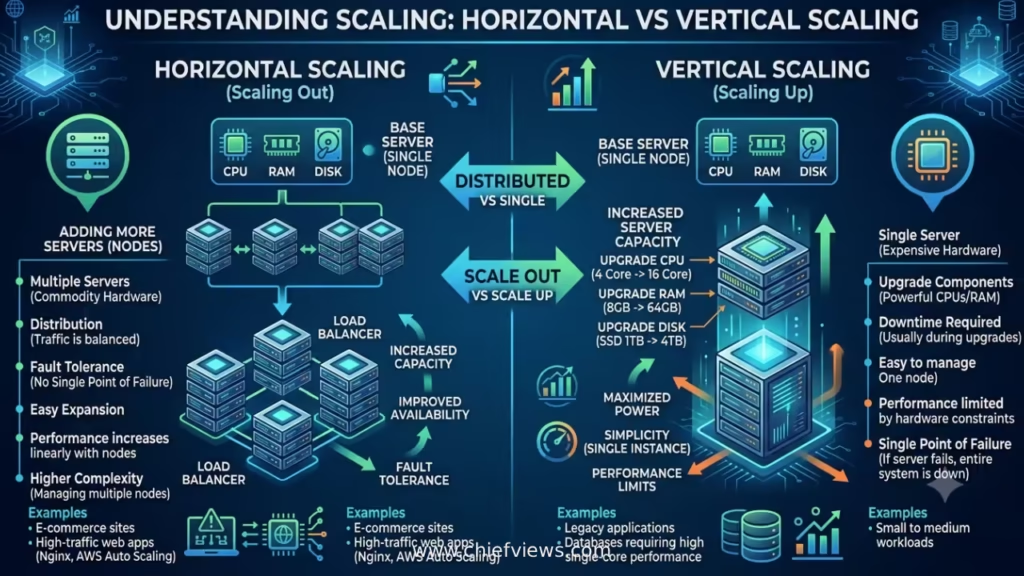
Horizontal vs Vertical Scaling Vertical scaling (scale-up) means you take the existing box and make it bigger. More cores. More memory. Faster disks. In the cloud that usually means changing the instance type—t3.medium to t3.xlarge, or bumping an RDS class.
No code changes required. The application keeps running the same way. Consistency stays strong because everything still lives on one machine. Implementation is fast—minutes to hours in most cloud consoles.
The limits show up quickly. Every provider has a maximum instance size. Costs climb non-linearly near the top end. That single machine remains a single point of failure. Resizing often needs a restart, so you accept some downtime. Once you hit the biggest available box, growth stops.



Vertical scaling shines for early-stage products, legacy monoliths that store session data in memory, and databases that resist easy partitioning. It buys time while you learn the real bottlenecks.
What Horizontal Scaling Actually Means
Horizontal scaling (scale-out) means you add more machines and put a load balancer in front. Traffic spreads across the fleet. One node dies and the others keep serving. You can add capacity in seconds with auto-scaling groups and remove it when demand drops.
The upside is clear: near-unlimited ceiling, built-in redundancy, and the ability to match capacity to real traffic curves. Stateless services love this model. Modern web tiers, container workloads, and message queues scale this way cleanly.
Horizontal vs Vertical Scaling The cost is complexity. You need load balancing, health checks, service discovery, and a plan for shared state. Sessions cannot live in local memory. Databases often need replication or sharding. Network hops appear. Distributed consistency becomes a real concern. Code and operations both get heavier.
Horizontal scaling is the default for customer-facing, bursty workloads once the architecture supports it.
Side-by-Side Comparison
| Dimension | Vertical Scaling | Horizontal Scaling |
|---|---|---|
| What you add | CPU, RAM, storage to one machine | More machines |
| Growth ceiling | Hardware maximum | Practically none |
| Failure impact | Entire system down | Capacity degrades, system stays up |
| Complexity | Low | Higher (load balancing, state, coordination) |
| Downtime to scale | Often required | Usually zero |
| Cost curve | Jumps at each tier, steep near the top | Closer to linear with traffic |
| Code changes needed | Rarely | Often (stateless design) |
| Best starting point for | Stateful services, early stage, quick wins | Stateless tiers, unpredictable traffic |
| Typical first move | Resize instance or database class | Auto Scaling Group + load balancer |
This table reflects patterns that hold across AWS, Azure, and Google Cloud environments in 2026. No approach wins every column.
When Vertical Scaling Makes Sense
Choose vertical when:
- The application is still monolithic or stores critical state locally.
- You need a fast fix and lack time for architectural changes.
- The workload is modest and predictable.
- Strong consistency on a single node matters more than redundancy right now.
A classic case: a relational database primary. Vertical upgrades remain the practical first step for most teams because sharding relational data is genuinely hard. Many successful systems scale the database vertically for years before introducing read replicas or partitioning.
When Horizontal Scaling Makes Sense
Horizontal vs Vertical Scaling Choose horizontal when:
- Services are already stateless or can become so with shared session stores.
- Traffic is spiky or hard to forecast.
- High availability is non-negotiable.
- You want to scale capacity up and down automatically with demand.
Horizontal vs Vertical Scaling Stateless API layers, worker fleets, and content delivery edges almost always go horizontal early. The extra operational surface pays for itself the first time a single node fails during peak traffic.
A Practical Decision Sequence
If I walked into a team facing growth pressure tomorrow, I would run this sequence:
- Map the dominant load shape. Read-heavy? Write-heavy? Bursty or steady? Measure actual request patterns, not assumptions.
- Separate stateful from stateless components. Stateless tiers can go horizontal with low risk. Stateful components usually start vertical.
- Apply the simplest capacity increase that buys measurable headroom. Vertical resize is often that first step.
- Instrument the result. Did latency improve? Did error rates drop? Did cost per request change?
- Plan the next move only after data arrives. Once vertical limits approach, introduce horizontal patterns for the ready components.
- Keep the hybrid path open. Most mature systems run vertical databases behind horizontal application tiers.
This order prevents premature complexity and still leaves room for real systems scale and performance acceleration later.
Common Mistakes and How to Fix Them
Mistake one: going horizontal too early on a stateful monolith. Sessions break, data consistency suffers, and the team spends weeks debugging distributed problems that a simple vertical upgrade would have avoided. Fix: make the application stateless first, or keep vertical until the architecture supports distribution.
Mistake two: staying vertical past the point of diminishing returns. Costs explode and a single failure takes everything down. Fix: set clear thresholds—when instance size hits the upper third of available options or when a single node failure becomes unacceptable, start the horizontal work.
Mistake three: treating load balancing as magic. Round-robin without health checks or connection draining creates cascading failures. Fix: use least-connections or weighted algorithms and require proper health checks from day one.
Mistake four: ignoring the cost of coordination. Horizontal systems pay in network latency and consistency complexity. Fix: design coarser APIs and push state to managed services where possible.
Mistake five: never revisiting the decision. Workloads change. A system that correctly started vertical can need horizontal layers two years later. Fix: revisit scaling strategy as part of regular architecture reviews.
How This Choice Feeds Systems Scale and Performance Acceleration
Horizontal vs vertical scaling is not an isolated infrastructure decision. It determines how easily you can apply the rest of the performance toolkit—caching layers, query optimization, asynchronous processing, and targeted acceleration techniques. A system stuck on an oversized single machine has fewer levers. A well-partitioned horizontal fleet opens more options for efficiency gains.
The teams that treat scaling as pure capacity addition miss the larger opportunity. The ones that pair capacity decisions with continuous efficiency work are the ones that keep latency stable while costs stay reasonable.
Key Takeaways
- Vertical scaling upgrades one machine. Horizontal scaling adds more machines.
- Vertical is simpler and faster early. Horizontal delivers redundancy and unlimited headroom.
- Most real systems use both: vertical for stateful cores, horizontal for stateless tiers.
- Decide based on workload shape, statefulness, and failure tolerance—not fashion.
- Measure before and after every change.
- Avoid premature horizontal complexity and late vertical ceilings.
- This decision directly enables or blocks broader systems scale and performance acceleration.
Horizontal vs Vertical Scaling Pick the path that matches your current architecture and traffic reality. Start with the lowest-complexity move that delivers headroom, measure the outcome, then plan the next layer. That sequence compounds better than any pure theory.
FAQs
Is horizontal scaling always better than vertical scaling for long-term growth?
No. Horizontal scaling offers better long-term headroom and fault tolerance, but only after the application is ready for distribution. Many systems correctly stay vertical for years on the database tier while the application layer goes horizontal.
How does the choice between horizontal vs vertical scaling affect overall systems scale and performance acceleration?
It sets the foundation. Vertical keeps things simple so you can focus on efficiency first. Horizontal opens parallel capacity but requires extra work on consistency and latency. The right sequence lets both capacity and performance techniques compound.
When should a team move from vertical to horizontal scaling?
When instance sizes approach provider limits, when single-node failure risk becomes unacceptable, or when traffic patterns demand elastic capacity that vertical cannot provide. Measure first, then migrate the ready components.

