







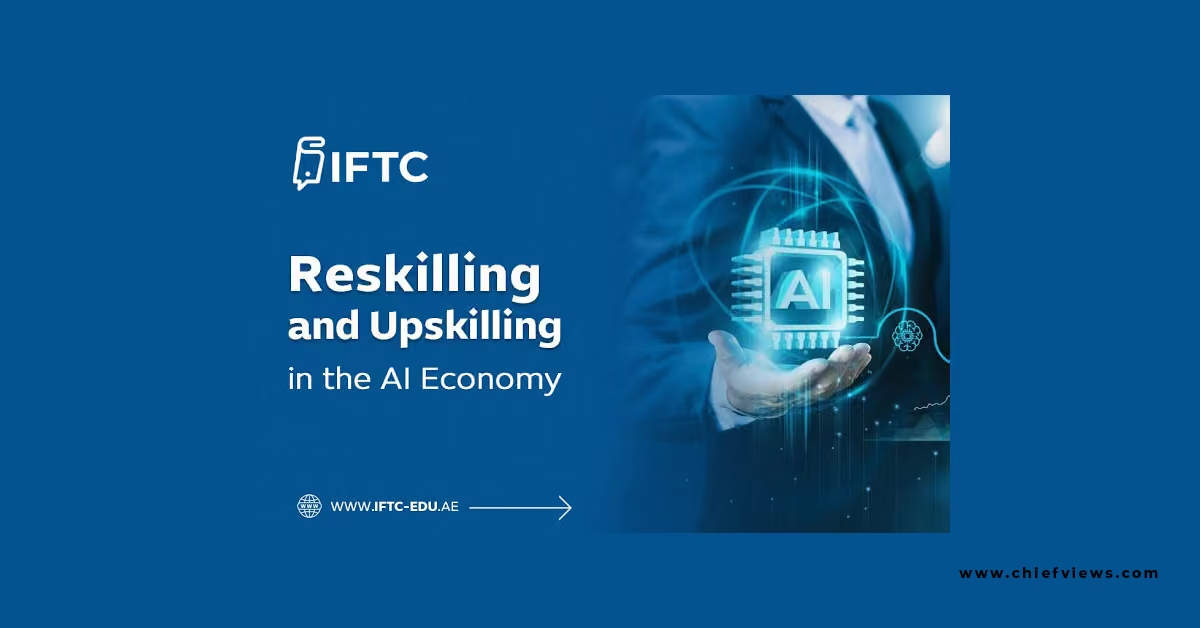
An AI workforce reskilling strategy is no longer a “nice-to-have” training initiative buried in L&D’s annual plan. It’s survival math. The World Economic Forum’s Future of Jobs Report 2025 puts it bluntly: if the global workforce were 100 people, 59 of them would need reskilling before 2030, and 22% of today’s jobs face disruption from automation and AI in that same window.
Quick answer — what an AI workforce reskilling strategy actually covers:
- A structured plan to close the gap between the skills employees have and the skills AI-augmented roles now require.
- Prioritizes high-exposure roles first — not a blanket “everyone takes an AI course” approach.
- Built around measurable skill outcomes, not just training hours logged.
- Directly tied to broader workforce planning — including the CHRO priorities for 41.7% productivity gains through AI, since reskilling is the lever that determines how much of that productivity number an organization actually captures.
- Requires manager involvement, not just HR-led rollout.
Here’s the uncomfortable part. Gartner-backed research shows 92% of HR leaders have already taken concrete steps to implement AI in just the past six months. Reskilling can’t be the thing you’ll “get to eventually.” Eventually already happened.
Why Reskilling Is the Make-or-Break Variable, Not a Side Initiative
Let’s be straight about something most vendors won’t tell you: buying AI tools is the easy part. Getting a workforce that actually knows how to use them well is the hard part.
Workday’s own research found that 40% of the time organizations expect to save through AI gets eaten right back up by human rework and quality verification. Read that twice. Nearly half the productivity gain, gone — not because the AI failed, but because people weren’t trained to use its output correctly.
That’s the direct line between reskilling and the broader CHRO priorities for 41.7% productivity gains through AI. You don’t get anywhere near that ceiling with undertrained employees double-checking everything the AI produces. Reskilling isn’t a support function here — it’s the engine.

The Core Pillars of an AI Workforce Reskilling Strategy
Pillar 1: Map Exposure Before You Map Training
Not every role faces equal disruption. Gartner-cited projections suggest generative AI will materially impact around 37% of the workforce within two to five years. That’s significant — but it’s not everyone, and treating it like it is wastes budget fast.
Start with a role-by-role exposure audit. Which jobs have tasks AI can already do competently? Which ones need a human judgment layer AI can’t replicate yet? Rank, don’t guess.
Pillar 2: Train for Judgment, Not Just Tool Buttons
SHRM’s 2026 workplace research found that 77% of workers already using AI say it helps them accomplish more in less time. Good news. But the same research flags a widening skills gap — people can click the buttons; far fewer can evaluate, correct, or push back on what the AI gives them.
An effective AI workforce reskilling strategy trains critical evaluation skills first. Prompt literacy is step one, not the whole course. Teaching people to spot a confidently wrong AI answer is where the real value sits.
Pillar 3: Make Managers the Delivery Mechanism
Here’s something I’ve seen fail over and over: HR builds a beautiful training module, nobody’s manager ever mentions it, and completion rates crater. Reskilling sticks when a direct manager connects it to real weekly work — not when it lives in an isolated LMS module nobody opens twice.
Pillar 4: Tie Reskilling Directly to Workforce Planning
The WEF research shows 96% of employers globally now plan to upskill and reskill their workforce as part of broader industry transformation efforts. That number only means something if reskilling plans are built alongside — not after — AI adoption roadmaps and the same CHRO priorities for 41.7% productivity gains through AI that leadership is already being measured against.
Reskilling Approaches Compared
| Approach | Best For | Typical Time to Impact | Key Risk |
|---|---|---|---|
| Company-wide generic AI training | Baseline literacy, policy awareness | 4–8 weeks | Low retention, little job-specific value |
| Role-based skill pathways | High-exposure roles identified via audit | 3–6 months | Requires upfront mapping effort |
| Manager-led, on-the-job coaching | Embedding skills into daily workflow | Ongoing, visible within 60–90 days | Inconsistent without manager training |
| Internal mobility / redeployment programs | Employees in heavily automated roles | 6–12 months | Needs strong internal talent marketplace |
Notice the pattern: the fastest wins come from role-specific and manager-led approaches, not sweeping, one-size-fits-all mandates.

Step-by-Step: Building Your AI Workforce Reskilling Strategy
- Run the exposure audit first. Rank roles by how much AI already touches their core tasks.
- Set skill targets, not course quotas. Define what “AI-competent” actually looks like for each role tier.
- Pilot with your highest-exposure team. Small group, fast feedback loop, real work tasks — not hypothetical case studies.
- Train managers before employees. They need to model and reinforce the behavior, not just approve the training budget.
- Measure skill application, not attendance. Track output quality and error-correction rates 60 and 90 days post-training.
- Build an internal mobility path. For roles facing heavier automation, reskilling should open a door to a new role — not just a new skill on paper.
- Report results back to the C-suite in productivity terms. Connect reskilling outcomes directly to the organization’s wider AI productivity goals.
Common Mistakes & How to Fix Them
Mistake 1: Reskilling everyone the same way. Fix: Segment by exposure level. A finance analyst and a customer support rep need completely different AI skill paths.
Mistake 2: Measuring training completion instead of competence. Fix: Test actual task performance before and after — not whether someone clicked through a module.
Mistake 3: Leaving managers out of the loop. Fix: Train the manager layer first, and give them simple scripts for reinforcing skills in weekly check-ins.
Mistake 4: Treating reskilling as a one-time event. Fix: Build a recurring cadence — quarterly skill refreshers beat a single annual “AI bootcamp” every time.
Mistake 5: Ignoring the emotional side of disruption. Fix: Acknowledge job anxiety directly. People reskill faster when leadership is honest about what’s changing and why, instead of pretending nothing’s shifting.
Key Takeaways
- An AI workforce reskilling strategy is the mechanism that determines how much real productivity gain an organization captures from its AI investment.
- WEF data shows 59% of the global workforce will need reskilling before 2030 — this isn’t a niche concern anymore.
- Role-based, manager-led training consistently outperforms company-wide generic AI courses.
- Up to 40% of expected AI time savings can be lost to rework when employees aren’t properly trained.
- Reskilling plans should map directly to the same CHRO priorities for 41.7% productivity gains through AI that leadership is tracking at the board level.
- Measure skill application and output quality — not attendance or completion rates.
- Treat reskilling as continuous, not a one-off event tied to a single tool launch.
Reskilling isn’t the soft, feel-good part of AI adoption — it’s the load-bearing wall. Skip it, and even the best AI tools end up producing more rework than results. Build the exposure map, train managers first, measure what people can actually do differently, and tie the whole program back to the productivity number leadership already cares about. Start with one high-exposure team this quarter and prove the model before scaling it.
FAQs
How is an AI workforce reskilling strategy different from regular employee training?
Regular training builds general skills; an AI workforce reskilling strategy specifically targets the gap between current employee capabilities and what AI-augmented roles now demand, prioritized by how exposed each role is to automation.
Who should own the AI workforce reskilling strategy — HR or department leaders?
HR should design and measure the framework, but department managers must deliver and reinforce it daily — programs run solely by HR without manager buy-in consistently show lower skill retention.
Does an AI workforce reskilling strategy actually affect productivity numbers like the 41.7% gain CHROs are tracking?
Yes — reskilling directly determines how much of that projected productivity gain gets realized, since undertrained employees generate more AI output errors and rework, which erodes the time savings AI is supposed to deliver.

