






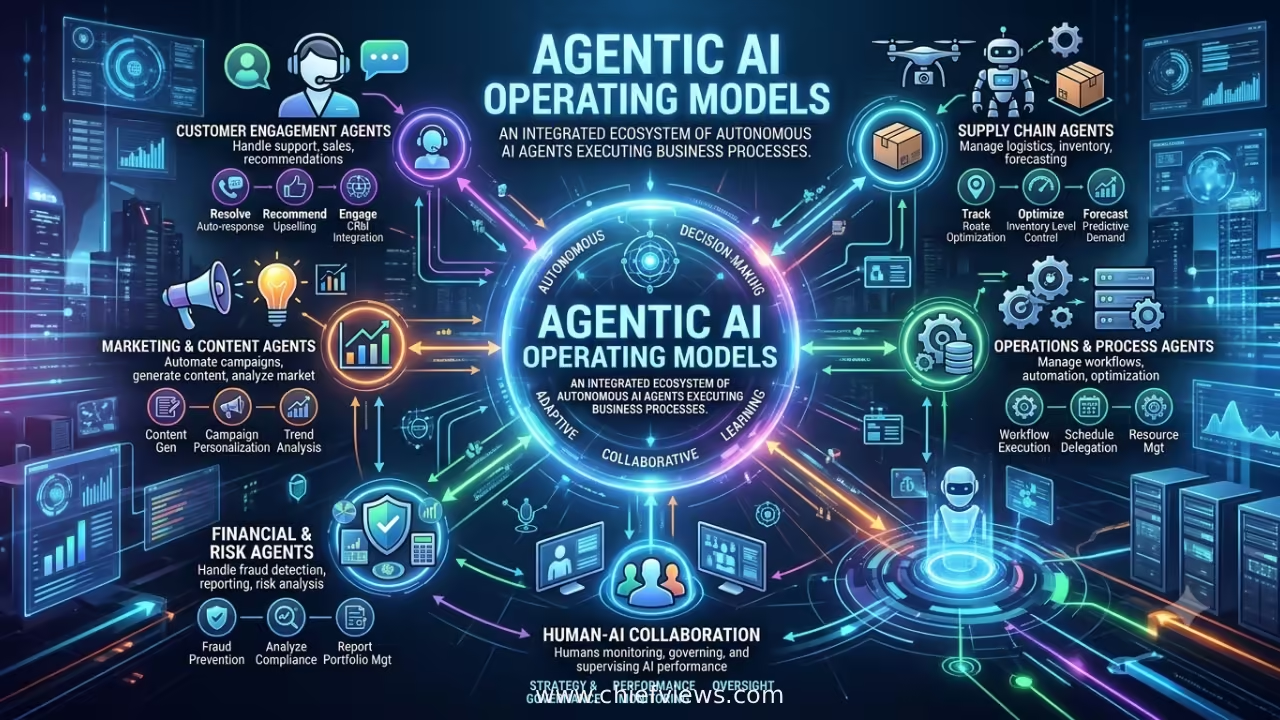
Agentic AI operating models are the real differentiator in 2026. Most companies still treat AI agents like smarter tools. The ones pulling ahead treat them as digital coworkers inside a redesigned operating model.
Here’s the quick picture:
- Agentic AI operating models organize work around outcomes instead of functions or job titles.
- Humans and agents share ownership of end-to-end processes with clear decision rights and handoffs.
- Success depends less on the model and more on governance, accountability, and continuous redesign.
- High performers use these models to capture enterprise value that pure tool adoption misses.
- The foundation is still process optimisation and workforce redesign under AI—without that work, agents simply accelerate broken processes.
In my experience, the gap between companies reporting individual productivity gains and those seeing real P&L impact almost always traces back to the operating model. Agents can plan, act, and collaborate. But if the organization still runs on sequential handoffs, siloed decision rights, and static role descriptions, the agents hit a wall.
From Org Chart to Orchestration Chart
Traditional operating models move work through functions. Marketing hands to sales, sales to operations, operations to finance. Each handoff adds delay, information loss, and accountability gaps.
Agentic AI operating models flip the logic. Start with the outcome—close the deal, resolve the claim, ship the order—then assemble the right mix of humans and agents to deliver it. Agents handle execution and coordination. Humans own judgment, exceptions, relationships, and system design.
McKinsey’s 2026 research shows the pattern clearly. High performers are far more likely to organize cross-functional teams around end-to-end products, customer journeys, and business processes. They put decisions closer to the work. Agents take on more of the coordination that used to require multiple meetings and status updates.


This is not a minor tweak. It is a shift from managing people to orchestrating hybrid systems.
What Makes an Agentic Operating Model Different
Several elements separate real agentic models from bolted-on automation:
Outcome ownership over functional ownership. One team (human + agents) owns the full result. Fewer handoffs. Clearer accountability.
Explicit decision rights. Leaders define what agents can decide, what requires human review, and what must escalate. Ambiguity here creates risk and slows everything down.
Dynamic resource allocation. Capacity flexes between human and agent work as demand shifts. Static headcount planning becomes less relevant.
Continuous feedback loops. Agents surface patterns and anomalies. Humans encode judgment back into the system. The model improves itself.
Governance built for digital labor. Agents need identity, permissions, performance standards, and offboarding paths the same way contractors do.
Deloitte’s 2026 findings reinforce this. Nearly three-quarters of leaders expect significant process redesign around AI agents, yet only about one in five say their organization is prepared. The biggest blockers remain poorly documented processes, fragmented data, and entrenched ways of working.
How Agentic AI Operating Models Connect to Process Optimisation and Workforce Redesign under AI
You cannot drop agents into yesterday’s processes and expect transformation. The operating model only works when the underlying work has been redesigned.
Process optimisation and workforce redesign under AI is the prerequisite. Map tasks. Decide what should exist. Assign ownership between humans and agents. Then build the operating model that supports the new flow of work.
Skip that step and you get expensive agents running on inefficient rails. Do the redesign first and the agents amplify the gains.
Practical Comparison of Operating Model Approaches
| Element | Traditional Model | Tool-Augmented Model | Agentic Operating Model |
|---|---|---|---|
| Unit of organization | Functions / departments | Same + AI tools layered on | Outcomes / end-to-end processes |
| Primary workforce | Humans only | Humans + copilots | Humans + agents as coworkers |
| Decision rights | Hierarchical, sequential | Mostly unchanged | Explicit human/agent split |
| Handoffs | Many, across functions | Reduced slightly | Minimized by design |
| Accountability | Role-based | Still mostly role-based | Outcome-based hybrid systems |
| Change cadence | Periodic restructuring | Project-based | Continuous redesign |
Most organizations sit in the middle column today. The move to the right column requires deliberate design choices, not just better models.
Step-by-Step Path to Building an Agentic AI Operating Model
1. Choose high-value outcome streams.
Start with processes that already cross multiple teams and carry clear business metrics. Quote-to-cash, customer onboarding, claims resolution, or inventory replenishment work well.
2. Redesign the work first.
Apply the principles of process optimisation and workforce redesign under AI. Strip unnecessary steps. Score tasks for agent suitability versus human judgment. Rebuild the flow with hybrid ownership.
3. Define the hybrid team structure.
Name the humans and agents that own the outcome. Clarify interfaces. Set decision rights and escalation paths. Document the operating rhythm.
4. Build the supporting infrastructure.
Data access, identity management, observability, and governance must be in place before scale. Agents without clean context and clear guardrails create more problems than they solve.
5. Pilot with real accountability.
Run the new model on live work. Measure cycle time, error rates, capacity freed, and business outcomes—not just agent activity. Adjust decision rights based on what the pilot reveals.
6. Codify and expand.
Turn successful designs into reusable patterns. Update role architectures, performance systems, and talent strategies around the hybrid model. Treat continuous redesign as an ongoing capability.
Agentic AI operating models What I would do if leading this in a mid-size U.S. company: pick one customer-facing process with visible pain, redesign it end-to-end with a small cross-functional team, run the hybrid version for 60–90 days, and only then expand. The learning from one clean example compounds faster than ten parallel experiments.
Common Mistakes That Kill Agentic Models
Treating agents as tools instead of digital labor.
Tools get managed by IT. Digital coworkers need onboarding, performance expectations, and clear ownership. Fix: Give agents the same operational discipline you apply to contractors.
Redesigning the org chart before the work.
New titles on old processes change little. Fix: Always redesign the process and decision rights first.
Leaving decision rights vague.
Ambiguity creates either paralysis or uncontrolled risk. Fix: Document what agents decide, what humans review, and what escalates—before the pilot starts.
Ignoring the human side of orchestration.
Managers shift from task supervisors to system orchestrators. That skill does not appear automatically. Fix: Train for hybrid leadership early and redesign performance metrics to match.
Scaling without continuous redesign capability.
Agentic models evolve as the technology and the business change. Static designs decay. Fix: Build the muscle for ongoing process and workforce redesign into the operating model itself.
Key Takeaways
- Agentic AI operating models organize around outcomes and hybrid human-agent teams rather than traditional functions.
- The real value appears only after process optimisation and workforce redesign under AI has cleaned up the underlying work.
- Decision rights, accountability, and governance determine whether agents create leverage or chaos.
- High performers treat continuous redesign as a core capability, not a one-time project.
- Start with one high-visibility outcome stream and prove the hybrid model before expanding.
- Measure business results and capacity freed, not agent activity metrics.
- Managers become orchestrators of hybrid systems—train and measure them accordingly.
- The operating model is now the competitive advantage, not the AI model itself.
Agentic AI operating models The companies that treat agentic AI as a technology upgrade will keep reporting modest productivity numbers. The ones that rebuild the operating model around hybrid teams will change how work gets done and how value is created.
Choose one outcome that matters. Redesign the work. Build the hybrid ownership model. That sequence turns agents from interesting experiments into structural advantage.
FAQs
What is the biggest difference between traditional and agentic AI operating models?
Traditional models organize people into functions and move work sequentially. Agentic models start with the desired outcome and assemble the right mix of humans and agents to deliver it with fewer handoffs and clearer accountability.
Do agentic AI operating models require full process redesign first?
Yes. Without process optimisation and workforce redesign under AI, agents simply run faster on broken or overly complex workflows. The redesign creates the conditions for agents to deliver enterprise-level impact.
How should companies measure success with agentic operating models?
Focus on end-to-end business metrics—cycle time, error rates, capacity growth without proportional headcount, and customer or financial outcomes. Agent activity and usage rates are secondary signals at best.

