







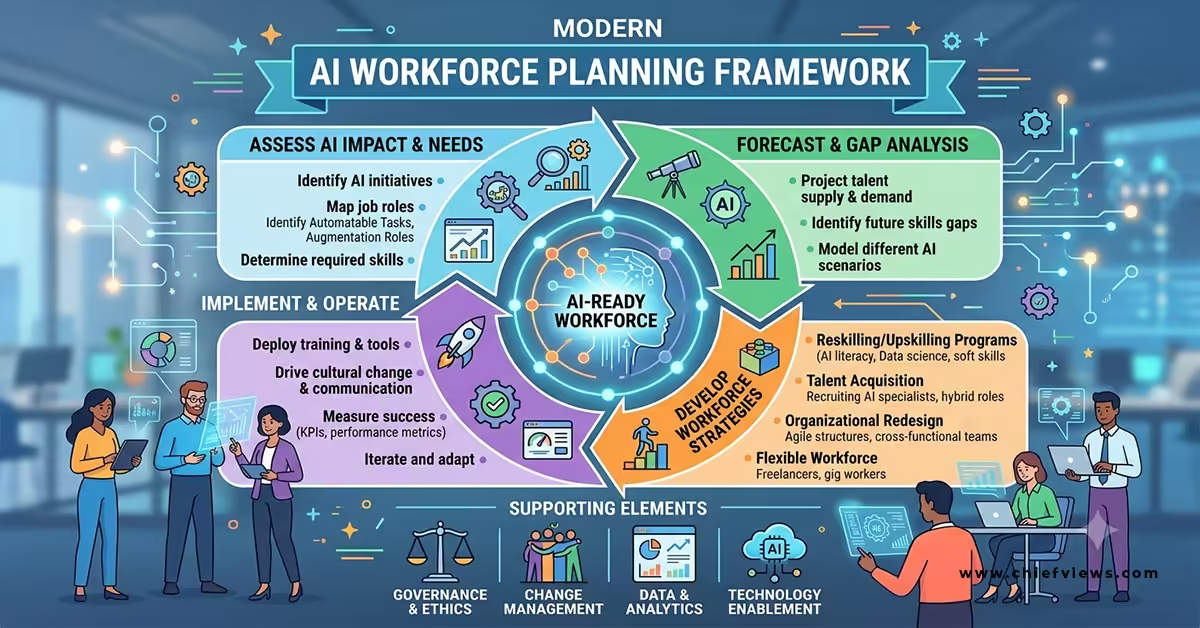
AI workforce planning frameworks are the operating systems CHROs need right now. Traditional headcount models built for stable jobs and annual forecasts collapse when AI agents absorb tasks at speed. The new frameworks shift the unit of analysis from roles to tasks and skills, then continuously match human and machine capacity to business demand.
Here’s the fast overview most leaders need:
- AI workforce planning frameworks treat work as tasks that can be agent-led, human-led, or collaborative.
- They prioritize skills visibility, scenario modeling, and real-time redeployment over static org charts.
- Success depends on integrating HR, finance, and technology data so decisions stay aligned.
- Organizations using them reduce external hiring costs, accelerate internal mobility, and protect human judgment skills.
- The best ones feed directly into continuous learning systems.
In practice, these frameworks turn workforce planning from a periodic spreadsheet exercise into a living capability. Deloitte research shows the shift is already underway: planning is moving from headcount to skills, tasks, roles, and capacity, with scenario modeling becoming continuous rather than snapshot-based. IBM’s 2026 CHRO study reinforces the point—organizations that map high-impact workflows where AI agents shape work achieve stronger revenue and workforce outcomes. Only a minority of companies currently involve the CHRO early in AI strategy, and that exclusion shows up in weaker results.
Why Old Workforce Planning Breaks Under AI
Classic models counted people against growth targets or cost targets. AI doesn’t eliminate whole jobs in clean packages. It chips away at tasks—data gathering, first-draft analysis, routine decision support—while leaving judgment, client trust, and ethical calls with people. When planning stays stuck at the job-title level, leaders miss the real supply-and-demand picture.
What usually happens is this: a new AI capability lands, productivity dips while teams adapt, managers scramble, and the organization either over-hires specialists or under-utilizes existing talent. The kicker is that many of the required adjacent skills already sit inside the company. Frameworks that start with task decomposition surface those adjacencies fast.
Think of traditional planning as navigating with a paper map printed last year. AI workforce planning frameworks act more like live GPS that recalculates as traffic, road closures, and new routes appear. One gets you there eventually. The other keeps you competitive while the landscape shifts.
Core Building Blocks of Effective AI Workforce Planning Frameworks
Strong frameworks share several non-negotiables.
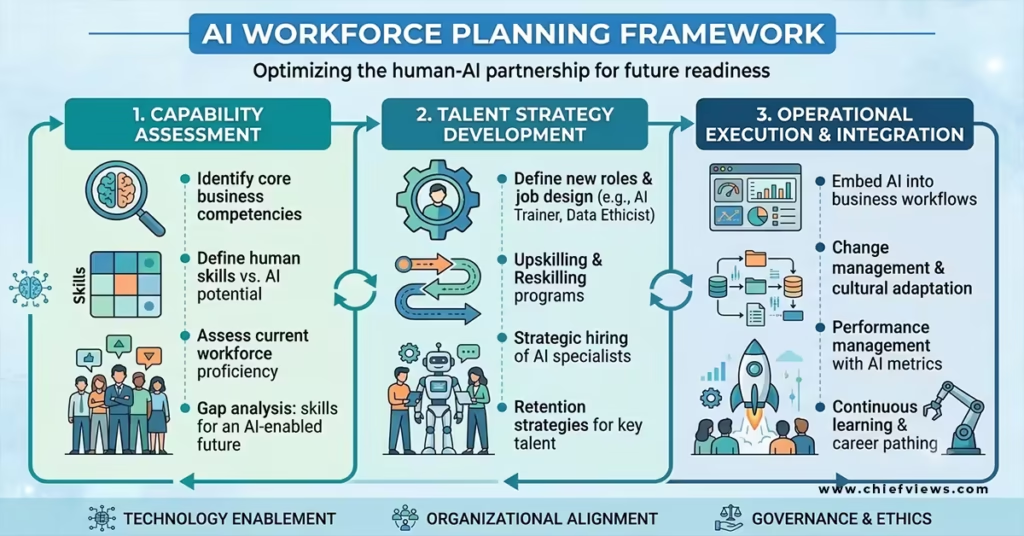
Task-level decomposition. Break every major role into discrete tasks. Score each on repetition, data intensity, need for judgment or trust, and risk if the output is wrong. Assign a working mode: agent-led (system executes, human samples), human-led, or collaborative.
Skills as the primary unit. Move from job architectures to skills graphs. Tools that infer skills from project histories, performance signals, and learning data give a more accurate inventory than self-assessments alone.
Scenario and capacity modeling. Model multiple futures—aggressive AI adoption, slower rollout, different productivity assumptions—and test the impact on headcount, cost, and skill demand. Continuous modeling beats annual plans.
Integrated governance. HR, finance, and technology leaders share ownership. Without it, AI investments optimize for tech metrics while workforce costs quietly erode the ROI.
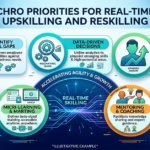
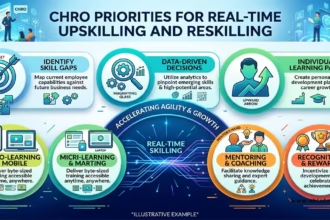
Feedback loops into learning and mobility. The planning system should surface reskilling priorities and internal pathways in near real time. This is where AI workforce planning frameworks connect tightly to CHRO priorities for real time upskilling and reskilling—the planning output becomes the input for targeted, workflow-embedded development.
A Practical Comparison
| Dimension | Traditional Workforce Planning | AI Workforce Planning Frameworks |
|---|---|---|
| Unit of analysis | Job titles and headcount | Tasks, skills, and decision rights |
| Planning cycle | Annual or quarterly snapshots | Continuous / always-on with scenario refresh |
| Primary goal | Fill seats and control cost | Maximize value from human + agent capacity |
| Skills focus | Current competencies in role | Adaptive skills, AI fluency, judgment capabilities |
| Manager role | Direct people and evaluate performance | Orchestrate workflows and coach judgment |
| Success metrics | Time-to-fill, turnover, budget variance | Productivity per workflow, internal fill rate, innovation throughput |
| Risk if ignored | Gradual skill obsolescence | Bad jobs, trust erosion, wasted AI spend |
Step-by-Step Action Plan for Building or Upgrading Your Framework
Start here if your current process still feels like last year’s spreadsheet.
- Secure joint ownership. Get the CHRO, CFO, and senior technology leader to co-sponsor. Without shared accountability, data stays siloed.
- Pick a high-visibility domain. Choose one process or function (finance close, customer support triage, product analytics) and decompose the work into tasks.
- Build a lightweight skills inventory. Combine existing HR data, project histories, and light manager calibration. Avoid lengthy self-surveys that kill momentum.
- Run three scenarios. Model current state, moderate AI absorption, and aggressive absorption. Quantify impact on capacity, cost, and critical human skills.
- Design the working modes and supervision. Explicitly assign who owns each outcome and how humans sample or override agent work.
- Link to mobility and learning. Translate gaps into internal pathways and real-time upskilling priorities.
- Measure and iterate. Track internal fill rates for priority work, time-to-productivity for redeployed talent, and employee confidence in AI-supported decisions.
In my experience, teams that skip the joint sponsorship step usually produce elegant models that never influence real hiring or budget decisions.
Common Mistakes and How to Fix Them
Mistake 1: Treating AI as a pure technology rollout and leaving workforce implications to HR later.
Fix: Bring the CHRO into AI strategy definition from the start. IBM data shows when the CHRO shares responsibility for human-led decisions, employee willingness to question or override AI rises sharply.
Mistake 2: Focusing only on technical AI skills while ignoring judgment and critical thinking.
Fix: Explicitly protect and practice the skills that AI can erode. Design work so people regularly evaluate, challenge, and improve agent outputs.
Mistake 3: Building a perfect skills taxonomy before acting.
Fix: Start with the 20 percent of skills that drive 80 percent of value in your critical workflows. Expand later.
Mistake 4: Running planning as a centralized HR exercise.
Fix: Democratize access to the models and insights so business leaders can test their own scenarios.
What Good Looks Like in 2026
Organizations that get this right stop asking “How many people do we need?” and start asking “What mix of human judgment and agent capacity will deliver the outcome, and how do we keep the human skills sharp?” They treat skills as a renewable resource and planning as continuous sensing rather than annual forecasting.
The practical test is simple: Can you answer, within days rather than months, which internal talent can be redeployed to a new priority with targeted development? If the answer is still “we’d have to start a search,” the framework is incomplete.
For deeper frameworks and research, see Deloitte’s work on AI-enabled strategic workforce planning, IBM’s 2026 CHRO Study on the Thinking Organization, and practical guidance on redesigning roles around AI agents.
Key Takeaways
- AI workforce planning frameworks replace job-title forecasting with task- and skills-based modeling.
- Task decomposition and working-mode assignment (agent-led, human-led, collaborative) form the foundation.
- Continuous scenario modeling and cross-functional ownership separate useful systems from shelfware.
- The planning output should directly feed real-time upskilling and internal mobility pathways.
- Protect human judgment skills deliberately—AI can erode them if work is designed poorly.
- Start with one high-visibility domain rather than attempting enterprise perfection on day one.
- Measure internal fill rates, time-to-productivity, and confidence in AI-supported decisions.
- Involve the CHRO early in AI strategy or accept weaker workforce outcomes.
The companies that treat AI workforce planning as a living system rather than a yearly project will keep their talent relevant and their capacity flexible. The ones still counting heads against last year’s model will discover the market has already moved.
Pick one critical workflow this quarter. Decompose the tasks. Model the human-plus-agent mix. Then build the shortest path that gets existing people ready. That single cycle will teach you more than another round of planning debates.
FAQs
How do AI workforce planning frameworks differ from traditional strategic workforce planning?
Traditional approaches center on headcount and role forecasts. AI versions start with tasks and skills, continuously model human and agent capacity, and tightly link planning outputs to redeployment and learning.
What is the biggest barrier to adopting AI workforce planning frameworks?
Most organizations still lack clean, integrated data on actual work and skills, and many leave the CHRO outside early AI strategy conversations. Both problems are fixable with focused pilots.
Can smaller organizations use these frameworks without expensive platforms?
Yes. Start with task decomposition workshops, simple skills adjacency mapping, and spreadsheet-based scenario models. Add technology later once the process proves value.

