







CHRO priorities for real time upskilling and reskilling sit at the center of every serious workforce conversation in 2026. The old model of annual training calendars and one-and-done courses is dead. AI is rewriting jobs faster than most learning systems can react, and the CHROs who win are treating skill development like a continuous operating system rather than a side project.
Here’s the quick overview:
- Real-time upskilling and reskilling means delivering targeted learning inside the flow of work so employees adapt as tools and roles shift.
- CHROs rank it among their highest priorities because AI is both creating new skill demands and quietly eroding existing ones.
- Success hinges on skills intelligence, manager enablement, and clear pathways from current roles to future ones.
- Organizations that move slowly risk talent shortages, lower productivity, and higher turnover.
- Done right, it turns workforce disruption into a competitive advantage.
The pressure is real. SHRM data shows 92 percent of CHROs expect deeper AI integration into daily operations, and 84 percent anticipate a sharp rise in demand for AI-specific skills. Mercer reports that 60 percent of HR leaders expect 11 to 20 percent of their workforce will need redeployment or reskilling because of AI within two years. Only 4 percent of U.S. CHROs feel very prepared to lead through that change, according to The Conference Board. The gap between urgency and readiness is where the opportunity lives.
Why Traditional Training Falls Short
Most companies still treat learning like a classroom event. Employees sit through modules, check a box, and return to the same workflows. The knowledge fades. The business keeps moving.
What usually happens is this: a new AI tool lands, productivity dips while people figure it out, and managers get stuck coaching on the fly with incomplete skills of their own. Gallup found half of CHROs lack confidence that their managers can guide employees through AI use. That’s a flashing red light.
Real-time approaches flip the script. Learning happens in short, contextual bursts inside the tools people already use. Think of it as the difference between reading a map before a road trip and having turn-by-turn guidance that updates as traffic changes. One gets you there eventually. The other keeps you moving at speed.

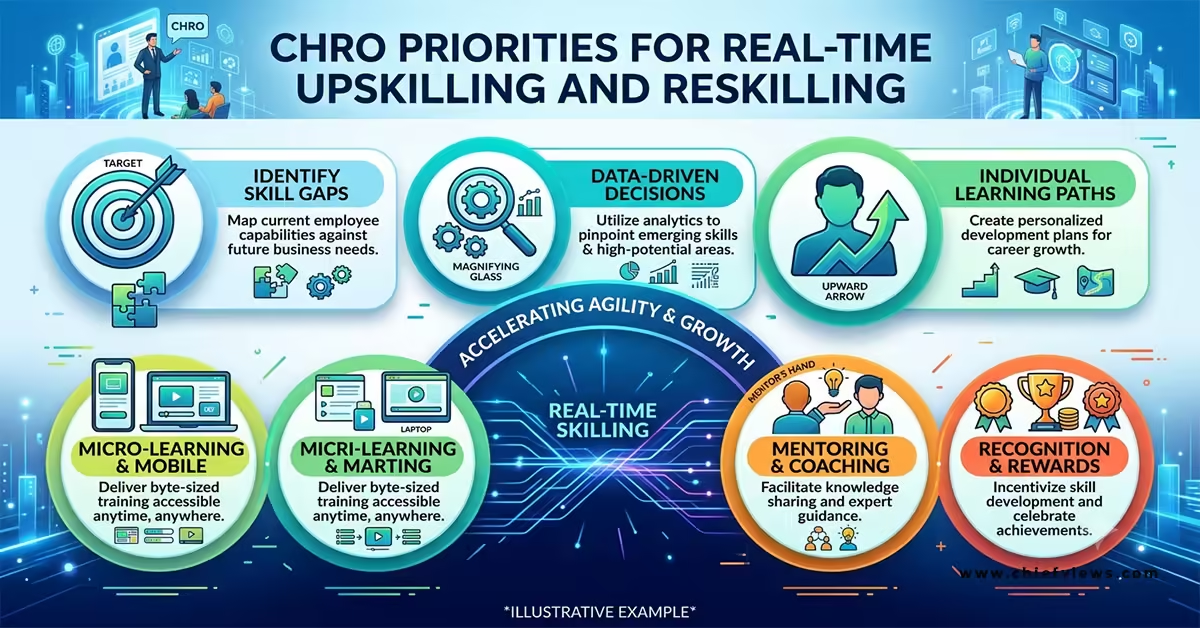
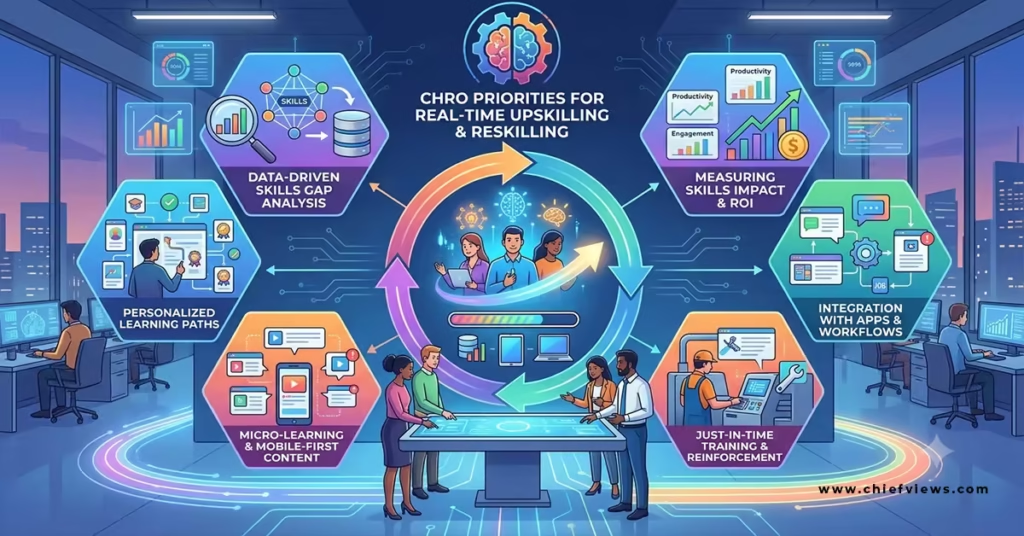
CHRO priorities for real time upskilling and reskilling in Practice
The strongest programs share a few non-negotiable elements.
First, skills visibility. You cannot close gaps you cannot see. Leading CHROs invest in skills taxonomies and AI-powered assessment tools that map current capabilities against future role requirements. IBM’s 2026 CHRO study notes that skill erosion ranks as a top concern for 46 percent of executives, while 60 percent of employees say it already affects them. Critical thinking and human judgment are the skills most at risk.
Second, manager ownership. Managers are the make-or-break layer. When they treat skill development as part of performance conversations and daily coaching, adoption sticks. When they don’t, even the best platforms gather dust.
Third, clear internal pathways. Reskilling only works if people can actually move into new roles. That requires transparent career frameworks and active talent mobility.
Here’s a practical comparison of approaches many organizations are weighing right now:
| Approach | Speed to Impact | Typical Cost Profile | Best For | Common Risk |
|---|---|---|---|---|
| Traditional classroom or LMS courses | Slow (weeks to months) | Lower upfront, high opportunity cost | Foundational knowledge | Low retention and weak transfer to work |
| Role-specific certification programs | Medium | Moderate to high | Targeted technical skills | Can feel disconnected from daily tasks |
| Real-time, workflow-embedded micro-learning + AI coaching | Fast (days to weeks) | Higher platform investment, lower ongoing disruption | AI collaboration, judgment skills, rapid adaptation | Requires strong change management and manager buy-in |
| Internal apprenticeship / project-based reskilling | Medium-fast | Time-intensive but high retention | Redeploying talent into growth roles | Needs protected time and clear role openings |
A Step-by-Step Action Plan for Getting Started
If you’re building or overhauling this capability, start here. These steps work for organizations still early in the journey.
- Map the critical few. Identify the 5–7 roles or skill clusters most exposed to AI disruption and the 5–7 that will create the most future value. Don’t try to boil the ocean.
- Build a living skills inventory. Use existing performance data, manager input, and light-touch assessments. Avoid making employees fill out endless self-surveys.
- Pilot inside the flow of work. Choose one high-visibility process, embed short learning moments or AI-assisted coaching, and measure both skill uptake and business metrics (cycle time, quality, employee confidence).
- Equip managers first. Give them the language, tools, and expectations to coach AI collaboration and judgment. Treat this as a leadership skill, not an optional extra.
- Create visible mobility paths. Publish the skills required for priority roles and the internal routes to acquire them. Celebrate people who move.
- Measure what the business cares about. Track time-to-productivity for people moving into new roles, reduction in external hiring for priority skills, and employee perception of growth opportunities.
In my experience, the organizations that skip step 4 usually stall. Managers either become bottlenecks or active blockers when they feel unprepared.
Common Mistakes & How to Fix Them
Mistake 1: Treating reskilling as an L&D project instead of a business operating model.
Fix: Put the CHRO and relevant business leaders jointly accountable for outcomes. Tie progress to strategic workforce planning, not just training completion rates.
Mistake 2: Over-indexing on technical AI skills while ignoring judgment and critical thinking.
Fix: Design learning that forces people to evaluate, override, and improve AI outputs. IBM research shows that where judgment is built into workflows, employee confidence in AI-enabled decisions rises.
Mistake 3: Launching platforms without protected time or manager support.
Fix: Explicitly carve out learning time in workload models and make coaching part of manager scorecards.
Mistake 4: Focusing only on at-risk roles and ignoring the broader workforce.
Fix: Give everyone a baseline of AI fluency while concentrating deeper investment where the business impact is highest.
CHRO priorities for real time upskilling and reskilling: What Success Looks Like
The companies pulling ahead treat skills as a renewable resource. They use real-time data to sense emerging gaps, close them quickly, and redeploy talent before the market forces their hand. They also protect the uniquely human capabilities—judgment, complex problem framing, ethical reasoning—that AI cannot fully replace.
One sharp question every CHRO should ask the leadership team: If we stopped external hiring for our top 10 growth roles tomorrow, how many could we fill from inside within 90 days? The answer reveals how serious the internal capability engine really is.
Another: Are our managers spending more time explaining AI tools or coaching people on when to trust or challenge them? That distinction separates organizations that merely adopt technology from those that extract lasting value.
For deeper reading on the shift away from traditional training, see the SHRM analysis of real-time upskilling. IBM’s 2026 CHRO Study on designing the thinking organization offers useful data on skill erosion and collaboration capabilities. Gartner’s work on identifying employee reskilling needs provides a practical framework for prioritizing where to act first.
Key Takeaways
- Real-time upskilling and reskilling has moved from nice-to-have to core CHRO priority because AI both creates new skill needs and erodes existing ones.
- Skills visibility and manager enablement are the two highest-leverage investments.
- Focus first on the roles with the greatest exposure and the greatest future value.
- Embed learning in daily work rather than pulling people out of it.
- Measure mobility, time-to-productivity, and business outcomes—not just course completions.
- Protect and deliberately practice the human judgment skills that AI cannot replace.
- Start small with a high-visibility pilot, then scale what works.
- Treat the effort as continuous workforce architecture, not a temporary program.
The organizations that treat skill development as a real-time capability rather than a periodic event will keep their people relevant and their businesses agile. The ones that wait for perfect data or complete consensus will find the market has already moved.
Pick one exposed process this quarter. Map the skills it requires today and six months from now. Build a short, embedded learning loop and put a manager accountable for the results. That single move will teach you more than another round of planning.
FAQs
What makes CHRO priorities for real time upskilling and reskilling different from traditional L&D goals?
Traditional L&D often focuses on broad knowledge transfer on a fixed calendar. Real-time versions prioritize speed, context, and immediate application inside actual work, driven by continuous skills sensing rather than annual needs assessments.
How should mid-sized companies with limited budgets approach CHRO priorities for real time upskilling and reskilling?
Start with free or low-cost AI tools already in use, pair them with manager coaching, and focus on one or two high-impact roles. Use internal experts as coaches before investing in large platforms.
Can real-time approaches actually prevent skill erosion caused by AI?
They can slow it and redirect it. By deliberately designing work that requires human judgment on top of AI outputs, organizations keep critical thinking muscles active instead of letting them atrophy through over-reliance on automated recommendations.

