







Process optimisation and workforce redesign under AI starts with a hard truth most leaders still dodge: bolting AI tools onto yesterday’s workflows delivers modest individual wins and almost zero enterprise lift.
Here’s the quick take:
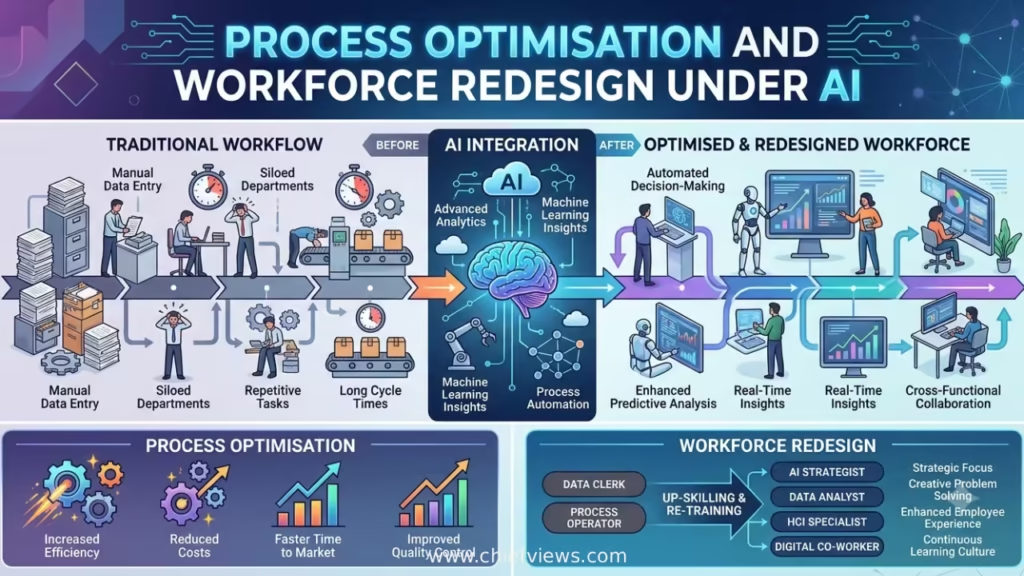
- Process optimisation and workforce redesign under AI means stripping processes down to outcomes, then rebuilding every step around what humans do best and what agents handle faster.
- It shifts the unit of planning from job titles to tasks and skills.
- High performers who redesign workflows capture far more value than those who just deploy copilots.
- The payoff shows up in cycle time, error rates, and the ability to grow output without matching headcount.
- Done right, it turns AI from a cost center into a capacity multiplier.
In my experience working with mid-market and enterprise teams across the U.S., the companies still stuck in pilot purgatory are the ones treating AI like a fancy spreadsheet add-on. The ones pulling ahead treat it like a full operating-model rewrite.
Why Most AI Rollouts Stall
McKinsey’s 2026 State of AI survey lays it out cleanly: 80 percent of respondents report better individual productivity from AI, yet only 37 percent see positive EBIT impact. Just 6 percent qualify as high performers. Nearly three-quarters of those high performers substantially redesigned workflows. Only one-quarter of everyone else did the same.
The gap is not the model. It’s the refusal to question whether the old process should still exist.
Think of it like rebuilding a kitchen while the chefs keep cooking. You can hand them better knives, but if the layout still forces them to walk across the room for every ingredient, the meal never gets faster. Process optimisation and workforce redesign under AI forces you to ask the only question that matters: if we designed this process today, knowing agents can own entire segments, would it look anything like the current map?


The Core Shift: From Jobs to Tasks and Outcomes
Traditional workforce planning starts with headcount and role descriptions. That model breaks the moment agents absorb 30–60 percent of the routine work inside a role.
What works instead:
- Map every process end-to-end at the task level.
- Score each task for automation potential, human judgment requirement, and risk.
- Rebuild the workflow with explicit ownership: agent-only, human-in-the-loop, or human-led.
- Redesign roles around the remaining high-judgment work and the new oversight demands.
Gartner now argues that continuous work redesign must become a core organizational capability by 2028. Companies that treat it as a one-time project will fall behind those that treat it as an always-on muscle.
Process Optimisation and Workforce Redesign under AI: A Practical Comparison
| Approach | Typical Outcome | Time to Meaningful ROI | Risk Profile | Best For |
|---|---|---|---|---|
| Bolt AI onto existing process | 5–15% individual productivity | 6–12 months | Low disruption, high wasted spend | Early experiments |
| Redesign process first, then insert AI | 25–40% end-to-end gains | 3–9 months once redesign is done | Higher change management load | Core value streams |
| Full agentic redesign (outcome-owned teams) | 30%+ plus capacity for growth without headcount | 9–18 months | Highest, requires governance maturity | Competitive differentiation |
The middle column is where most U.S. organizations should live right now. Full agentic models are powerful, but they demand clean data, clear decision rights, and real accountability for the hybrid system—not just the people.
Step-by-Step Action Plan for Beginners
If you’re leading a function or a business unit and have never done this, start here.
1. Pick one painful, cross-functional process.
Onboarding, quote-to-cash, claims handling, or monthly close all work. Avoid the shiny new product idea. Fix something that already bleeds time and money.
2. Map the current state at task level in two weeks or less.
Sit with the people who actually do the work. Record every handoff, every wait, every system touch. Skip the polished process maps—they almost always lie.
3. Run the “Should this step exist?” filter.
For each task ask: Does this exist only because we lack better coordination? Would an agent handle it better? Does it require empathy, ethics, or novel judgment? Be ruthless.
4. Redesign the workflow on a whiteboard.
Fewer handoffs. Clear ownership of the outcome, not the department. Explicit agent responsibilities and human checkpoints. One owner for the end-to-end result.
5. Pilot with a small team and measure six signals.
Track AI usage rate, handoff volume and wait times, review workload, cross-team contact, rework rate, and the actual business metric (cycle time, error rate, capacity). Compare against the baseline you captured in step 2.
6. Redeploy people before the productivity gains evaporate.
The biggest silent failure I see: AI frees capacity and that capacity simply disappears into lower utilization. Name the higher-value work the freed people will take on. Fund the reskilling. Set targets.
7. Codify and scale.
Once the pilot works, turn the new design into the default. Update job architectures, performance metrics, and hiring profiles around the hybrid model.
What I’d do if I walked into a 500-person mid-market company tomorrow: start with the process that owns the largest share of customer complaints or the longest cycle time. Fix that one end-to-end. The organizational learning compounds faster than any broad “AI literacy” program.
Common Mistakes & How to Fix Them
Mistake 1: Measuring adoption instead of redesigned outcomes.
People using ChatGPT more does not equal value. Fix: Tie every initiative to a process metric and a redeployment plan.
Mistake 2: Redesigning roles before redesigning the work.
You end up with new titles sitting on the same broken process. Fix: Work first, then roles. Deloitte’s guidance is explicit on this sequence.
Mistake 3: Treating agents as tools instead of digital labor.
Tools get managed by IT. Digital labor needs onboarding, performance standards, and offboarding. Fix: Give agents identity, permissions, and clear escalation paths the same way you would a contractor.
Mistake 4: Under-investing in change capacity.
Deloitte research links every dollar spent on change management to roughly four dollars in realized value. Most teams still treat change as a communications plan. Fix: Build continuous redesign capability into the operating model itself.
Mistake 5: Ignoring the night-shift and tribal-knowledge problem.
Agents surface patterns that only the experienced operators used to catch. If those operators leave before the knowledge is encoded, you lose institutional memory. Fix: Pair domain experts with agent builders early and deliberately capture judgment as rules and thresholds.
Process Optimisation and Workforce Redesign under AI in Practice
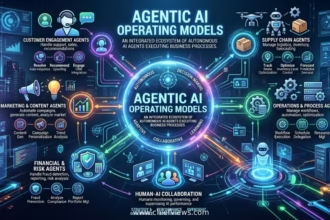
Look at the companies moving fastest. They organize cross-functional teams around end-to-end outcomes rather than functional silos. Decision rights sit closer to the work. Agents handle coordination and execution. Humans own judgment, exceptions, and relationship capital.
McKinsey research shows the organizations furthest along in AI reinvention are already shifting this way. The rest are still adding copilots and wondering why the P&L hasn’t moved.
The practical test is simple. Can you point to a process that runs with 40–60 percent fewer human touches and equal or better quality? If the answer is no, you are still in the tool phase, not the redesign phase.
Key Takeaways
- Process optimisation and workforce redesign under AI is the difference between using AI and capturing its value.
- High performers redesign workflows; most organizations do not. That single gap explains most of the ROI shortfall.
- Plan at the task and skill level, not the job title level.
- Always redesign the process before you redesign the roles.
- Measure handoffs, rework, and business outcomes—not just tool adoption.
- Redeploy freed capacity on purpose or it disappears.
- Continuous redesign capability will separate winners from the rest by 2028.
- Start with one painful process. Prove the model. Then scale.
Process optimisation and workforce redesign under AI The organizations that treat this as a technology project will keep reporting modest productivity gains and flat enterprise results. The ones that treat it as a fundamental rewrite of how work gets done will grow output, improve quality, and free their best people for higher-value problems.
Pick the process that hurts the most. Map it this month. Redesign it next month. That is the only next step that compounds.
FAQs
What does process optimisation and workforce redesign under AI actually change for frontline managers?
It shifts their job from supervising tasks to orchestrating hybrid systems—setting guardrails, handling exceptions, and coaching people on how to work with agents. The best managers become system designers rather than task cops.
How long does a solid process optimisation and workforce redesign under AI pilot usually take?
A focused pilot on one cross-functional process can move from current-state map to live redesigned workflow in 8–12 weeks if you keep the scope tight and the team small. Scaling across the enterprise takes longer because governance and skill systems have to catch up.
Is process optimisation and workforce redesign under AI mainly about cutting headcount?
No. The strongest results come from growing capacity and output without proportional headcount growth, then redeploying people into higher-value work. Companies that only chase reductions usually lose institutional knowledge and create resistance that kills the next initiative.

