




Agentic AI is no longer a futuristic concept—it’s exploding into the mainstream in 2026. These autonomous systems don’t just respond to prompts; they plan, reason, use tools, adapt on the fly, and execute complex goals with minimal human hand-holding. Think of them as digital teammates that handle entire workflows while you focus on strategy.
Industry giants like Gartner predict that 40% of enterprise applications will embed task-specific AI agents by the end of 2026 (up from less than 5% in 2025). The market? It’s surging from around $7-8 billion today toward projections of $50-180 billion by the early 2030s, with explosive CAGR figures in the 40-50% range. Why the hype turning into reality? Because agentic AI finally bridges the gap between generative chat and true business impact.
If you’re wondering how to become a CTO in an AI-first company 2026, mastering these trends isn’t optional—it’s your ticket to the C-suite. Let’s dive into the biggest shifts reshaping industries right now.
1. From Single Agents to Multi-Agent Orchestration: The Real Power Move
Gone are the days of one super-smart general-purpose agent trying to do everything (and often failing spectacularly). In 2026, the winners build teams of specialized agents that collaborate like a well-oiled orchestra.
Picture this: One agent handles data research, another analyzes risks, a third executes transactions, and a fourth monitors compliance—all orchestrated through protocols like Model Context Protocol (MCP). Gartner notes a massive surge in multi-agent inquiries, and companies are seeing this architecture scale where single agents stall.
This trend matters because it reduces risk, improves accuracy, and handles complexity in regulated sectors like finance and healthcare. For aspiring CTOs, understanding how to design these systems separates the visionaries from the experimenters.
2. Production Scaling: Moving Beyond Pilots to Real ROI
Here’s the harsh truth—most organizations experimented in 2025, but only a fraction scaled successfully. 2026 is the make-or-break year for production-grade agentic AI.

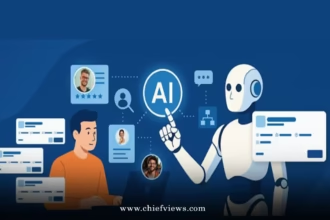

Challenges? Tool sprawl, governance gaps, escalating costs, and the infamous “pilot purgatory.” Success stories focus on clear metrics: tasks completed (not tokens generated), reduced manual effort, and measurable ROI. High-performers are three times more likely to scale, per McKinsey insights.
If you’re eyeing that CTO role in an AI-first company, prioritize governance frameworks and orchestration platforms early. The gap between hype and value is closing—those who bridge it win big.
3. Zero-Click Commerce and Agent-Driven Shopping
Retail is getting flipped upside down. Shoppers increasingly rely on AI agents for discovery, comparison, checkout, and even loyalty management—without ever visiting a website.
Zero-click commerce emerges as a dominant force: AI agents handle everything from personalized recommendations to secure payments. Retailers must optimize for Answer Engine Optimization (AEO) with structured data and clean catalogs, or risk invisibility.
Morgan Stanley forecasts nearly half of online shoppers using AI agents by 2030, driving massive revenue shifts. Brands rebuilding their digital presence around agentic experiences will dominate.
4. Governance, Security, and Ethical Guardrails Take Center Stage
With great autonomy comes great responsibility. 2026 brings heightened focus on AI sovereignty, model drift monitoring, bias detection, and new security benchmarks for agentic ecosystems.
Predictions include more CVEs targeting agent frameworks, rising “death by AI” legal claims (Gartner forecasts over 2,000 by year-end), and mandatory governance roles in large firms. Enterprises demand modular, trustworthy environments where agents operate within strict boundaries.
For leaders, this means championing responsible deployment—exactly the kind of strategic mindset that defines successful CTOs in AI-first organizations.
5. Human-AI Harmony: Agents as Collaborative Teammates
Forget the “AI will replace jobs” fear. 2026 emphasizes collaboration: humans set vision and strategy, while agents handle execution.
Employees delegate complex workflows, shifting focus to higher-level thinking. By 2028, many organizations will treat AI agents as official team members. Adaptability becomes the new job security.
This nuance matters—great CTOs build cultures where people and agents thrive together, boosting productivity without burnout.
6. Industry-Specific Breakthroughs: Healthcare, Finance, Logistics, and Beyond
Agentic AI shines brightest in verticals needing contextual judgment:
- Finance: Agentic payments go mainstream, with agents negotiating deals and managing fraud.
- Logistics: Embodied agents learn in real time through trial and error.
- Security: Agents automate alert triage and investigations.
- Customer Experience: Autonomous agents resolve issues 24/7 with personalization.
These use cases drive the massive market growth and prove agentic AI’s business value.
7. The Infrastructure and Skills Race
Behind the scenes, success demands robust data architecture, cloud scaling, and edge AI maturity. Open-source reasoning models push boundaries, while specialized small language models (SLMs) deliver efficiency.
Skills? Orchestrating agents, auditing workflows, and continuous learning top the list. For anyone pursuing how to become a CTO in an AI-first company 2026, deep expertise here is non-negotiable.

Final Thoughts: Position Yourself for the Agentic Future
2026 marks the year agentic AI graduates from hype to foundational technology. Multi-agent systems, scaled production, zero-click experiences, strong governance, and true human-AI partnership define the landscape. The market explodes, workflows transform, and companies that master these trends pull ahead dramatically.
If this excites you, now’s the time to act. Dive into multi-agent design, prioritize governance, and experiment boldly. The leaders shaping AI-first companies aren’t waiting—they’re building the future today.
Want to go deeper? Check out our earlier guide on how to become a CTO in an AI-first company 2026 for the full leadership playbook.
FAQs
1. What is the biggest agentic AI trend for 2026?
Multi-agent orchestration—teams of specialized agents collaborating on complex workflows—leads the pack, as single agents prove insufficient for enterprise scale.
2. How fast is the agentic AI market growing in 2026?
Explosively: from roughly $8-10 billion to projections of tens to hundreds of billions by early 2030s, with CAGRs often exceeding 40-50%.
3. Will agentic AI replace jobs in 2026?
Not outright—it’s creating harmony where humans oversee strategy and agents execute. Adaptability and orchestration skills become the new competitive edge.
4. Why is governance so critical for agentic AI in 2026?
Autonomy brings risks like bias, security vulnerabilities, and legal claims. Strong guardrails and sovereignty ensure trust and scalability.
5. How does agentic AI connect to becoming a CTO in an AI-first company 2026?
Mastering these trends—especially orchestration, scaling, and ethical deployment—is essential for strategic leadership in AI-native organizations.