



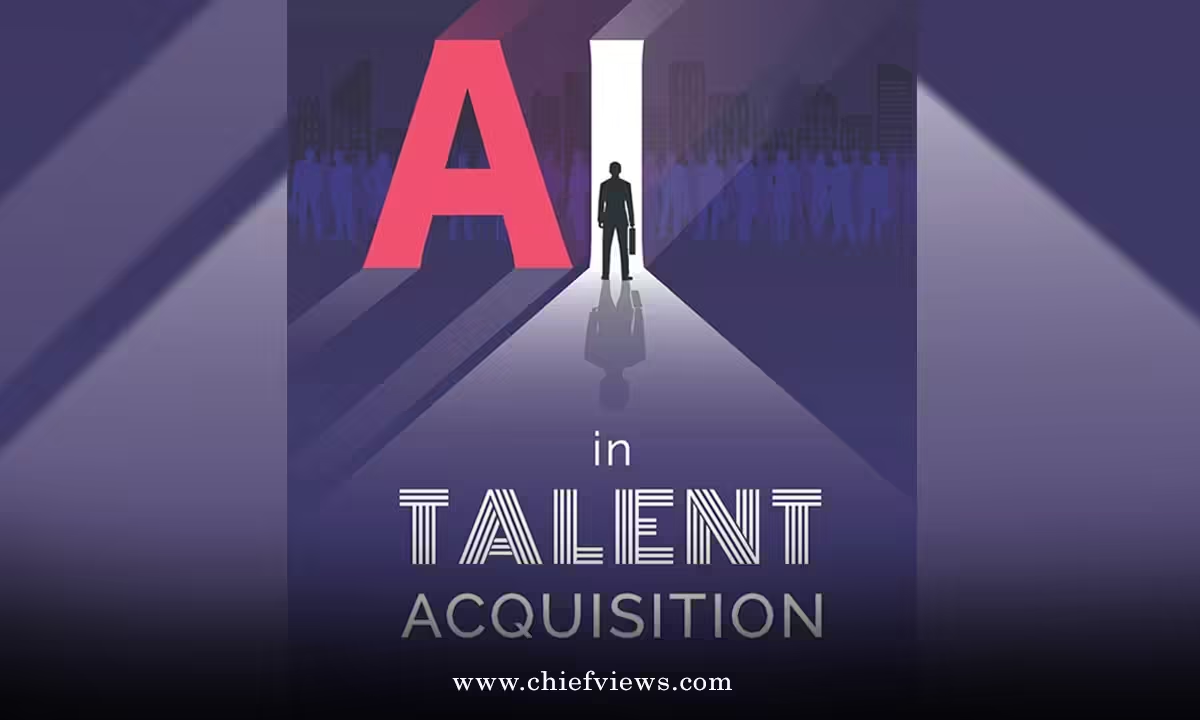
AI Talent Acquisition Strategies 2026 have shifted from experimental pilots to core operational weapons. Smart organizations now blend AI speed with human judgment to snag top talent before competitors even spot them.
AI Talent Acquisition Strategies 2026 focus on skills-first matching, ethical automation, predictive analytics, and creating experiences that feel personal despite the tech. In the U.S., where talent shortages persist in tech, healthcare, and leadership roles, these strategies deliver faster hires, better fits, and stronger pipelines.
- AI handles volume: 87% of companies use AI somewhere in hiring, with many pushing toward high-volume AI-first processes.
- Skills over degrees: Emphasis on verifiable capabilities rather than pedigree.
- Human-AI teams: Recruiters augmented by tools, not replaced.
- Candidate trust matters: Only 26% of applicants fully trust pure AI evaluation, making transparency essential.
This approach matters because traditional recruiting can’t keep pace with 2026’s speed of change. Get it right, and you cut time-to-hire dramatically while improving quality. Mess it up, and you amplify bias, lose candidates, or waste budget on flashy tools that underdeliver.
Why AI Talent Acquisition Strategies 2026 Are Non-Negotiable
The labor market keeps tightening. AI itself creates new roles while reshaping old ones. Recruiters face floods of applications, many generated or enhanced by candidate-side AI.
Here’s the thing: volume without signal creates noise. Top performers expect sophisticated processes. They ghost slow or impersonal ones.
Organizations tying talent acquisition directly to broader CHRO priorities for AI workforce strategy and leadership development 2026 win bigger. They don’t just fill seats. They build AI-ready teams from entry point.


Gartner highlights AI reshaping assessment and high-volume recruiting as key forces this year.
Core Pillars of Effective AI Talent Acquisition Strategies 2026
Skills-Based Hiring Powered by AI
Ditch the keyword-stuffed resume scan. Modern tools analyze portfolios, project history, and even simulation performance.
AI matches candidates to actual job demands with scary accuracy. The result? More diverse pools and fewer bad hires.
CEOs rank AI fluency high on wanted skills, but balance remains critical. Pure tech wizards without collaboration muscle fail fast.
Predictive Analytics and Sourcing
AI doesn’t wait for applications. It scans public data, professional networks, and internal signals to surface passive talent.
Predictive models forecast candidate success based on historical patterns. In practice, this means shorter funnels and higher offer acceptance rates.
Personalized Candidate Experiences at Scale
Chatbots handle initial questions. AI crafts tailored outreach. Yet the best strategies keep humans in final conversations.
Candidates notice when it feels robotic. The winners blend automation with authentic touchpoints.
Ethical AI and Bias Mitigation
This isn’t optional. Tools now include built-in fairness audits. Regular testing for demographic skews protects against legal headaches and reputation damage.
Step-by-Step Action Plan for Implementing AI Talent Acquisition Strategies 2026
Beginners and mid-level TA pros, follow this sequence:
- Audit Your Current Process (Weeks 1-2): Map every stage. Identify bottlenecks and bias hotspots. Survey recent candidates for feedback.
- Select Tools Strategically (Month 1): Prioritize platforms with strong explainability features. Start with resume screening and scheduling before advanced predictive stuff.
- Build Governance Rules: Define where AI decides versus recommends. Involve legal and diversity leads early.
- Train Your Team: Run hands-on sessions on prompt engineering for job descriptions and interpreting AI insights. Focus on using AI as a copilot.
- Pilot One Role Type: Test on high-volume or hard-to-fill positions. Measure time-to-hire, quality of hire, and candidate satisfaction.
- Scale and Iterate: Roll out successful elements. Review metrics monthly. Adjust based on real outcomes, not vendor promises.
Most organizations see 30-75% faster hiring when done right.
Comparison Table: Traditional vs. AI Talent Acquisition Strategies 2026
| Aspect | Traditional Recruiting | AI-Driven 2026 Strategies | Key Benefit |
|---|---|---|---|
| Sourcing | Job boards and networks | Predictive + passive talent identification | 3-5x more relevant candidates |
| Screening | Manual resume review | Automated with skills inference | Cuts time by up to 75% |
| Candidate Engagement | Generic emails | Personalized at scale with human oversight | Higher response rates |
| Assessment | Interviews + basic tests | AI simulations + predictive scoring | Better job fit prediction |
| Bias Management | Rely on reviewer awareness | Built-in audits and fairness checks | More diverse hires |
| Time-to-Hire | 40-60 days average | 10-25 days for many roles | Competitive edge |

Common Mistakes & How to Fix Them
Mistake 1: Going all-in on AI without oversight.
Fix: Always keep humans in final decisions. Use AI for speed and scale, judgment for fit.
Mistake 2: Ignoring candidate experience.
Fix: Test every automated touchpoint. Provide clear explanations when AI is used. Offer easy opt-outs to human contact.
Mistake 3: Poor data hygiene.
Fix: Clean and diversify training data regularly. Audit outputs quarterly for unintended patterns.
Mistake 4: Treating tools as set-it-and-forget-it.
Fix: Assign ownership. Review performance monthly and retrain models as your needs evolve.
AI feels like a force multiplier. It amplifies good recruiting practices and exposes weak ones instantly.
Tying It Back to Broader Strategy
Smart TA leaders connect their work directly to CHRO priorities for AI workforce strategy and leadership development 2026. New hires arrive with the right blend of technical and human skills. Onboarding includes AI fluency training from day one.
For proven frameworks, explore Gartner’s talent acquisition trends for 2026.
SHRM’s resources on AI in HR offer practical benchmarks.
Deloitte’s human capital insights provide excellent context on skills evolution.
Key Takeaways
- AI Talent Acquisition Strategies 2026 succeed through human-AI partnership, not replacement.
- Skills-based approaches outperform traditional credential focus.
- Transparency builds candidate trust in automated processes.
- Governance prevents bias and legal risks.
- Measurement must track quality, not just speed.
- Integration with leadership development creates stronger organizations.
- Continuous iteration beats one-time implementations.
- Early adopters gain significant competitive advantages in talent wars.
AI Talent Acquisition Strategies 2026 let you hire smarter, faster, and fairer. The organizations crushing it treat recruiting as a strategic advantage, not an admin function.
Start small. Pick one painful process. Apply AI thoughtfully. Then build from proven wins. Your talent pipeline will thank you.
FAQs
What makes AI Talent Acquisition Strategies 2026 different from previous years?
The focus has matured from basic automation to predictive, ethical, and skills-centric systems that integrate deeply with overall workforce planning.
How do AI Talent Acquisition Strategies 2026 connect to CHRO priorities for AI workforce strategy and leadership development 2026?
They feed the right AI-fluent talent into the organization while aligning new hires with leadership needs for managing hybrid human-AI teams.
Can small to mid-sized U.S. companies implement effective AI Talent Acquisition Strategies 2026?
Yes. Start with affordable tools for screening and scheduling, focus on high-impact roles, and leverage free resources from SHRM and similar groups before scaling.