



CHRO priorities for AI workforce strategy and leadership development 2026 center on turning AI hype into real business muscle while keeping humans front and center.
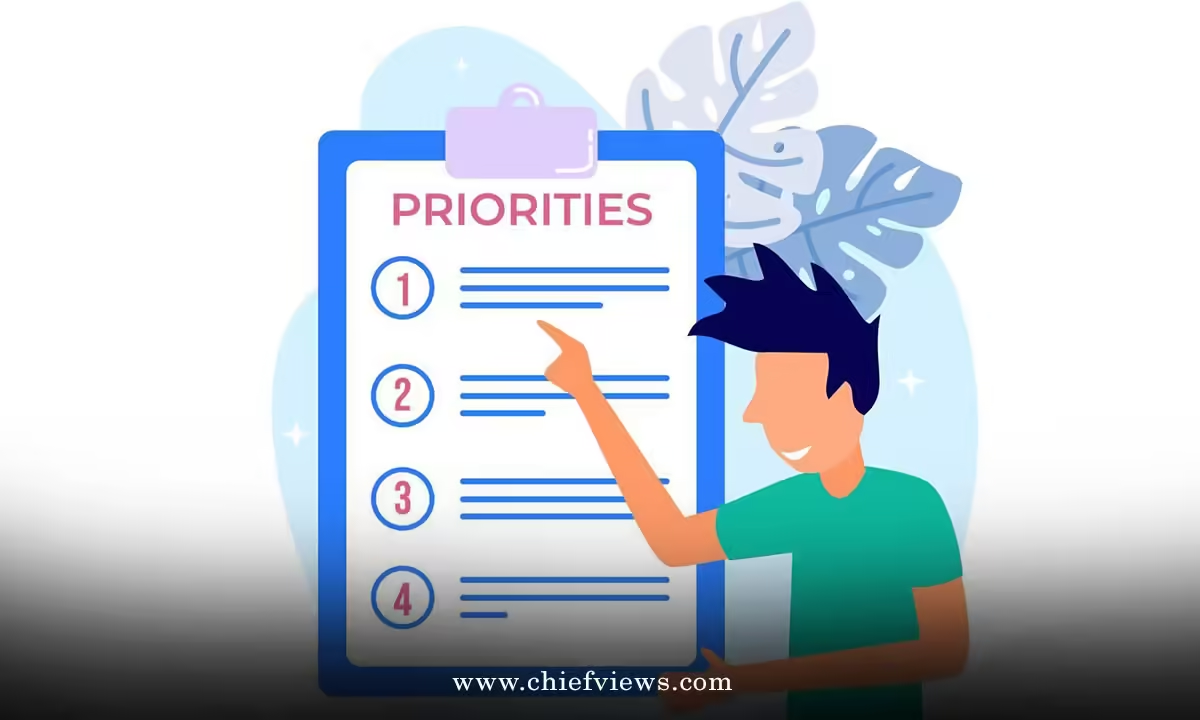
CHRO priorities for AI workforce strategy and leadership development 2026 boil down to four big moves: building an HR-focused AI playbook, redesigning work for human-AI teams, prepping leaders for constant flux, and protecting culture from dilution.
- AI integration without chaos: Most CHROs now rank HR tech and AI strategy as a top-two priority.
- Leadership overhaul: Leader and manager development holds the #1 spot for the second year running.
- Blended workforce planning: Shifting from headcount to skills and orchestration.
- Talent retention edge: Companies without people-centric AI plans risk losing top AI talent by 2027.
This matters because U.S. firms sit at roughly 18-20% AI adoption in operations as of mid-2026, but expectations for scaling sit much higher. Get it right, and you unlock productivity. Get it wrong, and you burn budget while watching good people walk.
Why CHRO Priorities for AI Workforce Strategy and Leadership Development 2026 Demand Immediate Action
Here’s the thing. AI isn’t coming for jobs in one clean wave. It nibbles tasks, reshapes roles, and forces every layer of the organization to adapt. In the U.S., CHROs face tight labor markets, aging demographics in some regions, and fierce competition for AI-fluent talent.
Leadership development now means teaching people to orchestrate networks instead of just managing teams. Workforce strategy means planning for humans plus agents plus tools that evolve monthly.
What usually happens is this: Tech teams push AI pilots. HR scrambles to catch up on governance, ethics, and skills. The organizations winning treat CHROs as co-architects from day one.



Gartner research shows evolving the HR operating model delivers the biggest AI productivity lift—up to 29% impact.
Core Elements of CHRO Priorities for AI Workforce Strategy in 2026
Building an HR-Focused AI Strategy
Stop bolting AI onto old processes. Top CHROs audit HR workflows first, then target high-pain areas like talent analytics, learning, and service delivery.
They partner tightly with CIOs and CFOs. The goal? Move from fragmented tools to an integrated system that actually frees managers from admin work.
In my experience, the organizations seeing real gains invest in AI literacy across HR itself. About 40% of CHROs still cite insufficient AI skills inside their own teams as the biggest roadblock.
Redesigning Work for the Human-Machine Era
This is the shift from “how many people” to “what capabilities do we need when.”
AI handles routine stuff. Humans tackle exceptions, creativity, and judgment. The kicker is rethinking handoffs. A contact center rep might move from answering basics to complex problem-solving once AI triages queries.
Deloitte notes that human-centric AI approaches outperform pure tech plays significantly.
Leadership Development as the Top Priority
Leader & manager development tops CHRO lists again in 2026.
Leaders need new muscles: guiding through ambiguity, fostering trust in hybrid setups, and making decisions with incomplete AI outputs.
64% of CHROs say their current leaders lack the mindset for continuous change. That’s not a nice-to-have problem. It’s make-or-break when growth remains the CEO obsession.
Step-by-Step Action Plan for CHRO Priorities for AI Workforce Strategy and Leadership Development 2026
Beginners and intermediates, here’s a practical playbook I’d run with:
- Assess Current State (Weeks 1-4): Map every HR process. Identify where AI could cut admin by 40-50%. Survey workforce on AI comfort levels.
- Build Governance (Months 1-3): Create an AI ethics framework with clear guidelines on bias, transparency, and data privacy. Involve legal and IT early.
- Launch Tiered Training: Start with executive AI literacy sessions. Move to role-specific proficiency. Focus on prompt engineering, critical evaluation of outputs, and data basics.
- Pilot Workforce Redesign: Pick one department. Redefine 2-3 roles around human-AI collaboration. Measure before/after productivity and engagement.
- Embed Leadership Development: Roll out programs teaching network orchestration, emotional intelligence under pressure, and change navigation. Use coaching platforms augmented by AI.
- Measure and Iterate: Track skills gaps, retention of AI talent, and business outcomes quarterly. Adjust fast.
Budget 2-4% of payroll for upskilling in year one, per common benchmarks.
Comparison Table: Traditional vs. AI-Ready Workforce Strategy
| Aspect | Traditional Approach | AI-Ready 2026 Approach | Expected Impact |
|---|---|---|---|
| Workforce Planning | Headcount-focused | Skills + orchestration focus | Better adaptability |
| Leadership Development | Hierarchy management | Network enabling + ambiguity navigation | Higher change success rate |
| Training Delivery | Annual programs | Continuous, AI-personalized | 2-3x faster skill acquisition |
| Performance Metrics | Output volume | Human judgment + AI efficiency | Productivity gains up to 30%+ |
| Talent Retention | Competitive pay | Growth opportunities in AI-augmented roles | Reduced loss of top talent |
Common Mistakes & How to Fix Them
Mistake 1: Chasing shiny tools without strategy.
Fix: Tie every AI investment to a specific business outcome or pain point. Say no to solutions in search of problems.
Mistake 2: Treating leadership development as generic training.
Fix: Customize for AI-era challenges. Include simulations of human-AI team conflicts and decision-making under uncertainty.
Mistake 3: Ignoring culture atrophy.
AI can make work feel impersonal fast. Fix: Intentionally embed culture into daily rituals and recognition programs. Research shows this boosts performance by up to 34%.
Mistake 4: Under-investing in HR’s own AI fluency.
Fix: Make HR the model. Run internal bootcamps before rolling out enterprise-wide.
Think of AI like electricity. It powers everything, but you still need skilled electricians and safe wiring. CHROs who master both the power and the safety win.
CHRO Priorities for AI Workforce Strategy and Leadership Development 2026: External Perspectives
For deeper dives on governance, check Gartner’s top priorities for HR leaders.
On human capital trends overall, Deloitte’s 2026 Global Human Capital Trends offers strong frameworks.
SHRM provides practical benchmarks in their State of AI in HR 2026 Report.
Key Takeaways
- Leadership development remains CHROs’ #1 priority while AI strategy rockets up the list.
- Success hinges on redesigning work, not just automating tasks.
- HR must build its own AI capabilities first to lead effectively.
- Focus on skills over headcount for resilient planning.
- Culture and human judgment become competitive advantages in an AI world.
- Early movers on people-centric AI strategies will retain top talent.
- Measure relentlessly—productivity, engagement, and retention.
- Partner cross-functionally; isolation kills AI value.
CHRO priorities for AI workforce strategy and leadership development 2026 separate organizations that merely survive disruption from those that thrive on it. The payoff is a more agile, innovative, and human workforce—even as technology accelerates.
Start with one department. Build momentum. Scale what works. Your next move? Schedule that cross-functional AI strategy session this month.
FAQs
What are the top CHRO priorities for AI workforce strategy and leadership development 2026?
Leader and manager development leads, followed closely by HR tech and AI strategy, change management, and blended workforce planning according to multiple 2026 surveys.
How can mid-sized U.S. companies approach CHRO priorities for AI workforce strategy and leadership development 2026 without massive budgets?
Focus on targeted pilots, leverage open-source or affordable AI tools for training, and partner with industry associations for shared learning programs. Prioritize high-impact areas like manager upskilling first.
Why does leadership development stay central to CHRO priorities for AI workforce strategy and leadership development 2026?
AI handles tactical work but amplifies the need for distinctly human leadership—judgment, empathy, and orchestration skills that machines can’t replicate.