





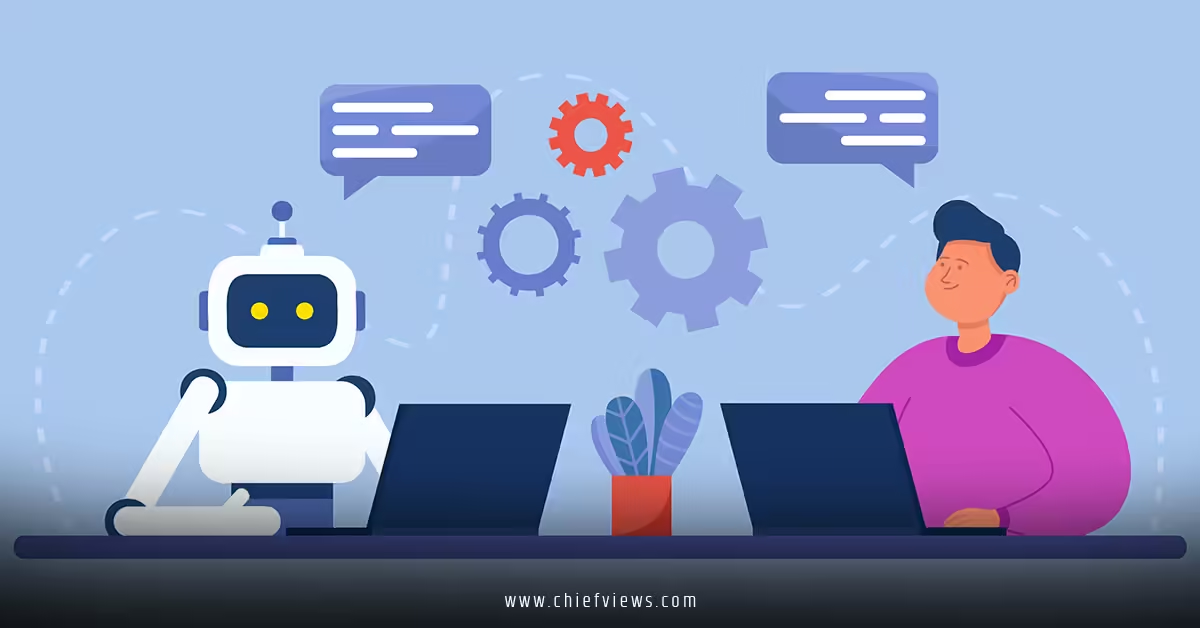
Best AI tools for executive productivity are reshaping how C-suite leaders work in 2026. They compress hours of manual work into minutes, surface insights from scattered data, and free up bandwidth for high-stakes strategy and decisions.
These tools go far beyond basic task lists. They handle meeting summarization, email triage, research synthesis, dashboard automation, and even scenario modeling. The smartest executives use them to stay ahead without burning out.
- What they deliver: Instant meeting recaps, personalized briefings, automated reporting, and decision support that actually understands context.
- Why executives need them now: Time is the ultimate constraint at the top. AI tools reclaim hours every week while reducing cognitive load.
- Biggest impact areas: Calendar management, information synthesis, cross-team alignment, and turning raw data into actionable recommendations.
- Key advantage: When paired with tools and platforms for C-suite collaboration and decision making, these AI solutions create a powerful flywheel—faster insights feeding directly into shared strategic workspaces.
Why Executive Productivity Tools Have Changed in 2026
Generic productivity apps no longer cut it for leaders handling complex, ambiguous, and high-velocity environments. Today’s best AI tools for executive productivity understand organizational context, respect data privacy, and integrate deeply with enterprise systems.
They don’t just automate repetitive tasks. They anticipate needs—flagging risks in quarterly forecasts, highlighting misalignments in OKRs, or preparing personalized briefings before board meetings.
Here’s the thing: most leaders still waste time hunting for information or re-explaining context. The right AI stack eliminates that friction and creates compounding returns.
Ever wonder how some executives seem to know everything happening in their organization without constant check-ins? It’s rarely superhuman memory. It’s usually a well-tuned AI layer sitting on top of their collaboration platforms.


Top AI Tools for Executive Productivity in 2026
Meeting Intelligence and Summarization
Otter.ai and Fireflies.ai have evolved into full meeting copilots. They transcribe, summarize action items, detect sentiment, and push key decisions straight into your project or collaboration tools. Fireflies now integrates tightly with CRM and decision platforms, automatically updating opportunity records or risk registers.
Microsoft Copilot for Teams stands out for organizations already in the Microsoft ecosystem. It generates real-time summaries, suggests follow-up tasks, and even drafts responses during meetings.
Email and Communication Management
Superhuman combined with AI triage layers or Shortwave help executives cut email time dramatically. These tools use AI to prioritize, summarize threads, and draft contextual replies. They learn your style and decision patterns over time.
For heavier lifting, SaneBox or enterprise-grade solutions built into Gmail Workspace and Outlook use AI to surface only what truly needs attention.
Research and Briefing Assistants
Perplexity Pro, ChatGPT Enterprise, and Claude for Work (Anthropic) serve as always-on research arms. Executives use them to synthesize industry reports, competitor moves, or internal data into concise briefings. Claude particularly shines at long-context analysis and careful reasoning.
NotebookLM from Google has become surprisingly popular for turning uploaded documents, earnings calls, and strategy decks into podcast-style briefings or interactive Q&A.
Workflow and Decision Automation
Zapier Central and Make.com with advanced AI agents now handle complex multi-step workflows across tools. More specialized platforms like Harvey.ai (for legal and strategy) or Elicit help with deeper analytical work.
When these AI tools feed directly into tools and platforms for C-suite collaboration and decision making, the magic happens—automated insights appear in shared dashboards without manual copying.
Comparison Table: Best AI Tools for Executive Productivity
| Tool | Best For | Standout 2026 Feature | Pricing (approx.) | Integration Strength | Privacy/Enterprise Ready |
|---|---|---|---|---|---|
| Microsoft Copilot | Microsoft-heavy teams | Deep Teams + 365 context awareness | $30/user/mo (add-on) | Excellent | Very High |
| Fireflies.ai | Meeting-heavy roles | Auto-push action items to Asana/monday.com | From $10/user/mo | Strong | High |
| Claude for Work | Deep analysis & writing | Superior long-context reasoning | Custom enterprise | Good via API | High |
| Otter.ai | Transcription + search | Conversation intelligence dashboards | From $8.33/user/mo | Good | Medium-High |
| Perplexity Pro | Fast research | Real-time web + source citation | $20/user/mo | Growing | Medium |
| Superhuman | Email dominance | AI triage + keyboard-first speed | $30/user/mo | Good | Medium |
| NotebookLM | Briefing synthesis | Audio overviews from docs | Free / Gemini Advanced | Strong with Google | High |
Choose based on your primary ecosystem. Microsoft shops win with Copilot. Teams wanting maximum flexibility often mix Claude or Perplexity with strong collaboration backbones.

How to Build Your AI Productivity Stack for Executives
Start simple. Don’t bolt on ten tools at once.
- Audit your biggest time sinks (1 week): Track where hours disappear—meetings, email, reporting, or research?
- Anchor to your collaboration foundation: Ensure new AI tools connect seamlessly to your tools and platforms for C-suite collaboration and decision making. This prevents new silos.
- Pilot one high-impact tool (2 weeks): Pick the area causing most pain. Measure time saved and decision quality before expanding.
- Set usage guidelines: Define what gets shared, what stays private, and how AI outputs feed into team workspaces.
- Review monthly: AI tools improve rapidly. Reassess integrations and prompts every 30–45 days.
What I’d do in a new executive role: First lock in strong tools and platforms for C-suite collaboration and decision making (like Teams + monday.com), then layer AI on top—starting with meeting intelligence and research assistants. This creates immediate visible wins.
Common Mistakes Executives Make with AI Productivity Tools
- Mistake: Using consumer-grade tools for sensitive work.
Fix: Switch to enterprise versions with proper SOC 2, data residency, and admin controls. - Mistake: Prompting too vaguely.
Fix: Develop executive-specific prompt templates that include role, company context, and output format. - Mistake: Ignoring the human layer.
Fix: Always review AI outputs for strategic nuance. AI handles synthesis; leaders provide judgment. - Mistake: Creating AI sprawl without governance.
Fix: Centralize approved tools and create a simple internal playbook.
The real productivity gains come when AI reduces meetings and email volume, not when it adds more tools to check.
Key Takeaways
- Best AI tools for executive productivity in 2026 focus on context-aware automation, not just task management.
- Integration with tools and platforms for C-suite collaboration and decision making multiplies their value.
- Prioritize meeting intelligence, research synthesis, and workflow automation first.
- Enterprise security and data privacy must come before flashy features.
- Start narrow, measure results, then expand thoughtfully.
- Prompt engineering and human oversight remain non-negotiable.
- The winning combination is strong collaboration platforms + targeted AI copilots.
- Track reclaimed time and improved decision speed as your real ROI metrics.
Executives who master this blend of AI tools and solid collaboration platforms operate with clearer heads and faster cycle times.
Ready to upgrade? Audit your current meeting and information workflow this week, then test one AI tool that directly addresses your biggest friction point. Small, focused changes deliver outsized returns at the executive level.
FAQs
What are the best AI tools for executive productivity in 2026?
Microsoft Copilot, Fireflies.ai, Claude for Work, and Perplexity Pro lead the pack, especially when connected to strong tools and platforms for C-suite collaboration and decision making.
How do AI tools improve executive productivity beyond basic automation?
They provide contextual briefings, anticipate information needs, and push insights directly into collaboration platforms, reducing context-switching and meeting time.
Can small teams or individual executives benefit from enterprise AI productivity tools?
Absolutely. Many tools offer flexible pricing, and even solo leaders gain massive leverage by connecting AI assistants to lightweight collaboration platforms.