





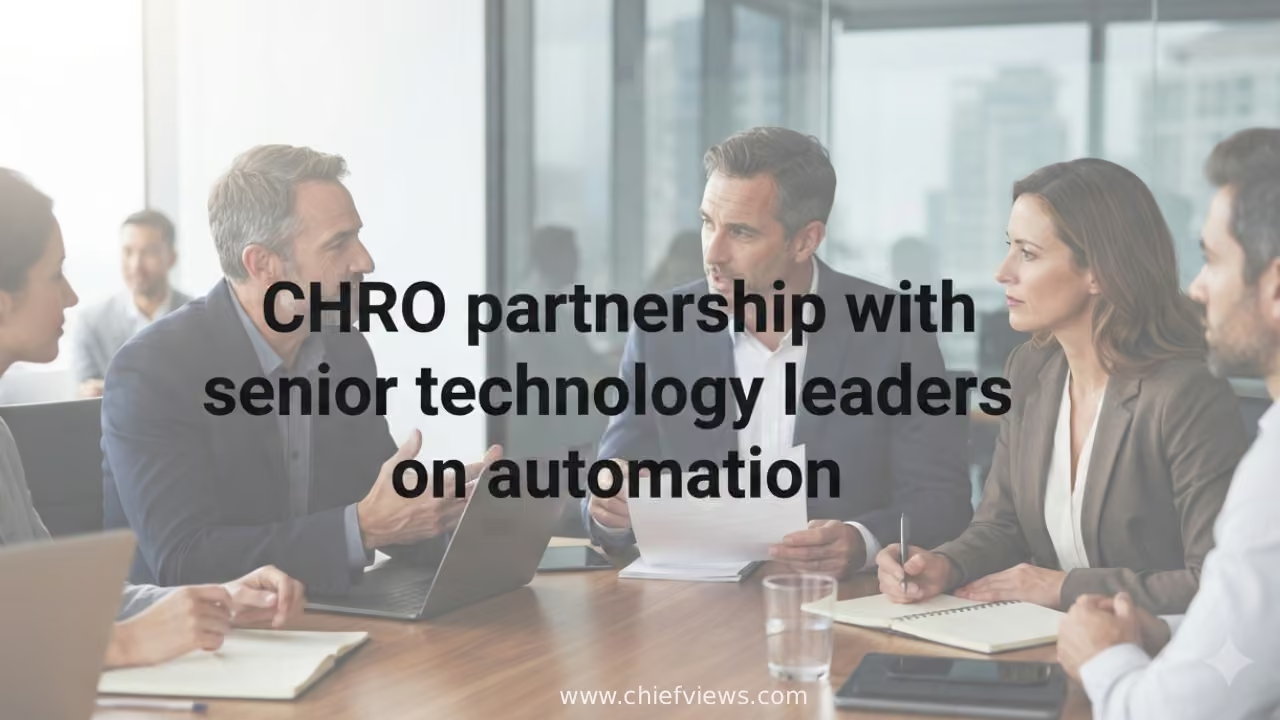
CHRO partnership with senior technology leaders on automation isn’t a nice-to-have anymore — it’s the thing separating companies that deploy AI well from companies that just talk about it. Here’s the blunt truth: HR can’t automate its way into relevance alone, and IT can’t roll out agentic AI without understanding the human fallout. They need each other, badly.
Quick overview:
- What it is: A structured, ongoing collaboration between the CHRO and leaders like the CTO/CIO to decide what gets automated, what stays human, and how the workforce adapts.
- Why it matters now: Agentic AI is landing on org charts faster than most companies can govern it.
- The core tension: Tech leaders push capability; HR leaders protect culture, trust, and legal exposure.
- The payoff: Smoother rollouts, less employee backlash, measurable productivity gains, and fewer compliance headaches.
- The risk of skipping it: Tool sprawl, shadow AI use, and a workforce that quietly disengages.
What a CHRO Partnership With Senior Technology Leaders on Automation Actually Looks Like
Forget the fuzzy “cross-functional synergy” language for a second. In practice, this partnership means the CHRO and CTO (or CIO) sit in the same room — often weekly — and jointly answer one question: can, should, or shouldn’t we automate this?
That framing isn’t mine. Pearson’s CHRO Ali Bebo and CTO Dave Treat describe it exactly that way, and it’s become something of a north star for how operators are thinking about automation decisions in 2026.
Short version: tech leaders know what’s technically possible. HR leaders know what’s organizationally survivable. Neither call works without the other.
I’ve seen plenty of companies skip this step. They hand automation projects entirely to IT, and six months later HR is cleaning up morale problems nobody saw coming. That’s backwards, and it’s expensive.
The CHRO-Tech Leader Automation Partnership Isn’t Just About HR Tools
Here’s where people get it wrong. They assume this partnership only covers HR software — applicant tracking, onboarding bots, that kind of thing. Wrong frame entirely.
The real work is enterprise-wide: deciding which jobs get redesigned, which tasks shift to AI agents, and how the company retrains people fast enough to keep up. Intuit’s CTO Alex Balazs reportedly spends roughly a third of his time working directly with the people team on exactly this kind of workforce-skills planning.
That’s not a courtesy meeting. That’s operational reality.
Why This Partnership Matters More in 2026 Than Ever
Agentic AI moved fast this year. Agents are handling customer service tickets, scheduling, recruiting logistics — real headcount-equivalent work. One firm cited in recent reporting now has AI agents resolving 63% of certain customer cases.
That pace creates a governance vacuum. Somebody has to own the “who’s accountable when the agent gets it wrong” question. Spoiler: it’s usually HR and IT fighting over who holds the bag.
Why Many CHRO-CIO Automation Efforts Still Stall
Here’s the uncomfortable number. Gartner’s 2026 research found that only 38% of CHROs and CIOs share a common understanding of how AI will actually affect the future of work.
Let that sink in. Most of the C-suite pairs responsible for this transition aren’t even speaking the same language about it yet.
That gap is the real obstacle — not the technology. The tech almost always works fine in a demo. It’s the alignment that breaks.
Step-by-Step Action Plan: Building This Partnership From Scratch
If you’re starting cold, here’s the sequence I’d follow. No theory, just the order that actually works.
- Get the CHRO and CTO/CIO on a recurring calendar invite. Not quarterly. Monthly at minimum, weekly during active rollouts.
- Build a shared “can, should, shouldn’t” automation checklist. Technical feasibility, business case, human impact — all three, every time.
- Map which roles touch “high human-connection” tasks. Protect those explicitly. Pearson draws a hard line around final hiring decisions never going to AI.
- Pilot in one function first. Customer service, scheduling, or recruiting ops are low-risk starting points.
- Set a retraining budget before the rollout, not after. West Monroe’s CPO redesigned its entire hire-to-retire process around this principle, working closely with its CIO.
- Measure displacement and redeployment, not just efficiency. Track where saved hours actually go.
- Report jointly to the board or exec team. One voice, one narrative, no finger-pointing later.
Simple plan. Hard to execute consistently. Most companies fall off around step 5 because retraining budgets get cut first when finance gets nervous.

CHRO Partnership With Senior Technology Leaders on Automation: Roles Compared
| Dimension | CHRO’s Primary Focus | CTO/CIO’s Primary Focus |
|---|---|---|
| Decision ownership | Workforce impact, culture, retraining | Technical feasibility, security, integration |
| Risk they watch for | Attrition, bias, legal exposure, trust erosion | System reliability, data quality, scalability |
| Success metric | Engagement, retention, skills coverage | Deployment speed, uptime, automation rate |
| Typical blind spot | Underestimating technical timelines | Underestimating change-management friction |
| Where they must agree | Which tasks get automated, and what “success” means for the business |
That last row is the whole game. Everything else is detail.
Common Mistakes & How to Fix Them
Mistake 1: Treating automation as an IT project with an HR “FYI” tacked on. Fix it by making the CHRO a co-owner of the rollout from day one, not a stakeholder who gets briefed after decisions are locked.
Mistake 2: Automating tasks before defining what stays human. Fix it by writing the “shouldn’t automate” list before the “could automate” list. Decide the boundaries first.
Mistake 3: No shared vocabulary between HR and tech leadership. Fix it with a plain-language glossary — what does “agentic AI” mean to your company specifically? Get everyone using the same definitions.
Mistake 4: Skipping the retraining budget. Fix it by locking that budget into the project cost from the start, same as you would infrastructure spend.
Mistake 5: Measuring only efficiency, never trust. Fix it with regular pulse surveys during rollout. Gallup’s workforce research shows AI adoption among frontline employees has plateaued, even as leadership usage climbs — that gap is a trust signal, not a technology problem.
Here’s the thing — most of these mistakes aren’t technical failures. They’re communication failures wearing a technology costume.
Key Takeaways
- A CHRO partnership with senior technology leaders on automation decides what gets automated and what stays human — together, not separately.
- The biggest barrier isn’t the AI itself; it’s alignment, and most CHRO-CIO pairs aren’t there yet, per Gartner’s 2026 findings.
- Automation decisions should run through a simple “can, should, shouldn’t” filter every single time.
- Retraining budgets belong in the project plan from day one, not as an afterthought.
- Protect tasks that require genuine human connection — don’t automate for automation’s sake.
- Track trust and adoption metrics alongside efficiency metrics; a quiet workforce is a warning sign, not a success story.
- Companies doing this well — Pearson, Intuit, West Monroe among them — treat it as an operating rhythm, not a one-time project.
The Bottom Line
CHRO Partnership With Senior Technology Leaders on Automation Think of this partnership like a tandem bike. One person steers, one person pedals hardest on the hills — but if either stops moving in sync, you both end up in the ditch. Automation without HR steering ends in backlash. HR strategy without tech horsepower ends in irrelevance.
What would I do if I were starting this from zero tomorrow? I’d skip the big strategy deck. I’d get the CHRO and CTO in a room, pick one painful manual process, and jointly decide — out loud, together — whether it should be automated. Small win, shared ownership, repeatable rhythm. That’s how trust between these two offices actually gets built.
The companies pulling ahead in 2026 aren’t the ones with the flashiest AI tools. They’re the ones where HR and tech leadership stopped operating in separate lanes.
FAQs
Does a CHRO partnership with senior technology leaders on automation require a formal governance structure?
Not necessarily a heavy committee, but you do need a recurring, documented decision process. Informal hallway conversations don’t scale once agentic AI touches multiple departments.
Who should initiate the CHRO-tech leadership partnership on automation — HR or IT?
Either side can start it, but it works best when the CEO explicitly frames it as a joint mandate. Without that top-down signal, the partnership tends to drift back into separate silos.
How do smaller companies apply a CHRO partnership with senior technology leaders on automation without a huge budget?
Start with one shared meeting cadence and one pilot process. You don’t need enterprise AI platforms to build the habit of joint decision-making — that part is free.

