








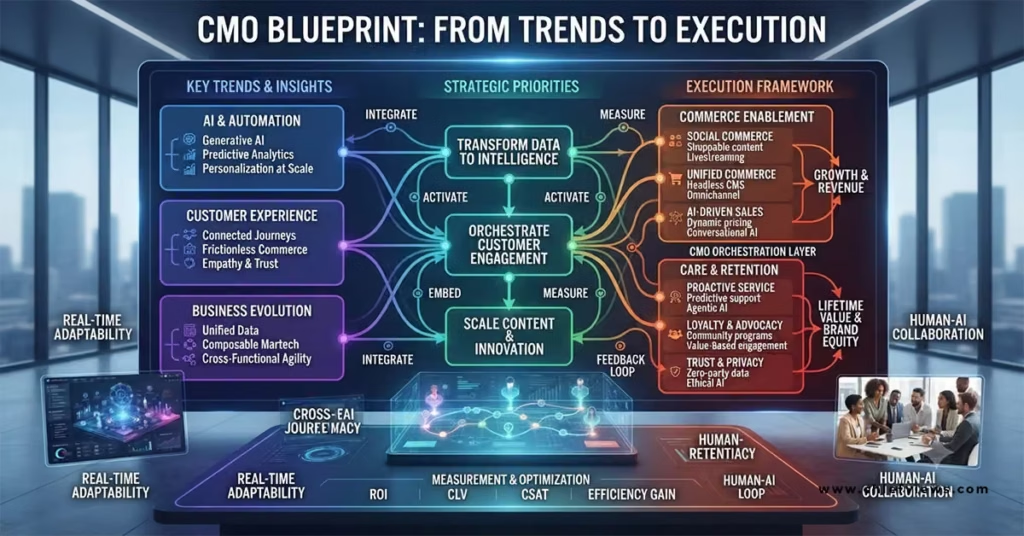
CMO blueprint for executing trends to commerce and care isn’t some shiny buzzword cooked up by a consulting deck. It’s the operating model marketing leaders are quietly rebuilding right now, because the old playbook — brand team here, commerce team there, customer service somewhere in a basement call center — just doesn’t survive contact with 2026 budgets, AI noise, and customers who expect every touchpoint to feel like one conversation.
Here’s the quick-hit version before we go deep:
- What it is: A unified operating framework that fuses marketing, commerce, and customer care into one accountable system instead of three competing departments.
- Why it matters now: Marketing budgets sit at roughly 7.8% of company revenue in 2026, barely up from 7.7% in 2025, per Gartner’s CMO Spend Survey — there’s no fat left to fund silos.
- The core shift: AI stops being a shiny tool and becomes infrastructure, embedded in workflows across content, shopping, and support.
- The payoff: Faster response to trends, higher team capacity, and measurable revenue tied directly to customer experience.
Let’s break down how it actually works.
What the CMO Blueprint for Executing Trends to Commerce and Care Actually Means
Think of the traditional marketing org like three separate restaurants sharing one kitchen but refusing to talk to each other. The hostess (marketing) seats the guest. The waiter (commerce) takes the order. The chef (care) has no idea what was promised. Everyone’s busy. Nobody’s coordinated.
The CMO blueprint for executing trends to commerce and care tears down that wall. It treats brand storytelling, the actual buying moment, and post-purchase support as one continuous loop — not three handoffs where context gets lost every time.
In practice, that means:

- Social content and product discovery live in the same workflow, not separate calendars.
- Customer service data feeds back into campaign targeting instead of sitting in a ticketing system nobody in marketing ever opens.
- One shared dashboard, one shared definition of “success.”
Sounds obvious. It almost never happens by accident.
Why 2026 Forces This Convergence
Here’s the thing — this isn’t optional anymore. Budgets are flat. AI spend is eating a bigger slice of what’s left. Gartner’s 2026 CMO Spend Survey found CMOs are now allocating about 15.3% of their marketing budget to AI initiatives, yet only 30% feel ready to actually scale that investment. That gap between ambition and operational readiness is exactly where silos get exposed and punished.
At the same time, commerce media — ads and shopping experiences built directly into retail and social platforms — is becoming a structural advantage for brands that can connect purchase data to media decisions in near real time, according to Mastercard’s analysis of the CMO-CFO relationship in 2026. Translation: the brands winning aren’t the ones with the biggest campaign budget. They’re the ones whose marketing, commerce, and care teams actually share a nervous system.
The Silo Tax Problem
There’s a hidden cost industry folks now call the “silo tax” — every dollar lost because your commerce team doesn’t know what your social team promised, or your care team is fielding complaints about a sale your marketing team already ended. It’s death by a thousand small disconnects.
Fixing it isn’t about hiring more people. It’s about rewiring how decisions move between teams. That’s the entire point of a CMO blueprint for executing trends to commerce and care — it’s a decision-routing system, not a slogan.
Step-by-Step Action Plan for Beginners and Intermediate Teams
If you’re starting from scratch, don’t try to flip everything in one quarter. In my experience, teams that try a full org redesign on day one burn trust fast and stall out by month three.
- Audit your current handoffs. Map where marketing, commerce, and care actually exchange information today. Most teams are shocked how little they do.
- Pick one trend to pilot. Don’t blueprint your whole company at once. Choose a single live trend — a viral product moment, a seasonal spike, whatever — and run it through marketing, commerce, and care as one coordinated play.
- Embed AI where it removes friction, not where it looks impressive. Use it for tagging support tickets by intent, drafting response templates, or spotting demand spikes early — not just for generating content nobody asked for.
- Build one shared metric. Revenue-per-customer-journey beats vanity engagement numbers every time. Get marketing, commerce, and care agreeing on the same scoreboard.
- Create a weekly cross-team sync. Thirty minutes. No decks. Just “what’s trending, what’s breaking, what needs a response.”
- Scale what worked, kill what didn’t. Treat the pilot like a product launch — measure, adjust, expand.
What I’d do if I were walking into this cold: start with care data. Support tickets are basically free market research nobody’s reading. That’s usually the fastest trust-builder with skeptical teams.
Commerce vs. Care: Where Teams Collide (and How the Blueprint Fuses Them)
| Function | Old Siloed Model | Fused 2026 Model | Primary Success Metric |
|---|---|---|---|
| Marketing | Owns brand voice, ignores sales data | Co-owns trend response with commerce and care | Trend-to-revenue speed |
| Commerce | Reacts to trends after they’ve peaked | Plugs into real-time social and search signals | Conversion lift per campaign |
| Care | Treated as a cost center, isolated from strategy | Feeds sentiment and friction data upstream | Resolution time and repeat-purchase rate |
| AI Layer | Bolted on as a side tool | Embedded infrastructure across all three functions | Workflow hours saved |
Common Mistakes & How to Fix Them
Mistake: Treating AI as a magic fix instead of infrastructure. Fix: Assign AI to specific, boring, repeatable tasks first — ticket routing, trend-spotting, content tagging. Glamour comes later; reliability comes first.
Mistake: Running the blueprint as a marketing-only initiative. Fix: Get commerce and care leaders in the room from day one. If they hear about it after launch, they’ll quietly sabotage adoption — not maliciously, just through indifference.
Mistake: Chasing every trend instead of the right ones. Fix: Build a simple filter — does this trend touch a real product moment, a real complaint pattern, or a real seasonal demand curve? If not, skip it.
Mistake: Measuring activity instead of outcomes. Fix: Kill vanity metrics. Track revenue and resolution speed tied to specific trend responses, not impressions.
Mistake: Ignoring data privacy while connecting systems. Fix: Any time you’re merging customer data across marketing, commerce, and care, follow established consumer privacy guidance, including the FTC’s business resources on data handling and security practices. Skipping this step isn’t just risky — it’s the fastest way to torch customer trust you spent years building.
Measuring What Actually Matters
Forget department-by-department scorecards. A working CMO blueprint for executing trends to commerce and care lives or dies on shared metrics:
- Time from trend detection to live response.
- Revenue attributable to that response, not just reach.
- Customer care resolution time tied to campaign-driven spikes.
- Repeat purchase rate after a care interaction.
If your marketing, commerce, and care teams can’t look at the same dashboard and agree on what “winning” looks like this week, you haven’t actually fused anything. You’ve just renamed the silos.
Key Takeaways
- The CMO blueprint for executing trends to commerce and care fuses marketing, commerce, and support into one decision loop.
- Flat budgets — around 7.8% of revenue in 2026 — mean silos are now a direct tax on growth, not just an inefficiency.
- AI works best as embedded infrastructure, not a bolted-on gadget.
- Start small: pilot one trend across all three teams before attempting a full rollout.
- Shared metrics beat departmental vanity numbers every single time.
- Customer care data is an underused goldmine for trend detection.
- Data privacy compliance has to travel with every system integration, not get bolted on afterward.
- Weekly cross-functional syncs do more for alignment than another slide deck ever will.
Here’s the honest bottom line: trends move fast, budgets don’t move at all, and customers don’t care which department dropped the ball. A CMO blueprint for executing trends to commerce and care gives you one system instead of three competing ones — and in a flat-budget year, that’s not a nice-to-have. That’s survival. Start with one pilot trend this month, map the handoffs, and build from there.
FAQs
Does a CMO blueprint for executing trends to commerce and care require a full org restructure?
No. Most teams succeed by piloting the fused workflow on one trend or campaign first, proving the model, then expanding — a full restructure upfront usually causes more friction than it solves.
How is this different from a standard omnichannel marketing strategy?
Omnichannel focuses on consistent presence across channels. The CMO blueprint for executing trends to commerce and care goes further — it ties brand response, actual purchase mechanics, and post-sale support into one accountable loop, not just a consistent voice.
What’s the biggest risk in rolling out this blueprint without the right guardrails?
Data privacy missteps. Merging marketing, commerce, and care data without following established consumer protection guidance can expose you to compliance risk and erode customer trust fast.

