




Finance AI use cases for FP&A and close are where the rubber meets the road for most finance teams in 2026. The teams that treat them as workflow redesign instead of shiny tools are already closing faster, explaining variances with less scramble, and giving leadership cleaner numbers sooner.
Here’s the short version of what matters:
- AI handles the grind—transaction matching, first-draft commentary, anomaly flags, and baseline forecasts—so analysts start higher up the value chain.
- Month-end close shrinks when reconciliations, accruals, and flux analysis move from manual checklists to assisted or agentic workflows.
- FP&A gains the most from variance ranking, driver investigation, and rapid scenario refreshes tied to the same data the close uses.
- Human sign-off stays non-negotiable for journals, board numbers, and material judgments.
- The biggest wins come when close and FP&A share the same governed data layer and exception process.
These patterns show up repeatedly in the stronger AI transformation case studies for CFOs and CHROs. The difference between a pilot that dies and a process that sticks is almost always the same: clear ownership, measurable baselines, and a hard rule that nothing material posts without a named reviewer.
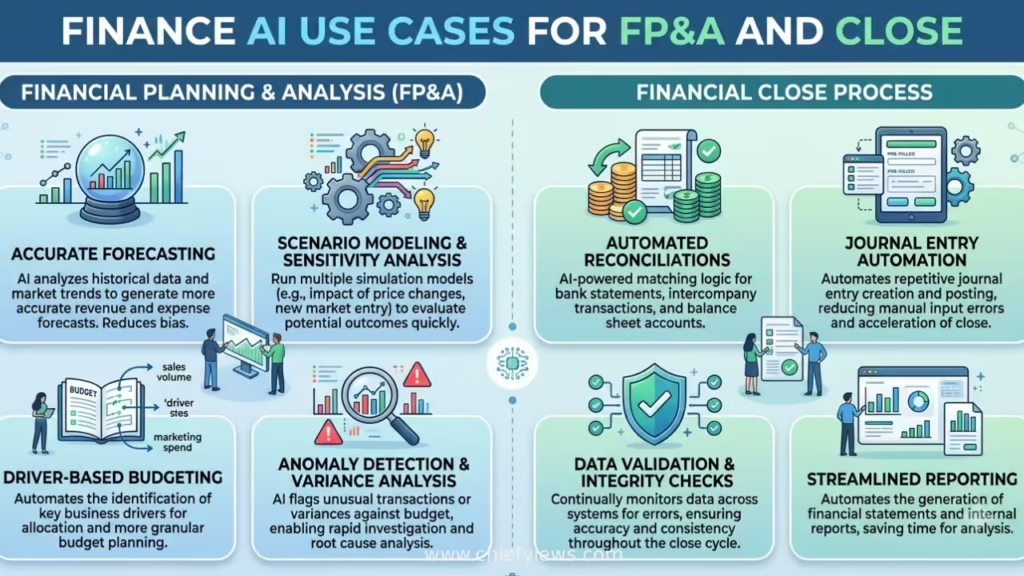
High-Impact Finance AI Use Cases for FP&A and Close
Start with the close. It is still the most time-boxed, audit-sensitive process in finance. AI does not own the close. It prepares it.
Reconciliations and matching are the clearest early win. Machine learning goes beyond exact matches. It pairs bank lines to ledger entries when amounts differ by fees, dates are off by a day or two, or references are typed inconsistently. Controllers review the proposed matches and clear true exceptions. Teams that run this continuously during the month instead of compressing everything into the final three days cut the end-of-period spike dramatically.
Accruals and missing-item detection follow the same logic. AI scans open purchase orders, recurring patterns, and historical timing to suggest accruals or flag items that look incomplete. A person still sets the amount and posts. The time saved is in the search and the first calculation, not the judgment.


Flux and variance analysis is where close and FP&A overlap. AI ranks movements by size or materiality, pulls the underlying transactions, and drafts a first explanation. The quality of that draft depends entirely on whether the model can see the ledger detail or only the summary line. Give it the transactions and it can spot a double-imported Concur file or a coding error. Give it only the summary and it invents a plausible but wrong story about “conference season.” Analysts then confirm, rewrite the business reason, and decide what it means for the forecast.
On the pure FP&A side, the strongest use cases sit in three places. First-pass forecast generation that uses drivers, pipeline stages, or historical conversion rates instead of a flat growth assumption. Scenario modeling that lets a leader ask “what if utilization drops two points” and get a refreshed view in minutes rather than days. And continuous variance monitoring that surfaces material items as soon as actuals land, not only at month-end.
Snowflake’s sales finance team cut a week-long monthly forecast and variance process down to a few hours by building governed skills that answer recurring questions against certified data sources. Adoption stuck because every answer traced back to a known source and the team kept ownership of the assumptions.
Finance AI use cases for FP&A and close A global consumer-goods example from McKinsey work showed a generative AI assistant reducing the time finance professionals spent delivering budget-variance insights by an estimated 30 percent. The tool handled the number crunching; the people handled the story and the recommendation.
What Actually Moves the Needle: A Practical Comparison
| Use Case | What AI Typically Does | What Stays Human | Typical Impact Observed | Risk If Poorly Governed |
|---|---|---|---|---|
| Bank & clearing reconciliations | Propose matches, explain unmatched items | Final sign-off, clearing true exceptions | Days reduced in close cycle | Incorrect matches posted |
| Accruals & missing items | Suggest amounts, flag gaps from POs/history | Amount, assumptions, posting | Fewer missed accruals, faster prep | Over- or under-accrual |
| Variance / flux analysis | Rank movements, draft first commentary from transactions | Confirm drivers, write business narrative, decide implications | 30%+ time reduction on commentary | Plausible but wrong explanations |
| Baseline forecasting | Generate driver-based first pass | Approve assumptions, override with judgment | Forecast cycle compressed from days to hours | Blind reliance on model |
| Scenario refresh | Recalculate multiple cases quickly | Choose which scenarios matter, interpret trade-offs | Faster response to leadership questions | Scenario theater without decision ownership |
Finance AI use cases for FP&A and close These outcomes appear across documented work from finance teams at companies ranging from high-growth software to multi-entity services firms. They are not guarantees. They require clean data definitions and a process owner who treats exceptions as training data.
Step-by-Step Action Plan for Finance Teams
- Map the current close and FP&A calendar in detail. List every task, owner, average duration, and recurring pain point. Identify the three highest-volume, lowest-judgment activities.
- Establish clean baselines before any tool discussion. Capture current close days, hours spent on variance packs, exception rates, and time from actuals available to first management commentary.
- Choose one process with clear transaction-level data. Bank reconciliation or a single high-volume variance package is ideal. Avoid starting with board-level narrative or complex intercompany.
- Define the human boundary in writing. AI proposes. A named person reviews, overrides if needed, and signs. Nothing material posts without that step. Log every override.
- Run a 60–90 day pilot with weekly metrics. Track time saved, accuracy of proposals, override rate, and user trust. Adjust the model or the process rules based on the overrides.
- Connect close and FP&A data early. The same ledger detail that powers better variance explanations also feeds faster reforecasts. Shared definitions prevent the classic “two versions of the truth” problem.
- Scale only after two clean cycles. Expand to adjacent accounts or the next variance package. Update job descriptions so analysts are measured on insight quality and decision support, not volume of manual prep.
What I’d do if I were running this next quarter: pick the single biggest time sink in the close that already has good transaction history, set a hard stop on expansion until the override rate drops below a pre-agreed threshold, and force a joint close/FP&A review of the first results.
Common Mistakes and How to Fix Them
Mistake: Letting AI draft commentary from summary lines only.
Fix: Require transaction-level access for any variance explanation tool. Summary-only drafts invent stories.
Mistake: Measuring only speed and ignoring override rates or audit trail quality.
Fix: Make exception rate, override volume, and completeness of supporting evidence first-class metrics from day one.
Mistake: Treating close automation and FP&A tools as separate projects.
Fix: Share the data layer and the exception process. The close feeds the forecast; the forecast informs what the close should watch.
Mistake: Rolling out without rewriting roles.
Fix: Update performance expectations so the team is rewarded for judgment and speed of insight, not for hours spent in the old checklist.
Mistake: Expanding before the first use case is stable.
Fix: Demand two consecutive months of clean metrics before adding the next process. Most failed programs skip this discipline.
Key Takeaways
- Finance AI use cases for FP&A and close deliver the fastest measurable returns when focused on preparation work—matching, first-draft commentary, anomaly detection, and baseline forecasts.
- Human ownership of journals, material amounts, and final narrative remains non-negotiable.
- Transaction-level data access separates useful variance explanations from plausible fiction.
- Continuous processing during the month beats end-of-period heroics.
- Close and FP&A gain more when they share governed data and exception handling.
- Override rates and audit evidence quality are better success metrics than raw time saved.
- The pattern in successful deployments matches what appears in broader AI transformation case studies for CFOs and CHROs: start narrow, measure hard, redesign the workflow, then scale.
Finance AI use cases for FP&A and close The finance teams pulling ahead in 2026 are not the ones with the most AI pilots. They are the ones that turned specific, high-volume steps in the close and the variance process into reliable, governed systems. Pick one process this quarter, set the baseline, and force the measurement. The rest of the roadmap becomes obvious once the first results are real.
FAQs
Which finance AI use cases for FP&A and close should a mid-market team tackle first?
Bank or clearing reconciliations and a single high-volume variance package. Both have clear transaction data, measurable baselines, and limited judgment required in the first pass.
How do finance AI use cases for FP&A and close fit into broader AI transformation case studies for CFOs and CHROs?
They are usually the highest-ROI starting points inside finance. The same principles—tight scope, human oversight, process redesign, and shared metrics—appear across the stronger cross-functional case studies.
What is the biggest risk when implementing finance AI use cases for FP&A and close?
Treating the technology as a bolt-on instead of redesigning the workflow and the roles around it. Speed without control creates new audit and decision risk.