







Hybrid workforce strategy for CXOs starts with one hard truth: flexibility is no longer a perk. It is the operating system that decides whether you keep top talent or watch it walk.
Here’s the quick snapshot CXOs need:
- Hybrid is the dominant model for remote-capable U.S. workers, with roughly half of them splitting time between office and home.
- Employees consistently prefer it over full office or full remote, and the preference gap is wide.
- Outcome-based management, purposeful in-person days, and manager capability decide whether the model delivers or creates quiet friction.
- AI is now part of the equation—teams that treat humans and digital tools as one system pull ahead.
- Rigid return-to-office mandates still backfire on retention more often than they fix collaboration.
Get this right and you build resilience, speed, and loyalty. Get it wrong and you bleed high performers while the competition runs leaner.
Most executives I work with still treat hybrid as a scheduling problem. It’s not. It’s a leadership and operating-model problem. The companies winning in 2026 design the work first, then decide where people need to be.
Why Hybrid Workforce Strategy for CXOs Matters More in 2026
Gallup’s latest readings show hybrid remains the majority arrangement among remote-capable employees, hovering around 52 percent. Fully remote sits near 26 percent and full on-site around 22 percent. Those numbers have barely budged for years despite loud return-to-office campaigns. Preference data is even clearer: most remote-capable workers still choose hybrid when asked.
The talent market noticed. CHROs report hybrid as one of the strongest levers for retention, and many candidates now rank flexibility ahead of pure compensation. Add AI agents into daily workflows and the stakes rise again. Organizations that integrate people and digital tools without clear governance create confusion. Those that treat them as one workforce gain leverage.


Proximity bias still lurks. Managers who grew up measuring presence often undervalue remote contributors. That habit quietly tanks engagement and promotion equity. Engagement overall has softened in 2026, with sharper drops among hybrid and remote teams that lack clear expectations and manager support when AI enters the picture.
The kicker? Hybrid done well does not lower performance. Studies and internal company data keep showing comparable or better output when leaders measure results instead of desk time. The difference is intentional design.
Core Pillars of a Working Hybrid Model
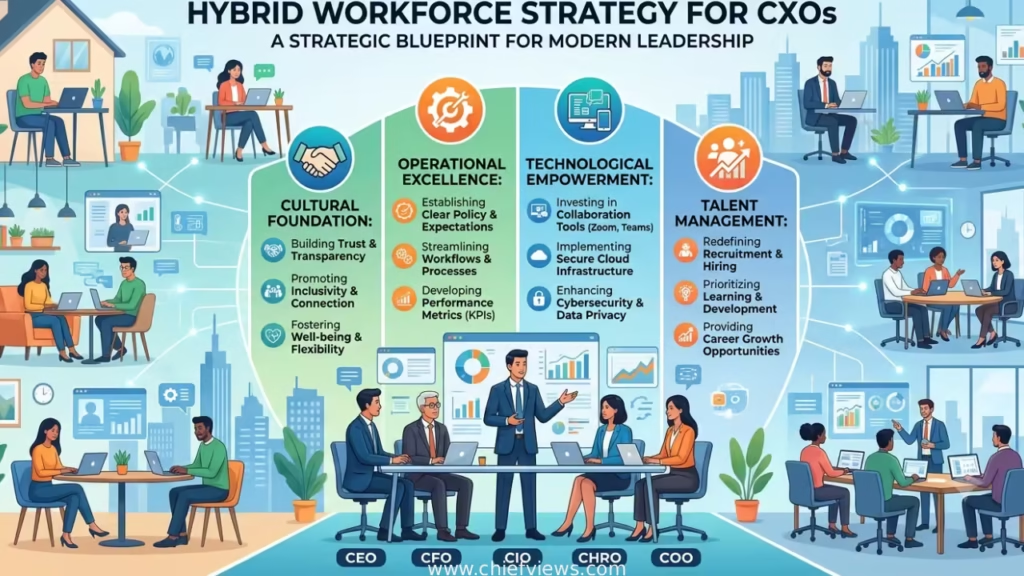
Hybrid workforce strategy for CXOs Successful hybrid workforce strategy for CXOs rests on three practical pillars.
Purposeful presence. Office days exist for specific reasons: onboarding, complex problem-solving, relationship building, or high-stakes decisions. Random “core days” without purpose breed resentment. Teams that define the “why” for in-person time see higher attendance and better energy.
Outcome ownership. Shift every performance conversation from activity to impact. What moved the needle? What did the customer or internal stakeholder experience? Managers who master this stop needing surveillance tools.
Manager capability. Most managers never learned how to lead people they cannot see. Train them on inclusive meetings, async decision-making, spotting burnout early, and equal access to stretch work. Without this investment the model collapses under uneven treatment.
Think of hybrid like a well-designed relay race. The baton (work) must pass cleanly between people, locations, and now AI agents. Drop the handoff and the whole team loses time.
Step-by-Step Action Plan for CXOs Building Hybrid Workforce Strategy
Start here if you are formalizing or fixing your approach.
- Audit the actual work. Map the top 15–20 high-volume or high-value activities in each function. Separate pure judgment work, collaborative work, and routine execution. This shows where location flexibility is real and where it is theater.
- Survey and co-create. Ask employees and managers what currently works and what creates friction. Then form a cross-functional group (include individual contributors) to draft the policy. Top-down rules feel arbitrary. Shared ownership sticks.
- Define the in-person trigger list. List the moments that truly benefit from physical presence. Everything else defaults to flexible. Review the list every six months.
- Reset performance systems. Replace time or presence metrics with clear deliverables, quality signals, and collaboration health. Train managers on the new language before you roll it out.
- Equip the environment. Standardize collaboration tech, security, and home-office support. Hybrid meeting rooms must treat remote participants as equal, not second-class. Fix audio and camera quality or stop pretending the meetings are inclusive.
- Pilot, measure, adjust. Run the new model with two or three teams for 90 days. Track retention signals, engagement, output quality, and manager confidence. Then scale what works.
- Add AI governance early. Decide which tasks agents own, where humans stay in the loop, and how handoffs are logged. Treat digital workers as part of the same operating system.
What I’d do if I were stepping into a new CXO role tomorrow: spend the first 30 days listening and mapping work before writing any policy. Speed without diagnosis just creates new problems.
Common Mistakes and How to Fix Them
Rigid, one-size-fits-all mandates remain the most common failure. Leaders announce “three days in office” without explaining the purpose. Attendance rises briefly. Trust and retention drop. Fix: replace mandates with clear triggers and team-level flexibility within guardrails.
Proximity bias is quieter but more damaging. Office regulars get more stretch assignments and informal coaching. Remote talent becomes invisible. Fix: run every meeting as if everyone is remote. Track promotion and opportunity data by work location. Make equity visible.
Manager neglect is widespread. Companies announce hybrid then leave middle managers to figure it out. Result: inconsistent experiences and rising frustration. Fix: invest in practical hybrid leadership training and give managers real authority to adapt schedules to their team’s work.
Hybrid workforce strategy for CXOs Ignoring the tech and space mismatch creates daily friction. Poor hybrid rooms, siloed tools, and uneven home setups slow everyone down. Fix: audit the collaboration stack and physical spaces against actual usage patterns, not square footage averages.
Finally, measuring the wrong things. Hours logged and badge swipes tell you almost nothing about value created. Move to outcome dashboards or you will keep managing ghosts.
Comparison of Hybrid Models CXOs Actually Use
| Model | Typical Office Cadence | Best Fit | Main Risk | CXO Focus |
|---|---|---|---|---|
| Core Days | 2–3 fixed days | Collaborative teams with regular sync needs | Scheduling conflicts | Purpose of those days |
| Flexible with Minimums | Employee choice + floor | Knowledge work, trust culture | Uneven presence | Equity of opportunity |
| Project-Based | Varies by phase | Creative, consulting, product | Inconsistent norms | Clear phase triggers |
| Role-Adaptive | Custom by function | Complex orgs with mixed work types | Policy complexity | Governance simplicity |
Pick the model that matches the work, not the one that looks neat on a slide.
Hybrid Workforce Strategy for CXOs: Leadership Behaviors That Scale
Hybrid workforce strategy for CXOs Leaders set the tone by modeling the behavior they want. If the C-suite never works from home or always works from home, the policy loses credibility. Show up for the purposeful days. Protect deep-work time. Make decisions transparent.
Communication has to travel in multiple formats—live, async, written, video. One channel is never enough across locations. Document decisions so remote teammates are not left reconstructing hallway conversations.
Watch for engagement dips, especially when AI tools roll out. Clarity of expectations has fallen in recent data. Managers who explain the “why” behind both human and agent work keep teams oriented.
Culture is the hardest part. Rituals, recognition, and informal connection need deliberate design. Left to chance they favor the people already in the building.
Key Takeaways
- Hybrid is the stable majority model for remote-capable U.S. workers and the clear employee preference.
- Strategy beats policy: design the work and the handoffs first.
- Purposeful presence, outcome metrics, and trained managers form the practical core.
- Proximity bias and rigid mandates still destroy trust and retention.
- Treat AI agents as part of the same workforce with clear ownership and governance.
- Pilot, measure real outcomes, and adjust—do not set and forget.
- CXO modeling and transparent communication determine whether the model feels fair.
- Equity of opportunity must be tracked, not assumed.
Hybrid workforce strategy for CXOs is no longer about choosing between office and home. It is about building an operating system that gets the right work done with the right people and tools, regardless of location. The organizations that treat it as infrastructure rather than a temporary accommodation will attract stronger talent and move faster.
Start with the work map and the listening tour. Everything else follows from there.
FAQs
What should a hybrid workforce strategy for CXOs prioritize first?
Map the actual work and define which activities truly need physical presence. Everything else becomes negotiable. Without that clarity, policies feel arbitrary and lose support fast.
How does hybrid workforce strategy for CXOs change with AI agents?
It expands from people-and-locations to people-agents-and-locations. Decompose tasks, set clear ownership, define handoffs, and measure the combined system against business outcomes rather than headcount alone.
Can smaller companies execute hybrid workforce strategy for CXOs effectively?
Yes. The same principles scale down: purposeful days, outcome focus, and manager skill. Smaller teams often move faster because communication lines are shorter and co-creation is easier.

