





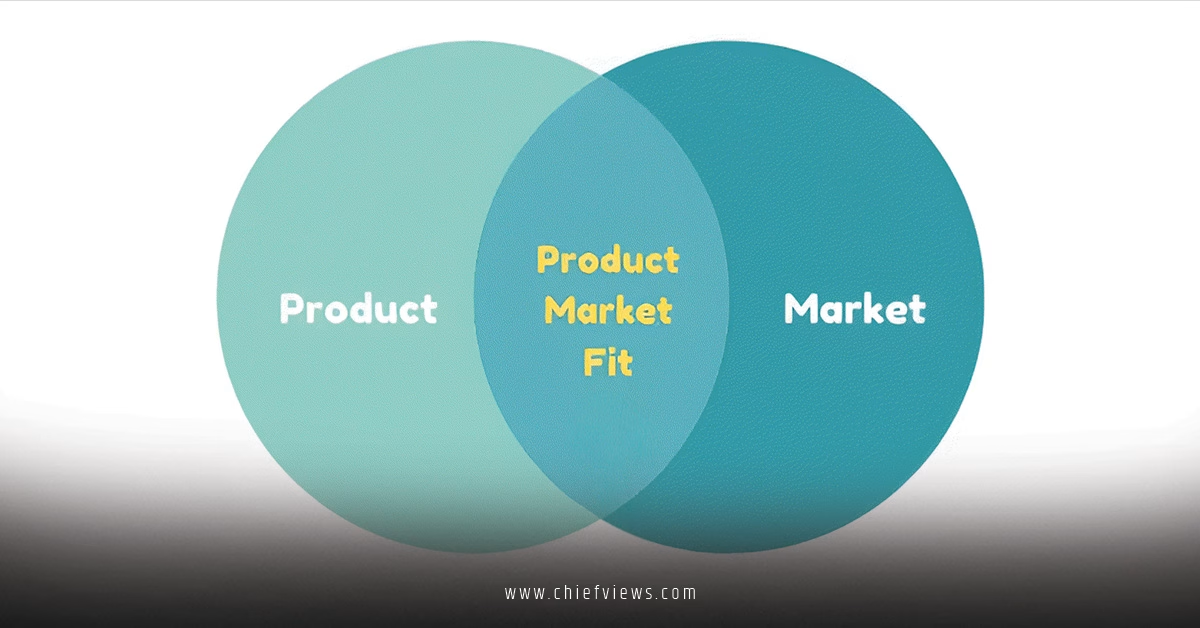
How to validate product-market fit is the single step that separates brands that stall after launch from those that keep growing. Too many UK founders pour time and money into building, marketing and stocking a product only to discover that customers are not buying it in the numbers needed. Validating early saves you from that expensive mistake and gives you clear evidence that people actually want what you are offering.
In this article, we’re going to be taking a look at How to validate product-market fit, and how you can test your idea properly before committing serious resources. If you would like to find out more, feel free to read on.
Pic – CC0 License
Talk to Real Customers First
Start by speaking directly to the people you believe will buy. Aim for at least 20 to 30 honest conversations. Ask open questions about their current problems, what they already use, what frustrates them, and what a better solution would look like. Listen more than you talk.
These conversations often reveal that the problem is slightly different from the one you assumed, or that the willingness to pay is lower than you hoped. Record the answers, look for patterns, and adjust your idea accordingly. This qualitative feedback is the foundation of solid validation.



Build a Simple Test Version
How to validate product-market fit You do not need a finished product to check demand. Create a basic version that shows the core value. This could be a landing page that describes the offer and collects email sign-ups, a simple prototype, or a small batch of handmade or digitally delivered product.
Drive a modest amount of traffic to it through targeted ads, social posts or your existing network. Measure how many people take the next step—signing up, requesting a demo, or placing a pre-order. Strong interest at this stage is an early signal that you are on the right track.
Watch the Numbers That Matter
Once people start using even a basic version, track behaviour rather than just compliments. Look at activation rates, how often they return, and whether they would recommend it. A useful rule of thumb used by many successful teams is that at least 40 percent of users should say they would be “very disappointed” if the product disappeared.
Keep an eye on conversion from interest to payment and on early retention. These metrics give you objective evidence instead of relying on polite feedback. Tools for simple analytics and surveys make this straightforward even for small teams.
Test Willingness to Pay
How to validate product-market fit Interest is not the same as buying. The clearest validation comes when people hand over money. Offer pre-orders, run a small paid pilot, or charge for a limited early version. Even a low price point tells you more than free sign-ups.
In the UK this also helps you understand real pricing sensitivity and whether your margins will work once you factor in VAT, shipping and other costs. If people hesitate to pay, dig into why. It may mean the value is not clear enough yet, or that the problem is not painful enough.

Iterate Quickly on What You Learn
How to validate product-market fit Validation is rarely a one-time event. Use every round of feedback and data to improve the offer. Change the messaging, adjust the features, refine the target customer, or pivot the whole approach if the evidence points that way.
The founders who later Took brands from launch to $100M+ almost always treated early validation as an ongoing process rather than a single checkpoint. They kept testing and refining until the demand was clear and repeatable. That discipline is what allowed them to scale with confidence instead of guessing.
Avoid Common Traps
Do not rely only on friends and family. Their opinions are usually too kind. Do not fall in love with your solution before confirming the problem is real. And do not scale marketing or inventory until the core metrics show consistent demand.
It is also easy to collect lots of data and still ignore what it is telling you. Set clear success criteria in advance so you know when the evidence is strong enough to move forward.
Put It All Together
How to validate product-market fit A practical sequence looks like this: hold customer interviews, build a minimal test, measure interest and behaviour, ask for money, then improve based on the results. Repeat until the signals are consistent. This approach works whether you are launching a physical product, a software tool or a service.
Many resources from established organisations can support the process. The Lean Startup methodology offers practical frameworks for testing assumptions quickly. Guidance from GOV.UK on starting and growing a business covers practical UK considerations such as research and early trading. For deeper reading on customer discovery, Harvard Business Review regularly publishes useful articles on product validation and market testing.
How to validate product-market fit We hope that you have found this article enlightening in some way and that these steps give you a clear, low-risk way to confirm demand before you invest heavily. Validating product-market fit early is one of the smartest moves you can make. It turns uncertainty into evidence and puts you on a firmer path toward real growth.