








AI-driven workforce redesign starts with treating every role as a living system of tasks, decisions, and human judgment rather than a fixed job description. In 2026, companies that simply bolt AI onto old processes leave value on the table. The ones pulling ahead break work apart, decide what stays human, what agents own, and how the two hand off—then rebuild the roles around that reality.
Here’s the snapshot that matters:
- AI-driven workforce redesign means re-architecting tasks, decision rights, skills, and career paths so people and agents create more value together than either could alone.
- Most organizations still spend the bulk of AI budgets on technology while under-investing in the people and process redesign that actually unlocks returns.
- The payoff shows up as higher productivity, clearer accountability, and stronger retention of high-judgment talent—when done right.
- Skip the redesign and you get automation without amplification, plus the hidden costs of skill erosion and later rehiring.
- CHROs who treat this as core strategy, not an HR side project, turn AI capacity into growth instead of just cost savings.
Picture an orchestra that keeps adding new instruments without rewriting the score. The noise gets louder. The music stays the same. AI-driven workforce redesign is rewriting the score so every player—human or digital—knows exactly when to lead, when to support, and when to sit out.
Why AI-Driven Workforce Redesign Beats Simple Automation
Plenty of firms still chase headcount reduction as the primary AI metric. That approach is incomplete. Gartner research points to a real risk: by 2029, up to 30 percent of employees displaced by AI may need to be rehired—often at higher cost—because institutional knowledge and critical judgment walked out the door. Pure cuts create budget; redesign creates value.
IBM’s 2026 CHRO study found that organizations which clearly define workflows as human-led, AI-assisted, or AI-executed report measurable improvements in risk reduction and quality. Those same organizations treat redesign as the engine that converts AI capacity into growth. McKinsey’s work on “reinventors” shows the same pattern: companies that reimagine roles and operating models around AI capture far more enterprise value than those stuck in the enablement or automation stages.
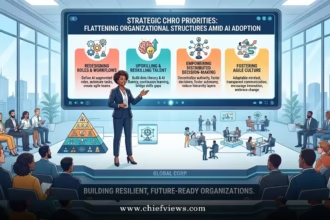
The connection to structure is direct. Effective AI-driven workforce redesign often surfaces the same pressure points addressed in CHRO priorities for flattening structures amid AI adoption—wider spans, fewer coordination layers, and managers who must oversee both people and agents. You cannot flatten intelligently without redesigning the work that sits underneath.


The Building Blocks of Effective AI-Driven Workforce Redesign
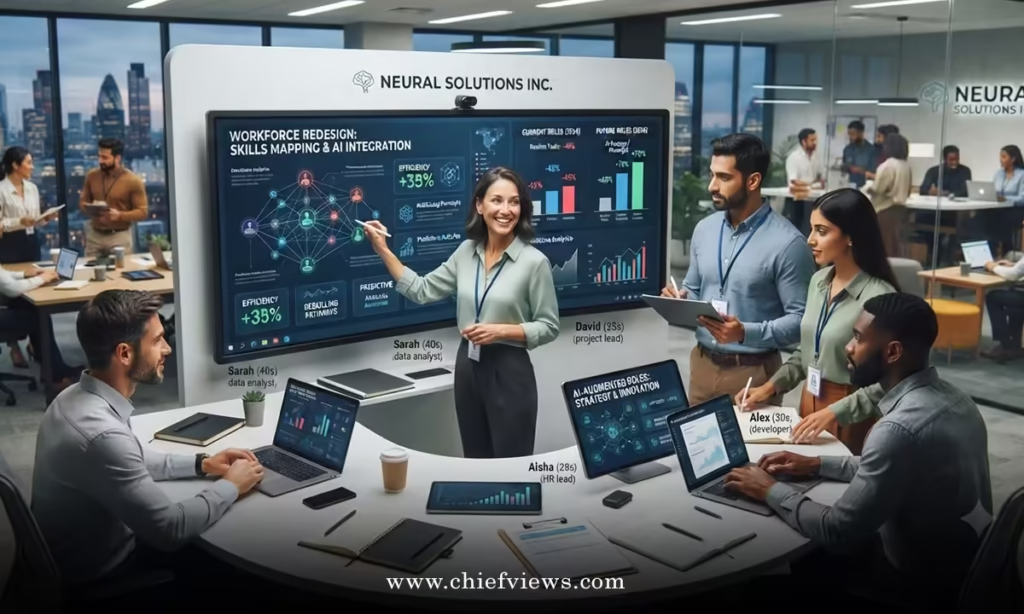
Start with the work, not the org chart. Map high-value workflows end to end. Break them into discrete tasks and decision points. Then assign ownership: pure AI, pure human, or hybrid loop with clear escalation rules.
Next, rebuild roles around the residual human contribution. PwC’s 2026 AI Jobs Barometer shows that the most AI-exposed jobs are adding tasks that rely on judgment, empathy, and creativity more than twice as fast as less-exposed roles. Entry-level jobs in highly exposed fields increasingly demand traditionally senior skills. That forces a redesign of early-career pathways, mentorship, and what “junior” even means.
Skills architecture becomes the connective tissue. Static job descriptions age out fast. Skills graphs, internal marketplaces, and continuous capability building let talent flow to the work that creates the most value right now. Deloitte data underscores the gap: the large majority of AI investment still goes to technology infrastructure while only a small fraction targets work and people redesign—yet the organizations that reverse that ratio see stronger financial outcomes.
Finally, reset accountability and performance systems. Managers need explicit responsibility for agent oversight and exception handling. Pay and progression models must reward the new mix of outcomes, not just the old activity metrics.
Step-by-Step Action Plan for AI-Driven Workforce Redesign
- Pick one high-impact value stream. Customer onboarding, claims processing, or product development all work. Inventory every task and decision. Tag each as human, agent, or hybrid. Measure current cycle time, error rates, and handoff friction.
- Co-design the new workflow with the people who do the work. Involve frontline employees and managers early. Define the exact points where human judgment overrides or validates agent output. Document the decision rights in plain language.
- Rewrite the role profiles. Strip out tasks that agents now own. Elevate the remaining human work—problem framing, relationship management, ethical oversight, creative synthesis. Make success profiles explicit about hybrid collaboration skills.
- Build the supporting infrastructure. Deploy skills platforms that surface internal talent for the redesigned roles. Create short, role-specific learning paths focused on judgment under AI conditions. Protect coaching time for managers who now carry larger, more complex spans.
- Run a controlled pilot. Limit the change to one team or geography for 90 days. Track both efficiency and quality metrics, plus employee confidence in challenging AI outputs. Adjust the handoff rules before scaling.
- Embed joint governance. Give the CHRO and CIO shared ownership of the redesign roadmap. Require a regular operating cadence that reviews both technology performance and workforce outcomes. This closes the gap IBM identified where nearly half of organizations still leave the CHRO out of AI strategy.
Common Mistakes and How to Fix Them
The most frequent error is deploying tools first and redesigning later. You get faster old work instead of better new work. Fix: treat workflow redesign as a prerequisite for any major agent rollout.
Second mistake: focusing only on the roles that disappear. The bigger opportunity sits in the roles that stay and expand. Fix: quantify the capacity released and deliberately redirect it toward higher-value human contribution.
Third: under-investing in middle managers. They become the primary interface between people and agents. Without new skills and protected time, spans of control widen and coaching collapses. Fix: update manager success profiles and training before the spans expand.
Fourth: measuring only productivity. You miss the erosion of critical thinking and the quiet loss of institutional knowledge. Fix: add judgment quality, exception rates, and leadership bench strength to the dashboard.
Comparison of Redesign Approaches
| Approach | Primary Focus | Typical Outcome Without Supporting Changes | Required CHRO Levers | Stronger Outcome When Redesign Is Complete |
|---|---|---|---|---|
| Task automation only | Speed and cost | Modest efficiency, high rework risk | Limited | N/A |
| Role compression + agents | Fewer layers, wider spans | Manager overload, skill gaps | Manager capability + coaching quotas | Faster decisions with maintained quality |
| Full AI-driven workforce redesign | Work + roles + skills + accountability | Initial disruption | Skills architecture, decision rights, talent mobility | Higher value capture, stronger retention of judgment talent |
Data patterns drawn from IBM, McKinsey, Deloitte, Gartner, and PwC research in 2026 show that the full redesign path consistently outperforms pure automation or compression alone.
AI-driven workforce redesign is not a one-time project. It is the ongoing discipline of matching human contribution to the work that agents cannot do well. When paired with the structural choices in CHRO priorities for flattening structures amid AI adoption, it produces organizations that move faster without becoming brittle.
Key Takeaways
- Redesign the work before you scale the agents; otherwise you automate inefficiency.
- Human judgment, problem framing, and creative synthesis become the scarce, high-value residual.
- Skills change twice as fast in AI-exposed roles—build continuous capability systems, not one-off training.
- Managers need new success profiles that include agent oversight and protected coaching time.
- Joint CHRO-CIO ownership of the redesign roadmap closes the strategy gap still present in nearly half of organizations.
- Track judgment quality and bench strength alongside productivity metrics.
- Redirect capacity released by AI toward higher-value human work rather than pure headcount reduction.
- Early-career pathways must be reinvented because junior roles now demand senior-level skills sooner.
The companies that treat AI-driven workforce redesign as strategy rather than cleanup will convert technology investment into durable advantage. Start with one value stream this quarter, co-design the hybrid workflow with the people who live it, and measure both the efficiency gain and the quality of the human decisions that remain. That single move builds the muscle the rest of the organization will need.
FAQs
How does AI-driven workforce redesign differ from traditional job redesign?
Traditional redesign optimized for human-only work. AI-driven versions explicitly allocate tasks between people and agents, define override rights, and rebuild careers around the judgment that remains uniquely human.
Where should a CHRO begin with AI-driven workforce redesign?
Pick one high-visibility workflow, map every task and decision point, then pilot the new human-agent split with clear metrics for both speed and decision quality. Scale only after the handoff rules prove reliable.
How does AI-driven workforce redesign connect to CHRO priorities for flattening structures amid AI adoption?
Flattening removes coordination layers that AI can absorb. Redesign ensures the remaining roles and managers can actually handle the wider spans and hybrid oversight without losing quality or talent.
