








How COO can optimize operations with agentic AI systems starts with treating these tools as digital teammates that plan, decide, and execute multi-step work—not as smarter chatbots. Agentic systems close the gap between insight and action. They handle routine handoffs, escalate exceptions, and keep processes moving while humans focus on judgment calls.
Here’s the quick view:
- Agentic AI systems autonomously manage end-to-end workflows such as demand adjustments, procurement routing, and exception triage.
- COOs unlock the biggest gains by redesigning high-friction domains first rather than scattering pilots.
- Success hinges on clear ownership, bounded autonomy, and treating agents as part of the operating model.
- Leading deployments improve logistics efficiency, inventory turns, and service levels when governance and change management stay tight.
- The COO becomes the natural orchestrator who aligns humans, agents, data, and processes across the enterprise.
In my experience, the COOs who win treat this as an operating-model redesign, not a technology install. What usually happens is teams bolt agents onto existing broken processes and then wonder why value stays stuck in pilot mode.
What Agentic AI Actually Changes for Operations Leaders
Traditional automation follows rigid rules. Generative AI drafts and summarizes. Agentic AI systems take the next leap: they reason through sequences, call tools across systems, adapt when conditions shift, and loop humans in only when needed.
Picture a shift handover on a production floor. An agent can pull prior-shift metrics, flag open issues, draft a remediation plan, and queue the incoming supervisor’s review—all before the first cup of coffee. McKinsey has documented similar patterns in manufacturing and procurement where agents surface quick savings and free people for higher-stakes work.
The kicker is modularity. You do not need a multi-year platform overhaul. Start with one domain, componentize the agent logic, then reuse those building blocks elsewhere. That factory mindset is what separates the teams still stuck in pilot purgatory from those shipping measurable results.


Where How COO Can Optimize Operations with Agentic AI Systems Delivers Fastest Impact
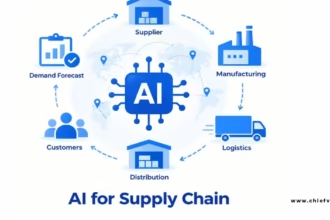
Target domains with high transaction volume and frequent handoffs. Production optimization, invoice reconciliation, inbound scheduling, and demand-signal adjustments consistently show earlier returns because the feedback loops are short.
BCG notes that leading deployments have improved on-time in-full service by a few percentage points, logistics performance more substantially, and inventory metrics in the double digits when agents coordinate across inventory, procurement, and commercial teams. The value is rarely just headcount reduction. A procurement function that costs tens of millions can influence billions in external spend. Agents amplify that leverage.
What I’d do if I were the new COO: map the three processes that generate the most recurring escalations or stalled approvals. Those are your lighthouse candidates.
Step-by-Step Action Plan for Getting Started
Beginners overcomplicate this. Keep the sequence tight.
- Audit the friction. Walk the actual work. Where do approvals sit for days? Where does data get re-keyed between systems? Where do exceptions bounce between teams with no clear owner?
- Pick one lighthouse domain. Choose volume plus pain over novelty. Invoice processing or production yield improvement tends to show results faster than long-cycle domains.
- Name a single accountable owner. Not a committee. One person whose performance is tied to the KPI the agent is supposed to move.
- Define autonomy boundaries first. Decide what the agent can do alone, what requires human confirmation, and what it must never touch. Document those rules the same way you would for a new hire.
- Redesign the workflow, then insert the agent. Do not automate the current mess. Strip out unnecessary steps, clarify decision rights, then give the agent its lane.
- Measure weekly in the pilot. Track cycle time, exception rate, accuracy, and human override frequency. Adjust the guardrails before you scale.
- Scale only after the operating model works. Replicate the componentized agent logic into adjacent processes once the first domain is stable.
This sequence keeps risk contained and forces clarity on ownership—the two things that sink most early efforts.
Comparison of Approaches for How COO Can Optimize Operations with Agentic AI Systems
| Approach | Speed to Value | Risk Level | Scalability | Best For |
|---|---|---|---|---|
| Scattershot pilots across many domains | Slow | High (diluted ownership) | Poor | Avoid this |
| Single lighthouse domain with redesign | 8–12 months typical | Moderate and controllable | Strong once proven | Most mid-to-large operations |
| Full end-to-end agentic operating model | Longer runway | Higher if governance lags | Highest long-term | Mature organizations with clean data and clear decision rights |
Common Mistakes and How to Fix Them
The first mistake is treating agents like software you install. They are digital teammates. Fix it by writing role descriptions, success metrics, and escalation paths for every agent the same way you would for a person.
Second, boiling the ocean. Fifteen pilots with no single owner produce noise, not results. Fix it by forcing prioritization: one domain, one owner, clear KPI.
Third, skipping the redesign. Agents amplify whatever process they sit inside. If handoffs are unclear, the agent just moves the mess faster. Fix it by mapping and simplifying the workflow before any code runs.
Fourth, weak governance. Without explicit autonomy levels and audit trails, trust erodes the first time an agent makes a costly call. Fix it by adopting a graduated autonomy framework and reviewing override logs weekly.
Fifth, under-investing in change management. People need to understand where the agent stops and their judgment begins. Fix it by pairing every deployment with targeted training and visible leadership sponsorship.
Building the Hybrid Human-Agent Operating Model
Deloitte frames four leadership priorities that COOs should own: align agent deployments to business outcomes, orchestrate human-agent responsibilities, build flexibility so processes can evolve, and scale with discipline against real success criteria. That is the practical job description for the modern operations leader.
The role itself is shifting. The traditional COO was often the deep technical specialist. With agents handling more of the execution, the job becomes enterprise orchestration—connecting commercial priorities, workforce design, data standards, and risk boundaries so the whole system moves together.
Think of it like conducting an orchestra where some musicians are human and some are agents. You set the tempo, cue the entrances, and keep the sections in balance. Without that conductor, even talented players produce noise.
External resources worth studying include McKinsey’s guidance on maximizing operational value from gen AI and agentic AI, Deloitte’s priorities for COOs navigating agentic transformation, and BCG’s perspective on the COO as enterprise orchestrator.
Key Takeaways
- Agentic AI systems execute multi-step operational work with bounded autonomy, closing the insight-to-action gap.
- Start with one high-volume, high-friction domain and redesign the workflow before inserting agents.
- Name a single accountable owner and define clear autonomy boundaries from day one.
- Measure cycle time, exception rates, and override frequency weekly during the pilot.
- Treat agents as digital teammates with role descriptions, escalation rules, and performance metrics.
- Governance and change management determine whether pilots become enterprise capability.
- The COO’s highest-leverage role is orchestrating the hybrid human-agent operating model across functions.
- Scale only after the first domain proves both technical reliability and operating-model fit.
The real payoff is not a slightly faster process. It is an operations function that continuously adjusts, surfaces issues earlier, and frees experienced people for the work that still requires human judgment. Pick the friction point that hurts most, put your name on the outcome metric, and run the sequence above. That is how momentum starts.
FAQs
How can a COO start optimizing operations with agentic AI systems without large IT budgets?
Begin with a tightly scoped pilot in a domain that already has relatively clean data and clear decision rights. Many early wins come from configuring existing platforms or using modular agent frameworks rather than building everything from scratch. Focus spend on redesign and ownership, not on shiny new tools.
What is the biggest risk when a COO tries to optimize operations with agentic AI systems too quickly?
Losing control of decision boundaries. Agents that act outside clear financial, safety, or compliance envelopes create real operational and reputational exposure. Graduated autonomy levels and mandatory human review for higher-stakes actions keep that risk contained.
How does how COO can optimize operations with agentic AI systems change the skills needed on the operations team?
Teams shift from pure execution toward exception handling, agent supervision, continuous improvement of agent instructions, and cross-functional coordination. The highest-value skills become defining good decision criteria, spotting when an agent is drifting, and redesigning work so humans and agents complement each other.
