



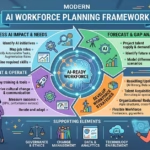
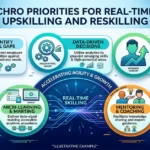


Chief Talent Officer strategic workforce orchestration has moved from a nice-to-have planning exercise to the operating system that decides whether a company can move as fast as its market. In my experience, the organizations still treating talent as annual headcount forecasts are already behind. The ones winning treat people, skills, contractors, and AI as modular resources that get reassembled around outcomes in near real time.
Here’s the short version of what matters:
- Strategic workforce orchestration replaces static headcount plans with continuous matching of work to the best mix of humans and technology.
- The Chief Talent Officer now sits at the center of business strategy, not just HR process.
- Skills, not job titles, become the atomic unit of planning.
- Build-buy-borrow-redeploy decisions happen faster and with clearer data.
- Organizations that master this reduce capability gaps and raise agility without simply adding headcount.
The shift is real. Deloitte’s 2026 Global Human Capital Trends work frames it as “dynamic orchestration”—the ability to sense demand and recombine talent, data, and AI around the outcomes that matter most. LinkedIn’s Future of Talent report calls the same move “talent orchestration”: stop starting with a hiring request and start with the business result you need. Both point to the same reality. Traditional workforce planning was built for a slower world. That world is gone.
Why Chief Talent Officer Strategic Workforce Orchestration Matters Now
Most companies still plan like it’s 2018. They forecast roles, open requisitions, and hope the market cooperates. What usually happens is the plan is outdated the moment it’s approved. Markets shift, AI capabilities jump, and critical skills walk out the door or get automated.
Chief Talent Officer strategic workforce orchestration flips the sequence. You start with the value the business needs to create. Then you decide the best combination of internal people, external talent, and technology to deliver it. Headcount becomes one lever among several, not the default answer.
In practice this means the CTO works shoulder-to-shoulder with the CEO, CFO, and technology leaders. The conversation is no longer “how many people do we need?” It becomes “what work needs to get done, who or what is best positioned to do it, and how fast can we reconfigure?”
I’ve watched teams that make this shift cut time-to-capability dramatically. They stop treating internal mobility as a last resort. They stop treating contractors and AI agents as afterthoughts. Everything sits on the same decision board.
Core Components of Effective Orchestration
Four elements show up consistently in organizations that do this well.
Skills as the unit of analysis. Job descriptions are too rigid. Break work into skills and tasks. Map current inventory against future demand. The gap analysis becomes the real strategy document.
Total workforce view. Employees, contractors, freelancers, managed service providers, and digital agents all count. Siloed views of “our people” versus “their people” create blind spots. The best CTOs insist on one integrated picture.
Real-time or near-real-time sensing. Annual plans die in volatile environments. Leading teams pull internal talent data, external labor market signals, and business demand indicators into the same view. AI helps here, but the judgment still belongs to people who understand the business.
Clear decision rights. Someone has to own the build-buy-borrow-redeploy choice for critical capabilities. That someone is usually the Chief Talent Officer working with the relevant business leader. Ambiguity kills speed.
Here’s a simple comparison of the old model versus the orchestration model:
| Dimension | Traditional Workforce Planning | Strategic Workforce Orchestration |
|---|---|---|
| Primary focus | Headcount and roles | Skills, tasks, and outcomes |
| Time horizon | Annual or multi-year static | Continuous with rolling scenarios |
| Talent sources | Mostly employees | Integrated: employees + external + AI |
| Decision trigger | Budget cycle or open req | Business demand or capability gap |
| CTO role | Support function | Strategic partner to C-suite |
| Success metric | Fill rate and cost per hire | Time to productivity and capability coverage |
The table is deliberately blunt. One approach optimizes for predictability. The other optimizes for adaptability. In 2026, adaptability wins more often.

Step-by-Step Action Plan for Beginners
If you’re starting from a traditional planning process, don’t try to boil the ocean. Here’s the sequence I recommend.
- Align on the business outcomes that matter most. Sit with the leadership team and name the three to five results the organization must deliver in the next 12–18 months. Everything else flows from those outcomes.
- Map the work, not the org chart. Deconstruct the critical outcomes into the skills and tasks required. Identify which can be done by people today, which can be augmented by AI, and which might be better sourced externally.
- Build a current-state skills inventory. Use what you already have—performance data, project history, learning records—and fill the obvious gaps with simple assessments or manager input. Perfection is the enemy of progress here.
- Create a living gap analysis. Compare current capabilities against the skills the outcomes demand. Rank the gaps by business impact and time sensitivity.
- Decide the intervention mix. For each high-priority gap, choose among develop (upskill or reskill), redeploy (move internal talent), borrow (contractors or partners), buy (hire), or automate. Document the rationale.
- Install a simple operating rhythm. Monthly or bi-weekly reviews of the top gaps and the status of interventions. Keep the conversation focused on outcomes and capability, not just open roles.
- Measure what actually moves the business. Track time from identified need to productive capacity, internal mobility rates for critical skills, and the percentage of priority outcomes that have full capability coverage.
Start with one business unit or one critical capability area. Prove the model. Then expand. Trying to convert the entire enterprise on day one usually creates more resistance than insight.
Common Mistakes and How to Fix Them
I’ve seen the same traps repeatedly.
Mistake 1: Treating orchestration as an HR project.
When the CTO owns it alone, it stays in the HR silo. Fix: Make the business unit leader co-accountable for the outcomes and the capability plan. Shared ownership changes the conversation.
Mistake 2: Over-investing in perfect data before acting.
Waiting for a pristine skills taxonomy or fully integrated systems delays decisions that need to happen now. Fix: Use the data you have, make the call, and improve the data in parallel. Directionally correct beats precisely late.
Mistake 3: Defaulting to hire.
It’s the path of least resistance for many managers. Fix: Require a short build-buy-borrow analysis before any new requisition for critical roles. Force the alternatives onto the table.
Mistake 4: Ignoring the human side of continuous change.
People experience constant reconfiguration as instability. Fix: Pair every major redeployment or skill shift with clear communication about why it matters and how individuals can grow inside the new model.
Mistake 5: Measuring only cost and headcount.
Those metrics encourage the wrong behaviors. Fix: Add capability coverage and time-to-productivity as primary indicators. What gets measured gets managed.
Putting Chief Talent Officer Strategic Workforce Orchestration to Work
The Chief Talent Officer who masters this becomes the person the CEO calls when strategy changes mid-year. That is a different level of influence than traditional talent leadership.
What I’d do if I were stepping into the role tomorrow: pick the single biggest capability risk on the leadership team’s mind, run a rapid skills-and-options analysis with the relevant business leader, and present three viable paths with clear trade-offs. Deliver a result in weeks, not quarters. Credibility compounds fast when you solve real problems instead of building process for its own sake.
For deeper reading on the underlying shifts, the Deloitte 2026 Global Human Capital Trends report on dynamic orchestration is worth your time. LinkedIn’s Future of Talent report lays out how talent acquisition itself is evolving into orchestration. And SHRM’s ongoing work on strategic workforce planning keeps the practical talent management side grounded.
Key Takeaways
- Chief Talent Officer strategic workforce orchestration treats skills and outcomes as the starting point, not jobs and headcount.
- The CTO role expands from process owner to strategic partner who shapes how work actually gets done.
- Success requires a total workforce view that includes external talent and AI alongside employees.
- A simple, repeatable operating rhythm beats an elaborate annual plan that sits on a shelf.
- Start narrow, prove value on a high-stakes capability gap, then scale.
- Measurement must shift from fill rates to capability coverage and time to productive capacity.
- The organizations that treat this as continuous rather than periodic will out-adapt their competitors.
Chief Talent Officer Strategic Workforce Orchestration The companies that treat talent as a static resource will keep reacting. The ones that treat it as something they actively orchestrate will set the pace. The difference starts with how the Chief Talent Officer frames the problem and who else is in the room when the decisions get made.
Pick one critical outcome. Map the skills. Decide the mix. Move. That is the work.
FAQs
What does Chief Talent Officer strategic workforce orchestration actually change day to day?
It changes the first question asked when a new need appears. Instead of “who do we hire,” the conversation becomes “what is the best way to resource this work right now—internal move, development, external talent, or technology?” That single shift cascades into faster decisions and better use of existing capability.
How is Chief Talent Officer strategic workforce orchestration different from traditional strategic workforce planning?
Traditional planning is largely periodic and headcount-focused. Orchestration is continuous, skills-based, and includes the full range of human and digital resources. The planning cycle shortens and the decision rights expand beyond HR.
Who else needs to be involved for Chief Talent Officer strategic workforce orchestration to succeed?
The CEO or business unit leader must co-own the outcomes. Finance needs visibility into the cost and capacity implications. Technology leaders must be at the table when AI and automation options are evaluated. Without those partners, the effort stays tactical.

