







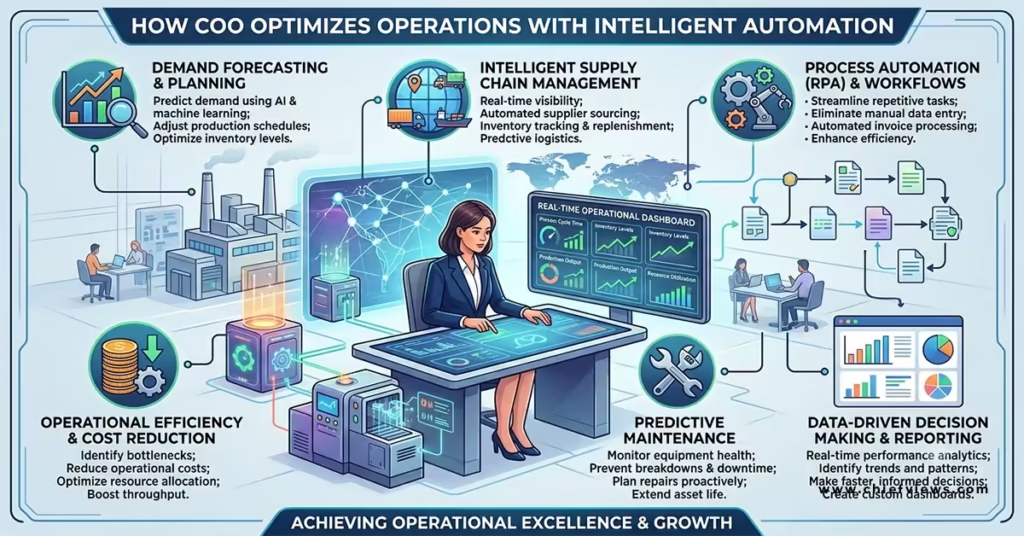
How COO can optimize operations with intelligent automation starts with picking the right problems instead of chasing shiny tools. In 2026, the best operations leaders treat intelligent automation—think process mining, agentic AI, predictive systems, and smart workflow engines—as a force multiplier for resilience and speed, not a headcount cutter. Here’s the quick view:
- It targets high-friction, high-volume workflows first (supply chain, finance ops, customer service).
- Success hinges on clean data, process redesign, and human-in-the-loop design.
- Early wins often show up as shorter cycle times, fewer errors, and better decision speed.
- The real prize is shifting the COO from firefighter to orchestrator of continuous improvement.
- Done poorly, it creates new bottlenecks and eroded trust.
Most COOs I talk with still run too much of the business on spreadsheets, tribal knowledge, and reactive firefighting. Intelligent automation flips that. It lets systems handle the repetitive and data-heavy work so people focus on exceptions, relationships, and strategy. The kicker? Companies that redesign the process before layering on the tech pull ahead of those who just bolt bots onto broken workflows.
What Intelligent Automation Actually Means for Operations Leaders
Intelligent automation blends robotic process automation (RPA), machine learning, generative AI, and increasingly agentic systems that can plan multi-step work and act across tools. It’s not the old “if-this-then-that” scripts. Modern setups can read invoices, forecast demand shifts, flag anomalies, route work, and even trigger replenishment orders while escalating only the edge cases to humans.
In my experience, the COOs who win treat it like building a new operating system for the company. They don’t ask “what can we automate?” They ask “which outcomes matter most, and where does automation remove the friction that blocks them?” Supply chain volatility, invoice processing backlogs, quality escapes, and customer response delays are the usual starting points. BCG has noted that leading agentic deployments improve inventory positions by 10–25% and shipment logistics by 15–20% when the redesign is solid.
Think of it like upgrading from a manual transmission to a smart adaptive drivetrain. The car still needs a skilled driver. But the system handles the constant micro-adjustments so the driver can watch the road and the traffic ahead.


How COO Can Optimize Operations with Intelligent Automation: A Practical Starting Playbook
Beginners and intermediate leaders both trip on the same spot: trying to boil the ocean. Here’s the sequence I recommend.
Step 1: Map the Real Work, Not the Ideal Process
Sit with the people who do the work. Use process mining tools if you have them, or just detailed observation if you don’t. Identify every handoff, every rework loop, and every place someone opens three systems to complete one task. Strip out non-value steps before you automate anything. Automating waste just makes waste faster.
Step 2: Pick One or Two Lighthouse Domains
Choose processes with high volume, clear metrics, and measurable pain. Invoice-to-pay, demand planning to replenishment, or customer case resolution usually deliver visible results in weeks to a few months. Avoid the complex, judgment-heavy processes for round one.
Step 3: Clean the Data Foundation
Garbage data produces garbage automation. Unify the sources, set ownership, and create basic governance rules. Many teams under-invest here and pay for it later. Gartner has repeatedly flagged data quality and integration as the top barriers to scaling automation.
Step 4: Design Human-in-the-Loop from Day One
Decide which decisions the system owns and which stay with people. Build clear escalation paths and audit trails. Train the team so they understand how the system reaches its conclusions. People resist what they don’t trust.
Step 5: Pilot Hard, Measure Ruthlessly, Then Scale
Run a controlled pilot with tight success criteria—cycle time, error rate, cost per transaction, exception volume. Prove the value, fix the friction, then expand. Scale only after the operating model (roles, incentives, handoffs) has adjusted.
Step 6: Build a Lightweight Nerve Center
Create a small cross-functional group—ops experts, data people, IT—that owns the automation roadmap and prioritizes the next opportunities. This keeps the work from becoming a random collection of departmental tools.
Comparison of Traditional vs. Intelligent Automation Approaches
| Area | Traditional Approach | Intelligent Automation Approach | Typical Impact Window |
|---|---|---|---|
| Process Visibility | Annual reviews, tribal knowledge | Continuous process mining + live dashboards | 3–6 months |
| Repetitive Work | More headcount or overtime | Agentic + rule-based automation | 1–4 months |
| Decision Speed | Email chains and meetings | Automated routing with exception escalation | 2–8 weeks |
| Error Handling | Manual rework after the fact | Validation at entry + audit trails | Immediate once live |
| Scaling Capacity | Linear with headcount | Near-linear with process volume | After first pilot |
This table reflects patterns I’ve seen across mid-market and larger U.S. operations teams. The numbers vary by industry, but the direction is consistent.
Common Mistakes & How to Fix Them
I’ve watched plenty of promising programs stall. Here are the patterns that show up most often.
Automating the broken process. Teams skip the redesign and just speed up the mess. Fix: Force a process redesign step before any tool selection. Measure the “as-is” baseline first.
Chasing 100% automation too early. Edge cases explode complexity and delay value. Fix: Target 70–80% automation in the first version. Let humans handle the long-tail exceptions while you learn.
Weak data and integration. Systems can’t talk, so the automation breaks or produces bad recommendations. Fix: Treat data quality as a core workstream with clear owners and funding.
No change management. People feel threatened or simply don’t trust the new tools. Fix: Involve frontline teams early, show them how the system frees them for better work, and celebrate the wins publicly.
Scattered pilots with no accountability. Multiple teams launch competing tools. Fix: Central prioritization through that nerve center and a single executive owner for results.
Ignoring governance. Agents act without clear boundaries. Fix: Define autonomy levels, approval thresholds, and audit requirements before go-live.
How COO Can Optimize Operations with Intelligent Automation at Scale
Once the first lighthouse succeeds, the work shifts. You’re no longer proving the technology works. You’re redesigning the operating model so intelligent automation becomes the default way work flows.
That means updating job descriptions, incentives, and decision rights. It means building reusable components so the next automation takes weeks instead of months. And it means moving from periodic optimization to continuous orchestration—where systems surface problems early and propose or execute responses.
McKinsey’s work on the topic underscores that COOs who treat gen AI and agentic systems as enterprise capabilities—rather than departmental experiments—capture more of the value. The same principle applies across intelligent automation broadly: operating structure, data governance, and change management determine whether you get pilot theater or lasting impact.
Key Takeaways
- Start with high-volume, high-pain processes and redesign them before automating.
- Clean data and clear governance are non-negotiable foundations.
- Keep humans in the loop for judgment and exceptions; let systems handle the rest.
- Measure cycle time, error rates, and cost per output from day one.
- Build a small cross-functional nerve center to own prioritization and scaling.
- Treat the first pilots as proof points that earn the right to expand.
- Update roles, incentives, and decision rights as automation matures.
- Focus on orchestration and resilience, not just headcount reduction.
The COOs who pull ahead in 2026 and beyond are the ones who stop treating intelligent automation as a technology project and start treating it as the new way operations runs. Pick one painful workflow this quarter. Map it. Clean the data. Pilot with clear metrics. Then expand what works.
That single focused move beats a dozen scattered experiments every time.
FAQs
How can a COO start with intelligent automation if the team has limited technical resources?
Partner with a focused external team for the first lighthouse while building internal capability. Many mid-market companies succeed by starting with off-the-shelf process mining and automation platforms that don’t require heavy custom development.
What metrics should a COO track to prove how COO can optimize operations with intelligent automation?
Cycle time, first-pass yield or error rate, cost per transaction, exception volume, and employee time freed for higher-value work. Tie each metric to a business outcome the CEO and board already care about.
Is intelligent automation mainly about cutting costs?
Cost is one outcome, but the bigger gains usually come from speed, consistency, and the ability to handle volume growth without proportional headcount increases. The best programs free people to solve problems the systems can’t.

