







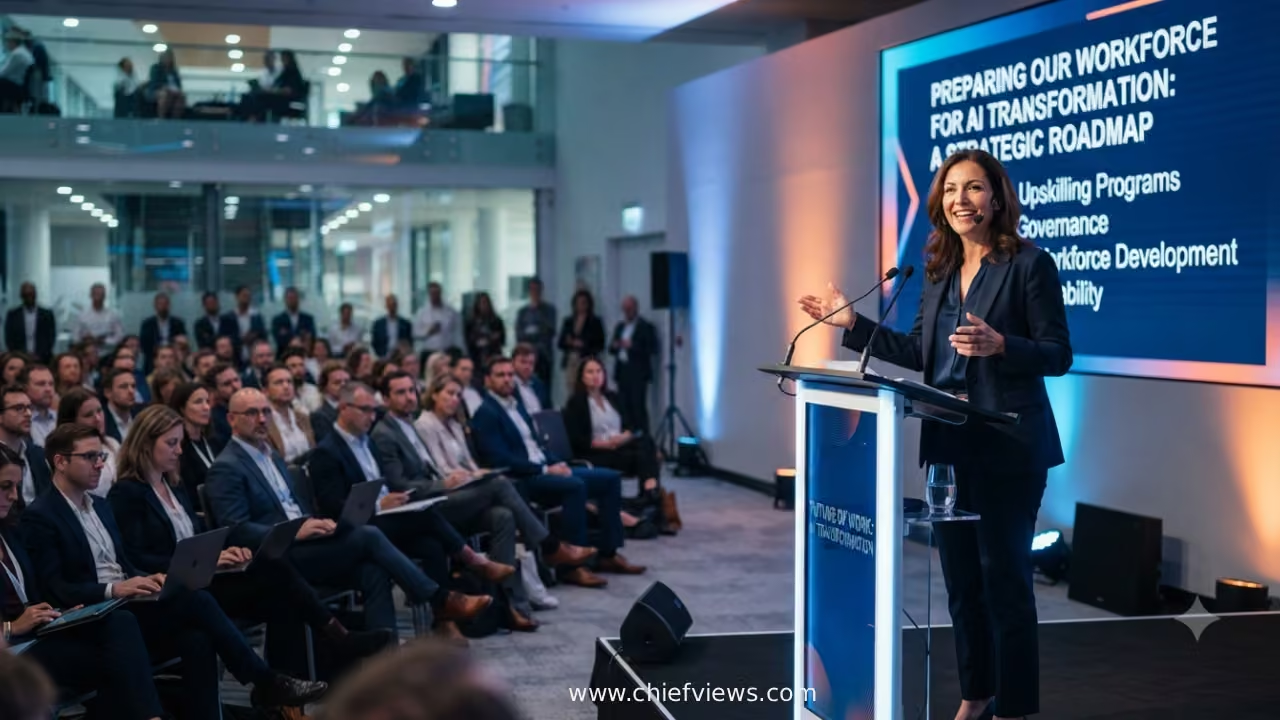
Preparing the workforce for AI transformation as CHRO starts with a hard truth: most organizations are still treating AI as a tech rollout instead of a full redesign of how work gets done. Only 4% of U.S. CHROs say they feel very prepared to lead AI-driven workforce change over the next two years, according to The Conference Board’s 2026 CHRO Confidence survey. The rest are stuck between pilots and real scale.
Here’s the quick read on what preparing the workforce for AI transformation as CHRO actually requires:
- Shift from “deploy tools” to “redesign work, roles, and skills first”
- Build broad AI literacy while targeting high-impact role changes
- Equip middle managers as the critical adoption layer
- Measure workforce costs and rehiring risks alongside productivity gains
- Own the human side of AI strategy so the C-suite doesn’t leave people as an afterthought
The job has changed. You’re no longer just the people person. You’re the architect of how humans and AI operate side by side.
Why Most CHROs Are Still Behind
What usually happens is familiar. Leadership buys the platforms. IT wires them up. Then HR gets the clean-up job when employees resist, managers freeze, or the expected productivity never materializes.
Gartner has flagged the hidden workforce costs that can erase AI ROI: specialized AI talent commanding three to four times average pay, skill relevance windows shrinking to two to five years, and the prediction that up to 30% of AI-displaced workers may need rehiring by 2029—often at higher cost.
In my experience, the organizations that pull ahead treat the CHRO as a full partner from the strategy conversation, not after the contracts are signed. IBM’s 2026 CHRO research found that 46% of organizations still leave the CHRO out when AI strategy is defined. Those that build strong “thinking organization” capabilities around people and AI deliver roughly twice the revenue uplift and workforce outcomes.

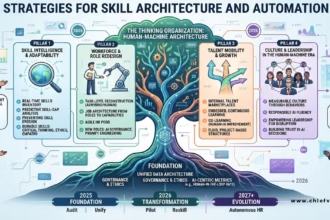
The kicker is simple. Technology moves fast. Work redesign and human readiness move at the speed of trust and learning. You’re the one who sets that pace.
Preparing the Workforce for AI Transformation as CHRO: The Practical Reality Check
Start by separating adoption from readiness. You can light up tools in weeks. Getting people to change how they decide, collaborate, and create value takes deliberate design.
Focus on three layers:
- Work redesign — Deconstruct existing processes before layering AI on top of broken ones.
- Capability building — AI literacy for everyone, deeper fluency for roles that change most.
- Manager enablement — Half of CHROs in recent Gallup data lack confidence that their managers can guide employees through AI use. That gap kills scale.
One fresh analogy helps here. Think of AI like installing a high-speed elevator in an old building. The elevator is impressive. But if the floors still have the same narrow hallways, the same bottlenecks at the exits, and people who’ve never used elevators before, you just create faster congestion. The CHRO’s job is to redesign the entire flow of movement—not just press the install button.
Step-by-Step Action Plan for Preparing the Workforce for AI Transformation as CHRO
Here’s what I’d do if I were walking into a mid-to-large U.S. organization tomorrow with a clear mandate but limited runway.
Step 1: Get the data on current work, not just current roles.
Run a rapid task-level audit in two or three high-volume processes. Identify what is routine, judgment-heavy, relationship-driven, or creative. Involve the people who actually do the work. They know the friction points better than any vendor demo.
Step 2: Define the human-AI boundary early.
Create a simple transition compact with the CEO, CFO, and CTO. Spell out where AI can act with autonomy, where human judgment stays non-negotiable, and what evidence is required before roles change or headcount shifts. This prevents the quiet erosion of accountability that happens when no one owns the gray areas.
Step 3: Build AI literacy as table stakes, then layer role-specific fluency.
Give every employee foundational training on how the tools work, what good prompts look like, and the risks of over-reliance. Then create deeper tracks for the roles that will transform most. Pair this with internal AI champions who sit inside the business, not just in HR or IT.
Step 4: Treat middle managers as the make-or-break layer.
Train them to coach, set new performance expectations, and orchestrate work between people and digital agents. Without this, adoption stays surface-level. Managers who feel unprepared become the quiet resistance.
Step 5: Redesign careers and skills taxonomies around capabilities, not job titles.
Preparing the workforce for AI transformation as CHRO Move toward skills-based talent systems. Identify which capabilities will differentiate the company in three to five years, then decide where to build, buy, redeploy, or redesign. Traditional succession plans built only on past roles will break under AI speed.
Step 6: Measure what the CFO cares about.
Track not only training completion rates but also productivity shifts, quality changes, time-to-proficiency in new workflows, and any rehiring costs. Connect reskilling investment to business outcomes the finance team already watches.
Common Mistakes & How to Fix Them
| Mistake | What It Looks Like | How to Fix It |
|---|---|---|
| Treating AI as a pure technology project | Tools go live; people and processes stay the same | Redesign workflows first, then deploy. Involve employees in the design. |
| Over-investing only in specialist AI talent | Sky-high salaries for a few experts while the broader workforce lags | Balance specialist hiring with enterprise-wide literacy and internal mobility. |
| Leaving managers out of the enablement plan | Frontline leaders feel exposed and default to old ways of working | Make manager AI coaching a core leadership competency with dedicated support. |
| Measuring only activity metrics | “We trained 80% of the company” becomes the success story | Tie metrics to business outcomes and track rehiring or skill-atrophy risks. |
| Waiting for perfect prediction of job impact | Analysis paralysis while competitors move | Run controlled pilots in contained areas, learn fast, then scale what works. |
Preparing the workforce for AI transformation as CHRO The organizations that avoid these traps treat preparing the workforce for AI transformation as CHRO as an ongoing operating rhythm, not a one-time program.
Building the Supporting Systems
You’ll need updated talent acquisition that screens for curiosity and judgment alongside technical skills. Learning systems that protect the development of human capabilities AI can’t easily replicate—complex problem framing, ethical trade-offs, relationship building. Performance management that rewards effective human-AI collaboration, not just volume of AI usage.
Preparing the workforce for AI transformation as CHRO Governance matters too. Responsible AI frameworks that cover bias, privacy, and decision transparency should live partly under the CHRO’s roof because the people impacts are real. Gartner and others continue to stress that workforce costs and risks must sit alongside technology investment decisions.
For deeper reading on the cost side, see Gartner’s analysis of hidden workforce costs of AI. The Conference Board’s ongoing CHRO Confidence work provides the readiness baseline many U.S. leaders are using. IBM’s 2026 CHRO study offers a useful frame for the capabilities that separate high-performing “thinking organizations.”
Key Takeaways
- Only 4% of CHROs currently feel very prepared—most are still in experimentation mode.
- Work redesign must come before or with tool deployment, not after.
- Middle managers are the critical bottleneck for scale; invest there heavily.
- Hidden costs (premium talent, short skill cycles, potential rehiring) can erase ROI if ignored.
- AI literacy for all + deeper fluency for transforming roles is the practical starting point.
- Skills-based talent systems and clear human-AI boundaries create lasting advantage.
- The CHRO who sits at the strategy table early shapes better outcomes than the one who inherits the mess.
- Measure what finance cares about or the investment conversation stays one-sided.
Preparing the workforce for AI transformation as CHRO is no longer optional side work. It is the central people strategy for the next several years. The organizations that treat it that way will convert AI capacity into growth. The ones that treat it as another digital project will keep wondering why the results stay modest.
Your next step is straightforward: pick one high-friction process this quarter, redesign it with the people who live it, equip the managers who own it, and measure the real shift. Then expand from there. The rest of the C-suite is watching whether you can lead this or whether they need to find someone who will.
FAQs
What does preparing the workforce for AI transformation as CHRO look like in the first 90 days?
Focus on three things: a clear human-AI decision compact with the executive team, foundational AI literacy launched across the company, and one or two controlled work-redesign pilots with strong manager support. Avoid boiling the ocean.
How should CHROs balance specialist AI hiring versus broad upskilling?
Hire the specialized talent you truly need for core platforms and high-value use cases, but put the larger investment into making the existing workforce AI-fluent. The talent market for pure AI specialists is expensive and the skill windows are short. Building internal capability compounds better over time.
Why do so few CHROs feel ready for AI-driven workforce change?
The biggest barriers are difficulty predicting exact workforce impact, limited AI skills inside the organization, and the absence of a clear enterprise AI strategy that includes people implications from the start. The uncertainty is real, but waiting for perfect clarity guarantees you fall further behind.

