





CHRO priorities for manager development and resilience 2026 are landing right at the point where many businesses are feeling the pressure most: managers are being asked to lead change, keep teams steady and deliver results with less room for error. If you run a business, you already know this truth — when managers are stretched too thin, the whole company feels it.
In this article, we’re going to be taking a look at CHRO priorities for manager development and resilience 2026, and how you can build stronger managers, reduce avoidable churn and support better performance across your business. If you would like to find out more, feel free to read on.
Pic – CC0 License
CHRO priorities for manager development and resilience 2026
The first priority is simple: make managers better at the job they are actually doing today, not the job they were hired for three years ago. In 2026, CHROs are focused on practical manager development because businesses need people leaders who can coach, communicate and make decisions under pressure. That means less one-off training and more regular support that fits real work.
For you, this means teaching managers how to run clear one-to-ones, set expectations early and handle conflict before it spreads. It also means helping them lead hybrid or distributed teams without losing trust or momentum. A manager who can do those things well becomes a force multiplier for your business.
According to Gallup’s research on manager impact, managers play a major role in employee engagement, which is closely tied to performance and retention. That is why CHROs are moving away from generic leadership programmes and toward development that is tied to day-to-day outcomes. In plain English, the goal is not to “train managers”; it is to make managers more useful, more stable and more effective.


Why resilience matters more than ever
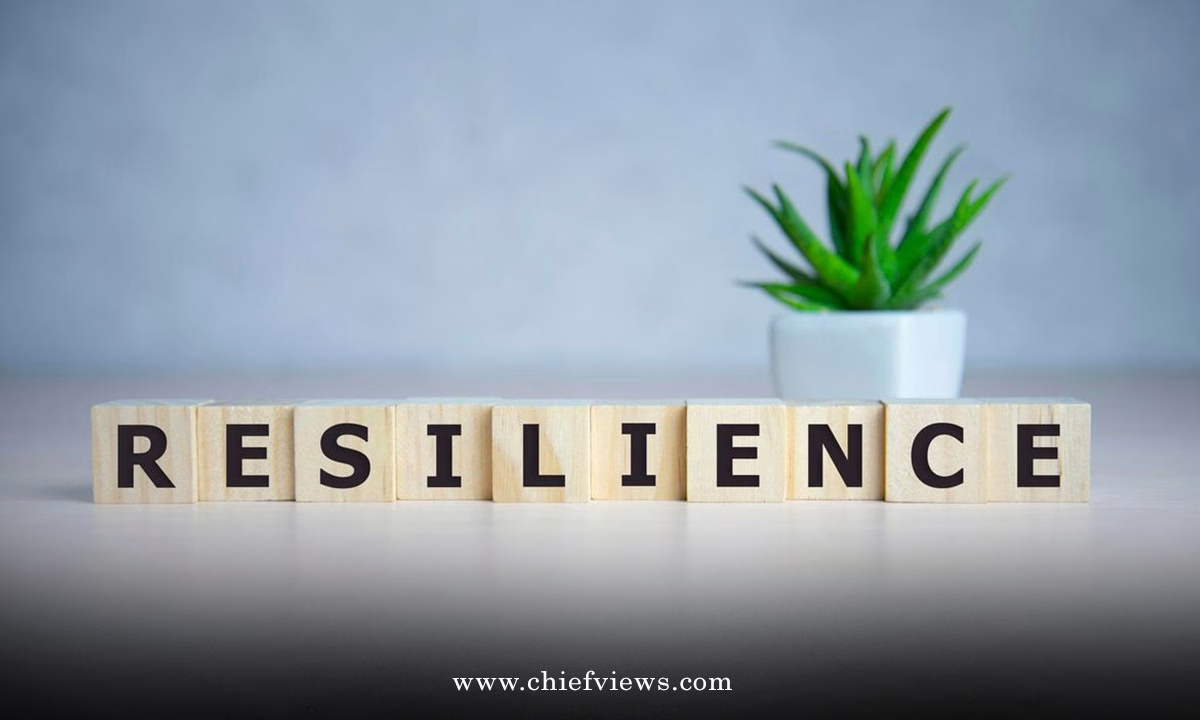
Resilience is not about telling managers to “stay positive” when things get hard. It is about giving them the tools, habits and support to stay clear-headed when the business is under pressure. CHRO priorities for manager development and resilience 2026 reflect a basic reality: stressed managers make poor calls, send mixed messages and often pass that stress down to their teams.
That is why more HR leaders are building resilience into workload design, not just wellbeing programmes. They are looking at span of control, meeting overload, role clarity and whether managers have enough time to actually manage. If a manager spends all day firefighting, there is no space left for coaching or planning.
The World Health Organization notes that workplace stress can affect health, engagement and performance. For business owners, the takeaway is clear: resilience is not a soft extra, it is part of operational strength. If your managers are burning out, your business will feel it in slower decisions, lower morale and weaker customer service.
Build managers who can coach, not just supervise
One of the biggest shifts in CHRO priorities for manager development and resilience 2026 is the move from supervision to coaching. Many managers still believe their job is to chase updates and approve work. That may keep things moving for a while, but it does not build a stronger team.
Coaching managers ask better questions, give sharper feedback and help people solve problems for themselves. That saves time over the long run because the team becomes more capable and less dependent. For a founder or owner, that is a smart investment because it frees you from being the answer to everything.
You do not need a huge learning budget to start. You can train managers to use a simple rhythm: set goals, check progress, remove blockers and review outcomes. Keep it practical. If the advice cannot be used in a real meeting this week, it probably is not useful enough.
Make role clarity part of the system
A lot of manager stress comes from unclear expectations. When people do not know what “good” looks like, managers spend their time guessing, correcting and redoing work. That is exhausting, and it weakens confidence on both sides.
CHROs are paying more attention to role clarity because it improves both development and resilience. Managers perform better when they know what they own, what they can decide and where they need to escalate. Your business benefits too, because fewer things fall through the cracks.
A simple fix is to define three things for every manager: the outcomes they own, the decisions they can make and the support they can expect from above. That alone can remove a lot of noise. It also creates a cleaner path for growth when someone is ready for more responsibility.
Use data, but keep it human
Another part of CHRO priorities for manager development and resilience 2026 is using people data more intelligently. This does not mean turning management into a spreadsheet exercise. It means noticing patterns early, so you can step in before problems become expensive.
Look at signs such as regrettable turnover, repeated team conflicts, low engagement or managers who are always overloaded. These patterns often point to development gaps, not just individual weakness. When you see them early, you can coach, adjust workload or change the support structure.
The CIPD has long highlighted the importance of effective leadership and management in building productive workplaces. That matters across the USA, UK, Australia, Singapore and Dubai, where competition for good people is intense and the cost of poor management is high. Good people data helps you act with care instead of guessing.
What business owners should do next
If you want to align with CHRO priorities for manager development and resilience 2026, start with the basics. Do not try to fix everything at once. Pick the areas that will have the biggest effect on day-to-day stability.
A practical starting point looks like this:
- Audit manager workloads and remove the obvious overload points.
- Train managers on coaching, feedback and difficult conversations.
- Set clear expectations for what each manager owns.
- Review team health regularly, not just once a year.
- Give managers support when they are under pressure, not after they burn out.
These steps are not flashy, but they work. They help managers become steadier, clearer and more useful to the business. That is exactly what most owners need right now.
We hope that you have found this article enlightening in some way, and that it gives you a clearer view of how CHRO priorities for manager development and resilience 2026 can shape a stronger business. If you focus on practical coaching, clear roles and real support, you will give your managers a better chance to succeed and your company a better chance to grow.