




AI Operations Playbook for Startups delivers the exact blueprint early-stage founders need to embed AI into daily ops without burning cash or breaking what works. In 2026, lean teams win by automating the grind and focusing humans on what matters.
- AI Operations Playbook for Startups means practical, phased tactics for automating processes, leveraging data, orchestrating human-AI teams, and scaling efficiently with minimal headcount.
- It matters because startups that redesign workflows around AI see significantly higher returns than those running isolated experiments.
- Founders and first ops hires gain speed, cut costs, and build resilience in competitive USA markets.
- The result? More runway, faster iteration, and operations that support growth instead of choking it.
Startups no longer have the luxury of manual everything. AI agents handle repetitive tasks. Predictive tools spot issues early. Smart playbooks turn limited resources into unfair advantages.
Here’s the thing: most founders dabble with ChatGPT and call it a day. The ones pulling ahead treat AI as core infrastructure. They build systems that compound.
Why Every Startup Needs an AI Operations Playbook in 2026
Bootstrapped or venture-backed, resources stay tight. Talent costs climb. Markets shift overnight. An effective playbook turns these constraints into strengths.
In my experience, ops chaos kills more startups than bad products. AI changes that equation. Teams reclaim 30-40% of founder time by automating the right things. What usually happens is founders stay stuck in the weeds until they systematize.
The kicker? Early AI wins create momentum. One automated process funds the next. Before long, your ops run leaner and smarter than bigger competitors.
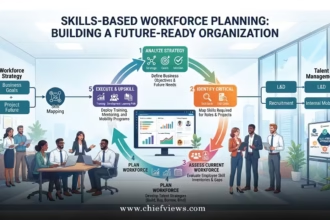
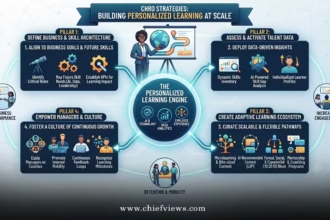

Picture a small engine room where AI agents act as tireless crew members. The captain—your team—sets direction and handles the unpredictable. Smooth sailing follows.
Core Elements of an AI Operations Playbook for Startups
Start Small: Identify High-Impact Use Cases
Skip the shiny object syndrome. Map your biggest time sucks and bottlenecks first. Customer support triage, invoice processing, inventory forecasting, or hiring screening often deliver quick ROI.
Focus on repetitive, high-volume tasks. These justify the investment and prove value fast.
What I’d do: Run a one-week audit. List every recurring task. Score them by time saved versus implementation effort. Pick the top two.
Data Foundations That Actually Scale
AI is only as good as your data. Startups often operate with messy spreadsheets and scattered tools. Fix that early.
Establish basic governance. Centralize key datasets. Use simple ETL tools or no-code platforms. Ensure privacy compliance from day one—especially with US regulations tightening.
Tool Stack for Lean Teams
Prioritize affordable, integrable solutions. No massive suites.
- Automation: Zapier, Make, or n8n for workflows.
- Analytics: Lightweight BI with AI insights.
- Agents: Custom GPTs or platforms for specific domains.
- Monitoring: Tools that alert on anomalies.
Test integrations ruthlessly. Broken automations waste more time than they save.
Human-AI Orchestration
AI augments. It doesn’t replace judgment. Train teams to collaborate with tools. Define clear handoff points—AI handles 80% routine, humans review exceptions.
This approach mirrors successful patterns where escalation-based models deliver strong productivity lifts.
Traditional vs AI-Native Operations Comparison
| Aspect | Traditional Startup Ops | AI Operations Playbook Approach | Scaling Impact |
|---|---|---|---|
| Process Handling | Manual checklists, founder-dependent | Automated workflows + agentic AI | 40%+ time reclaimed |
| Decision Making | Gut feel + weekly reviews | Predictive analytics + real-time data | Fewer surprises, faster pivots |
| Team Structure | Generalists wearing many hats | Specialized humans + AI augmentation | Higher output per person |
| Cost Management | Reactive budgeting | Continuous optimization via AI insights | Extended runway |
| Risk Management | Post-incident fixes | Proactive monitoring and scenario tools | Lower failure rates at scale |
Results vary, but patterns from enterprise deployments show clear advantages when implemented thoughtfully.
Step-by-Step Action Plan for Implementing Your AI Operations Playbook
- Audit and Prioritize – Document current processes. Identify quick wins. Align to business goals like customer acquisition or burn reduction.
- Build Data Hygiene – Clean core data sources. Set up basic dashboards. Limit access to sensitive info.
- Pilot One Workflow – Choose support triage or sales follow-ups. Implement AI assistance. Measure baseline vs. new metrics over 4 weeks.
- Integrate and Automate – Connect tools securely. Create playbooks for common scenarios. Document everything.
- Train and Iterate – Run short team sessions. Gather feedback. Refine prompts and rules.
- Scale and Monitor – Expand successful pilots. Set KPIs and alerts. Review quarterly.
- Governance and Ethics – Establish guidelines for responsible use. Review for bias and compliance regularly.
Follow this sequence and momentum builds without overwhelm.
Common Mistakes & How to Fix Them
Mistake 1: Boiling the ocean with too many tools.
Fix: Limit to 3-5 core platforms initially. Master them before expanding.
Mistake 2: Ignoring the people factor.
Fix: Communicate benefits clearly. Involve the team in pilots. Celebrate wins publicly.
Mistake 3: Poor data quality undermining AI.
Fix: Treat data cleanup as a prerequisite. Assign ownership early.
Mistake 4: No measurement.
Fix: Define success metrics before launch. Track ROI religiously.
Mistake 5: Treating AI as set-it-and-forget-it.
Fix: Build review cadences. AI evolves—your playbook must too.
For deeper leadership context, see proven COO skills for scaling operations AI era that complement this playbook perfectly.
Key Takeaways
- AI Operations Playbook for Startups starts with ruthless prioritization of high-ROI automations.
- Strong data foundations prevent garbage-in-garbage-out disasters.
- Human-AI collaboration beats pure automation every time.
- Pilot fast, measure obsessively, then scale.
- Governance protects against risks as you grow.
- Focus on outcomes, not technology hype.
- Consistent iteration turns early wins into sustainable advantage.
- This approach extends runway and sharpens competitive edge.
An AI Operations Playbook for Startups ultimately frees founders to do what they do best: innovate and lead. Operations stop being a drag and become a growth engine.
Next step? Pick one process this week. Audit it. Run a small AI pilot. Action compounds faster than planning ever will.
FAQs
What should a basic AI Operations Playbook for Startups include?
Clear use cases, data practices, tool recommendations, implementation steps, and governance rules tailored to limited resources.
How does an AI Operations Playbook for Startups link to broader leadership skills?
It builds directly on COO skills for scaling operations AI era, helping ops leads and founders execute at the intersection of technology and business.
Can solo founders or small teams realistically use an AI Operations Playbook?
Yes. Start with no-code tools and free tiers. Focus on one area at a time for immediate relief and measurable gains.