








Enterprise AI governance framework work starts with a simple reality check: most companies already run more AI than they can see, let alone control. Shadow tools, agent experiments, and vendor models pile up faster than policies can catch them.
Here’s the fast take on what matters in 2026:
- An enterprise AI governance framework turns principles into named owners, risk tiers, and enforceable controls across the full lifecycle.
- Visibility comes first—an inventory of every model, agent, and embedded AI system is non-negotiable.
- Risk classification drives the intensity of oversight so low-stakes tools move fast while high-impact systems get real scrutiny.
- Strong frameworks connect directly to data control and sovereignty so models never outrun the organization’s ability to audit or exit them.
- The payoff is faster, safer scaling of agentic AI without constant fire drills when regulators or boards ask hard questions.
In my experience sitting with US enterprise teams this year, the gap between AI ambition and governance maturity keeps widening. Adoption numbers look impressive. Mature operating models do not. The organizations that close that gap treat governance as an operating system, not a policy binder.
Why an Enterprise AI Governance Framework Matters More in 2026
Agentic systems change the game. They act, call tools, move data, and chain decisions. Traditional model risk processes were never designed for that speed or autonomy. At the same time, state-level rules, federal procurement clauses, and board expectations around accountability keep tightening.
Enterprise AI governance framework work What usually happens is predictable. A business unit launches a productive agent. Six months later no one can produce the owner, the last risk review, the data lineage, or proof that the agent stayed inside its approved boundaries. The CIO then spends cycles explaining gaps instead of delivering value.
A working enterprise AI governance framework prevents that. It creates a single, living system of record for every AI asset, assigns clear decision rights, and embeds controls that travel with the system from intake through retirement. It also supports broader CIO strategies for sovereign AI and data control by making sure the organization retains authority over data use, model behavior, and exit options.

Core Components of a Practical Enterprise AI Governance Framework
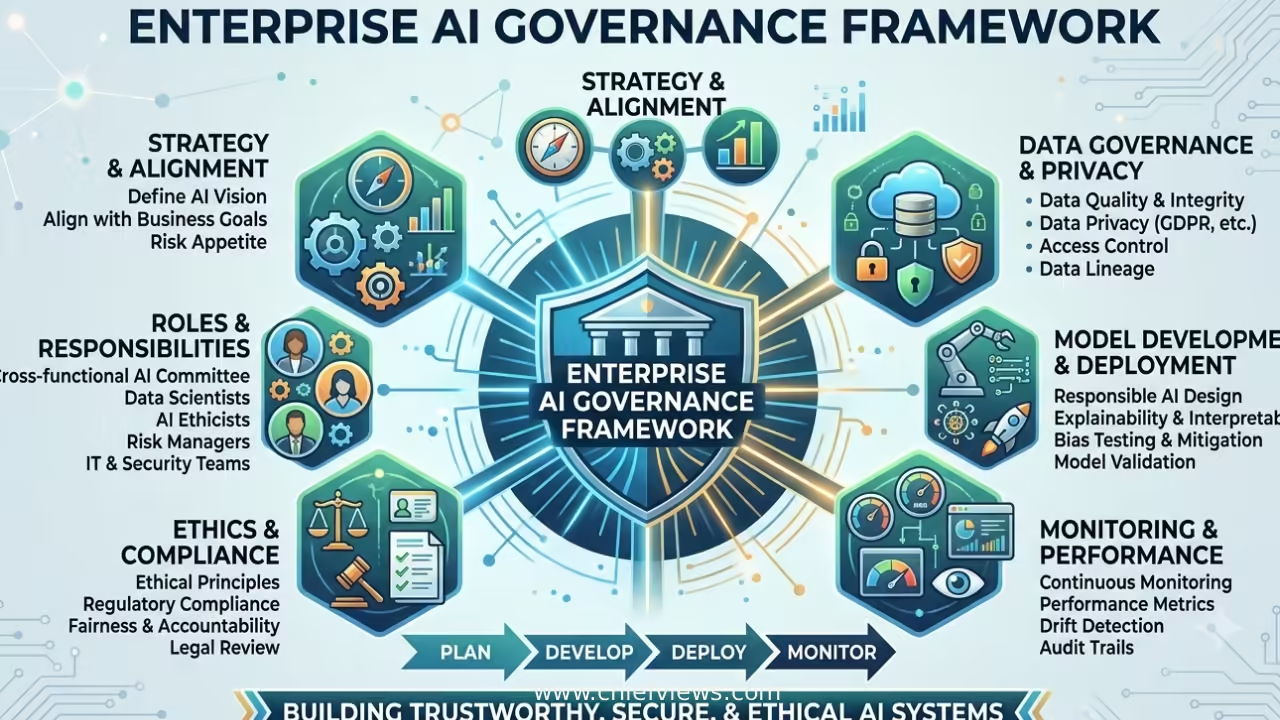
Most effective frameworks share six connected layers:
- Inventory and discovery – A living registry of internal models, third-party tools, embedded AI, and agents with named owners and purpose.
- Risk classification – Clear tiers based on data sensitivity, decision impact, autonomy level, and regulatory exposure.
- Ownership and accountability – Business owner plus technical owner for every system, plus a cross-functional governance body for escalations.
- Lifecycle controls – Gates at design, testing, deployment, monitoring, and retirement with evidence requirements that scale by risk.
- Runtime enforcement – Permissions, guardrails, logging, and human-in-the-loop rules that actually stop unsafe actions.
- Evidence and continuous improvement – Audit-ready records of approvals, tests, incidents, and reviews that regulators or boards can examine without a scramble.
These layers work best when they sit on a solid data foundation. Governance that ignores data lineage or key ownership quickly becomes theater.
Risk Tiers and Control Intensity
| Risk Tier | Typical Characteristics | Required Controls | Review Cadence | Example Use Cases |
|---|---|---|---|---|
| Low | Internal productivity, limited data access, no customer impact | Basic inventory, acceptable-use policy, light logging | Annual or on material change | Drafting assistants, code suggestions |
| Medium | Customer-facing or sensitive internal data, moderate autonomy | Risk assessment, bias/performance tests, named owners, monitoring | Semi-annual | Support chatbots, internal analytics agents |
| High | Decisions affecting people, money, or regulated data; high autonomy | Full impact assessment, human oversight gates, continuous monitoring, formal approval | Quarterly + event-driven | Credit decisions, clinical support, hiring tools |
| Critical / Restricted | Potential for significant harm or legal exposure | Board or executive sign-off, independent review, kill-switch capability, strict data isolation | Continuous + formal re-approval | Autonomous agents with broad system access |
Enterprise AI governance framework work Classify early. Apply the lightest controls that still manage the risk. Over-governing everything kills velocity. Under-governing high-risk systems creates the incidents that stop programs cold.

Step-by-Step Action Plan to Build Your Enterprise AI Governance Framework
If you are starting from scattered pilots and incomplete visibility, run this sequence:
- Stand up a cross-functional core team. Include IT, security, legal, privacy, risk, data, and at least two business representatives. Give them a clear charter and executive sponsor.
- Build the initial inventory in 30–45 days. Capture every known AI system plus a discovery process for shadow tools. Record owner, purpose, data sources, model or vendor, and current risk estimate.
- Define risk tiers and decision rights. Document what each tier requires and who can approve movement between tiers or into production. Keep the language operational, not philosophical.
- Write the minimum viable policy set. Cover acceptable use, data handling, third-party AI, agent permissions, and incident response. Reference NIST AI RMF functions (Govern, Map, Measure, Manage) as the backbone so the framework stays flexible as regulations evolve.
- Embed gates into existing processes. Add intake forms, pre-deployment checklists, and monitoring requirements into the tools teams already use. Avoid creating parallel bureaucracy.
- Operationalize monitoring and evidence. Require runtime logging for medium and higher tiers. Store approvals, test results, and review records in one place that survives staff turnover.
- Review and iterate every quarter. Technology, regulations, and business needs shift. Treat the framework as living infrastructure.
Enterprise AI governance framework work What I would do if I walked into a typical mid-size US company tomorrow: freeze net-new high-autonomy agents for two weeks, force the inventory exercise with business owners in the room, then fund the registry and risk-classification process before anything else. Everything downstream becomes cleaner once you know what you actually own.
Common Mistakes and How to Fix Them
Mistake 1: Treating governance as a one-time policy project.
Fix: Build operating processes and technical controls. Policies alone get ignored the first time a deadline pressure hits.
Mistake 2: Applying the same process to every system.
Fix: Use risk tiers. A summarization tool and a hiring decision engine should never share the same approval path.
Mistake 3: Leaving ownership fuzzy.
Fix: Require a named business owner and technical owner before any system moves past pilot. No owner, no production.
Mistake 4: Ignoring agents and shadow AI.
Fix: Expand the inventory process to include discovery of unsanctioned tools and give agents the same identity and permission discipline as human users.
Mistake 5: Separating AI governance from data and sovereignty concerns.
Fix: Connect the framework to data classification, residency, and portability requirements. This is where enterprise AI governance framework work directly supports CIO strategies for sovereign AI and data control.
Linking Governance to Broader Control
Enterprise AI governance framework work An enterprise AI governance framework only delivers full value when it reinforces data and model control. If you cannot prove where training or inference data came from, who can access it, or how to move a workload, the governance layer becomes cosmetic. Teams that already invest in strong data foundations find it far easier to operationalize the framework because the hard visibility and lineage work is already done.
Key Takeaways
- Start with a complete inventory—you cannot govern what you cannot see.
- Risk classification determines control intensity; one-size-fits-all fails.
- Named owners and clear decision rights beat vague committees.
- Embed controls into the lifecycle and runtime rather than relying on after-the-fact reviews.
- Align the framework with NIST AI RMF for a durable, flexible structure.
- Connect governance tightly to data control so sovereignty and accountability reinforce each other.
- Treat the framework as living infrastructure that gets reviewed and updated regularly.
Enterprise AI governance framework work The organizations that treat an enterprise AI governance framework as core operating infrastructure move faster and sleep better. They can answer the board, satisfy auditors, and still ship useful AI. The ones that treat it as optional paperwork keep rediscovering the same gaps under pressure.
Begin with the inventory and risk tiers this quarter. Once those exist, the rest of the framework has a solid place to live. Pair that work with deliberate attention to data control and you build the foundation for durable, trustworthy AI at scale.
FAQs
What should an enterprise AI governance framework include at minimum in 2026?
A living inventory, risk classification, named owners, lifecycle approval gates, runtime controls for higher-risk systems, and an evidence trail that can withstand external scrutiny.
How does an enterprise AI governance framework support CIO strategies for sovereign AI and data control?
It enforces visibility, ownership, and runtime rules over data use and model behavior, making it practical to keep sensitive workloads under organizational authority while still using external models where appropriate.
How long does it typically take to stand up a workable enterprise AI governance framework?
A focused mid-size organization can reach a usable minimum viable version in 90–120 days if executive sponsorship is clear and the initial inventory receives priority. Scaling and refining continues afterward.
