




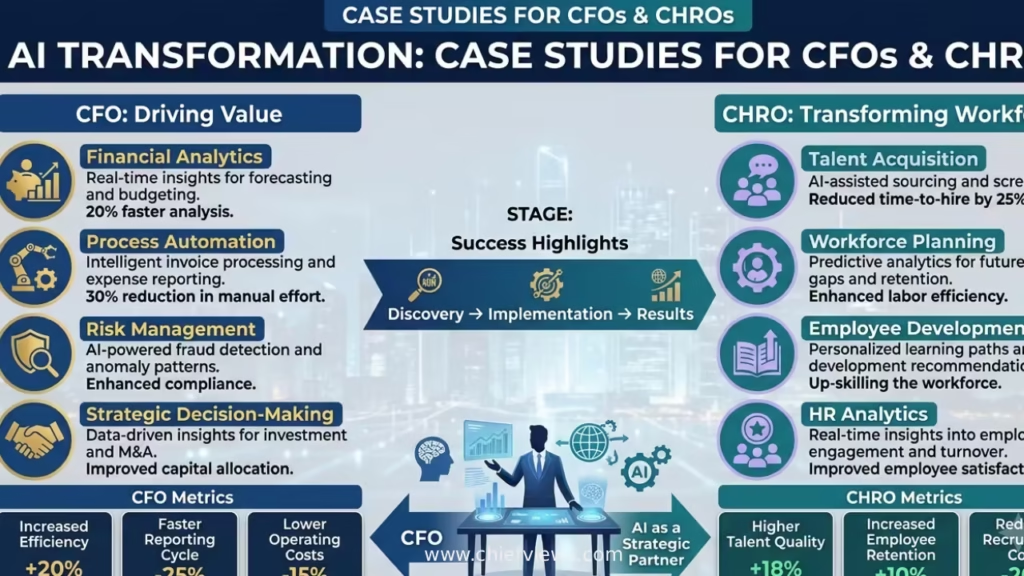
AI transformation case studies for CFOs and CHROs reveal the difference between pilots that stall and programs that rewrite how finance and people operations actually run.
Here’s the quick view of what works in 2026:
- Real value shows up first in high-volume, rules-heavy work: invoice processing, close cycles, variance analysis, employee self-service, and coaching at scale.
- CFOs who treat AI as a controllership and insight engine (not just a cost cutter) free capacity for scenario work and margin recovery.
- CHROs who pair AI with process redesign and trust-building turn transactional HR into a strategic capacity play.
- The winners start small, measure tightly, insist on human oversight for high-stakes decisions, and scale only after the first wins stick.
- Most failures trace back to poor data foundations, weak change management, or treating AI as a bolt-on tool instead of a workflow redesign.
The numbers from the field are no longer theoretical. Cisco’s finance team now generates 80–90% of the first draft of its Management’s Discussion and Analysis with AI. A global beverage producer hit 92% touchless invoice processing and cut manual effort by more than 80%. Prudential scaled AI coaching to nearly 9,000 U.S. employees and freed roughly 10,000 hours of HR business-partner time. These are not press-release claims. They are operating results.
Why AI Transformation Case Studies for CFOs and CHROs Matter Right Now
Finance and HR sit on the cleanest structured data and the highest volume of repetitive decisions in most companies. That makes them natural launchpads. When the CFO and CHRO move together, the organization stops treating AI as an IT experiment and starts treating it as a core operating system.
In my experience, the companies that pull ahead do three things differently. They pick use cases with clear before-and-after metrics. They redesign the surrounding process instead of dropping a model on top of the old one. And they keep humans in the loop for judgment calls while letting the machine handle the grind.
AI transformation case studies for CFOs and CHROs The payoff is measurable capacity. Finance teams reclaim days in the close. HR teams stop drowning in tickets and start coaching managers and redesigning work. The alternative is more of the same: stretched teams, slower decisions, and competitors who already automated the baseline.

Real-World AI Transformation Case Studies for CFOs
Start with finance. The pattern is consistent across industries.
Cisco expanded AI agents across its roughly 90,000-person workforce while embedding them deeply in finance. AI now produces the bulk of the first MD&A draft for public filings. The team built an investor-relations tool that analyzes historical performance and competitor earnings calls to anticipate questions. They are also developing a “CFO cockpit” that consolidates performance across products, geographies, and segments. The operating lesson is straightforward: treat AI as a drafting and pattern-spotting partner so senior people spend time on the narrative and the judgment.
A global beverage producer, working with Deloitte, applied agentic AI to accounts payable. The result was 92% touchless invoice processing and a reduction of more than 80% in manual effort. Accuracy improvements strengthened cash-flow forecasting and supplier management. The key design choice was full audit trails plus self-healing capabilities so the system could flag and resolve many exceptions without constant human intervention.
AI transformation case studies for CFOs and CHROs Hewlett Packard Enterprise partnered with Deloitte on CFO Insights, an agentic platform running on private cloud infrastructure. It replaced static, backward-looking reporting with near-real-time interaction across hundreds of millions of line items. Reporting cycle time dropped by about 40% and processing costs by at least 25%. Discussions shifted from data preparation to operational performance.
McKinsey’s work with finance teams shows similar patterns. At one global consumer-goods company, a generative AI assistant cut the time finance professionals spent delivering budget-variance insights by an estimated 30%. At a biopharma company, a decision-support agent halved the time required for resource-allocation decisions. These are not edge cases. They are repeatable when the data foundation is solid and the use case is tightly scoped.
AI transformation case studies for CFOs and CHROs What I’d do if I were sitting in the CFO seat tomorrow: pick one high-volume process with clear exception rates (AP, close, or variance analysis), demand a measurable baseline, and refuse to expand until the first use case shows both speed and control improvements.
AI Transformation Case Studies for CFOs and CHROs in People Operations
HR faces different constraints—trust, fairness, and employee experience—but the leverage is just as high.
Prudential Financial moved AI coaching from a six-month pilot to nearly 9,000 U.S. users in a little over a year. Employees logged roughly 98,000 conversations with the tool, which sits inside Microsoft Teams. The company estimates it freed about 10,000 hours of HR business-partner time. Usage spikes around year-end reviews and difficult conversations. Leadership loaded culture expectations and the performance framework into the coach so it also functioned as a change-management channel.
Microsoft built an Employee Self-Service agent on its own Copilot stack, integrated with Workday, ServiceNow, and SuccessFactors. Early results included a 31% reduction in support ticket volume. The design goal was simple: one front door for common HR and IT questions so employees stop navigating multiple systems.
IBM’s AskHR journey is longer and more instructive. After an early version saw low adoption, the company made a hard call—temporarily shutting off traditional email and phone channels for managers so they had to use the system. Net Promoter Score initially cratered, then recovered as the tool improved. Today AskHR handles 11.5 million transactions a year across 52 languages and 30 HR domains. Ninety-four percent of employee questions are resolved entirely inside the system. The HR operating budget dropped 40%. The lesson is cultural as much as technical: adoption requires both capability and deliberate friction against the old ways of working.
Workday applied AI inside its own recruiting function and cut screening volume by 57% while collapsing interview scheduling from days to hours. Recruiters shifted time toward candidate engagement and hiring-manager partnership.
The common thread across these CHRO cases is the same as in finance: start with high-volume, lower-risk interactions, prove reliability, then expand into higher-stakes coaching and decision support while keeping clear human override.
Side-by-Side Comparison of Leading Outcomes
| Function | Organization / Use Case | Primary Metric | Reported Result | Key Design Choice |
|---|---|---|---|---|
| Finance – Reporting | Cisco MD&A & IR tools | Draft generation & anticipation | 80–90% of first MD&A draft AI-generated | Human review of narrative; competitor-call analysis |
| Finance – AP | Global beverage producer | Touchless processing | 92% touchless; >80% manual effort reduction | Full audit trail + self-healing exceptions |
| Finance – Insights | HPE CFO Insights | Cycle time & cost | ~40% faster reporting; ≥25% lower processing cost | Agentic interaction with 300M+ line items |
| HR – Coaching | Prudential AI coach | Scale & capacity | ~9,000 users; ~10,000 HRBP hours freed | Embedded in Teams; culture & performance content loaded |
| HR – Self-Service | Microsoft ESS Agent | Ticket volume | 31% reduction in support tickets | Single front door integrated with core systems |
| HR – Transactions | IBM AskHR | Resolution rate & cost | 94% questions handled in-system; 40% HR budget reduction | Forced adoption window + continuous capability upgrade |
AI transformation case studies for CFOs and CHROs These numbers come from public company statements, Deloitte case material, and CHRO Association briefings. Treat them as directional proof points, not guaranteed outcomes for every organization.
Step-by-Step Action Plan for Beginners
- Pick one painful, measurable process. AP matching, month-end close, employee policy questions, or first-line coaching are ideal. Establish the current baseline (cycle time, error rate, hours spent) before any technology discussion.
- Clean the data and define ownership. AI amplifies whatever data quality you already have. Assign a single process owner who owns both the outcome metric and the exception handling.
- Run a tightly scoped pilot with human oversight. Give the system clear guardrails and a human review step for anything material. Measure accuracy, time saved, and user trust weekly.
- Redesign the workflow, not just the tool. Remove steps the AI makes unnecessary. Update job descriptions and performance expectations so people are rewarded for the new work, not the old volume.
- Build the feedback loop. Capture every override and exception. Feed them back into the model or the process rules. This is how reliability compounds.
- Scale only after two consecutive clean months. Expand to adjacent processes once the first use case is stable. Involve legal, compliance, and internal audit early so governance scales with the technology.
- Pair the CFO and CHRO on the next wave. Finance needs better people data for forecasting. HR needs cleaner financial signals for workforce planning. Joint ownership accelerates both.
Common Mistakes & How to Fix Them
Mistake: Launching AI on top of broken processes.
Fix: Map the current process and kill or simplify steps before you introduce the model.
Mistake: Measuring only speed and ignoring accuracy or auditability.
Fix: Require exception rates, override rates, and full audit trails as first-class metrics from day one.
Mistake: Treating change management as an afterthought.
Fix: Identify the people whose daily work changes most and give them early access, clear incentives, and a voice in the redesign. IBM’s NPS drop and recovery is the cautionary tale.
Mistake: Buying platform features without redesigning roles.
Fix: Rewrite the job description for the roles most affected. If the AI handles the volume, the human role must shift to judgment, exception handling, and relationship work.
Mistake: Letting every team experiment in isolation.
Fix: Create a lightweight intake process and a shared prioritization scorecard so the organization learns once and scales what works.
Key Takeaways
- High-volume, rules-based work in finance and HR delivers the fastest, most measurable AI returns.
- Real case results include 80–90% AI-generated MD&A drafts, 92% touchless invoices, 40% faster reporting cycles, 31% fewer HR tickets, and 40% lower HR operating cost in mature deployments.
- Process redesign and human oversight matter more than model choice.
- Start with one tightly measured use case, prove reliability, then expand.
- Joint CFO–CHRO ownership turns isolated wins into enterprise capacity.
- Data quality and exception handling determine whether pilots become operating systems.
- Trust is built through transparency and consistent override rights, not through slogans.
- The organizations pulling ahead treat AI as workflow redesign, not as a feature bolt-on.
The companies that treat AI transformation case studies for CFOs and CHROs as operating blueprints rather than inspiration decks are already running leaner closes, faster employee support, and higher-leverage finance and people teams. The next step is simple: choose one process this quarter, set the baseline, and force the measurement. Everything else follows from proof.
FAQs
What do the strongest AI transformation case studies for CFOs and CHROs have in common?
They start with high-volume, measurable processes, insist on human review for material decisions, redesign the surrounding workflow, and only scale after the first use case shows both speed and control gains.
How should a mid-sized company approach AI transformation case studies for CFOs and CHROs without enterprise budgets?
Pick one painful process with clean data, run a 90-day pilot with clear success metrics, and partner with a vendor or internal team that already has domain experience. Most of the value comes from process clarity, not model sophistication.
Where do AI transformation case studies for CFOs and CHROs typically fail first?
Weak data foundations, no process owner, and treating AI as an add-on instead of a redesign. The technical failure is almost always secondary to the organizational one.