








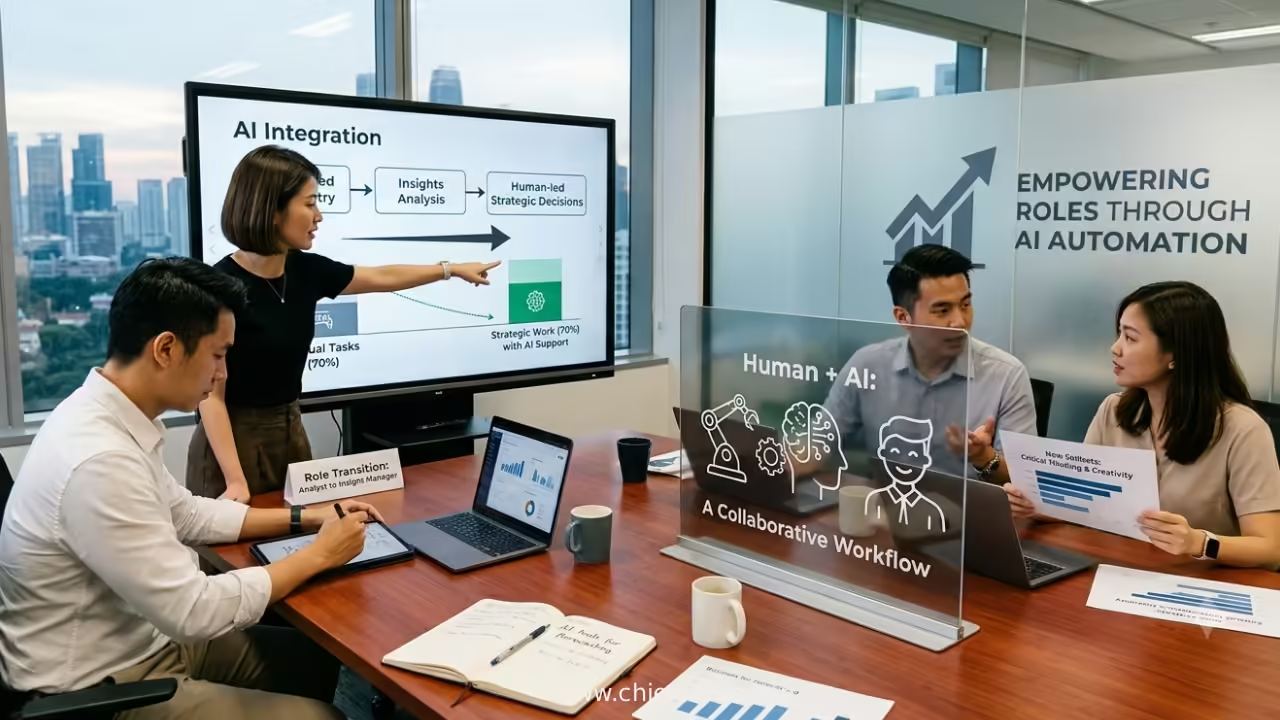
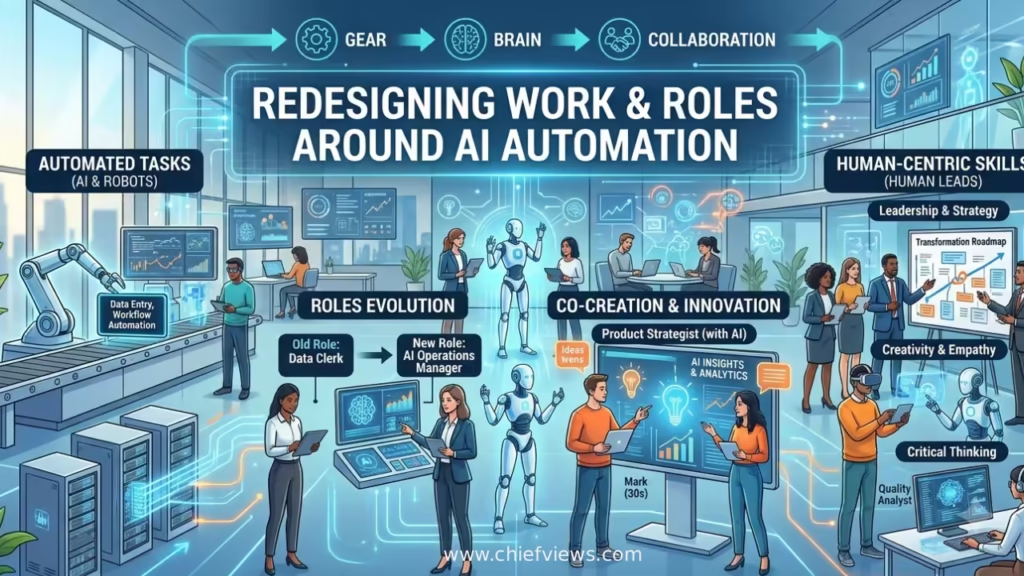
Redesigning work and roles around AI automation is no longer optional for U.S. companies that want real productivity gains instead of pilot-project theater. Most organizations still bolt AI tools onto old job descriptions and wonder why the P&L barely moves. The winners treat the job itself as the redesign unit: they break roles into tasks, decide what belongs to people versus agents, then rebuild the remaining human work around judgment, oversight, and outcomes.
Here’s the quick view of what redesigning work and roles around AI automation actually requires and why it matters right now:
- Almost every job contains tasks AI can handle or change; full job elimination is rarer than task reshuffling.
- High-performing companies redesign workflows and roles far more aggressively than the average firm.
- Continuous redesign—not one-time reorgs—is becoming a core organizational capability.
- The goal is hybrid teams where people and AI agents each do what they do best.
- Done well, this shifts capacity toward higher-value work instead of pure headcount cuts.
In my experience working with leadership teams, the companies that stall are the ones still asking “Which jobs can we automate?” The sharper question is “How do we recombine human and machine capacity so the work itself creates more value?”
Why most AI efforts stall without redesigning work and roles around AI automation
Dropping generative tools or agents into existing processes is easy. Capturing enterprise value is harder. McKinsey’s 2026 state of AI research shows the gap clearly: the large majority of people report personal productivity lifts from AI, yet only a small share of organizations see meaningful EBIT impact. The difference? Nearly three-quarters of the high performers substantially redesigned workflows. Only about a quarter of everyone else did.
Gartner has pushed a related point hard: by 2028, organizations that make continuous work redesign a core capability will be roughly twice as likely to succeed with AI-driven transformation. Static job architectures and annual workforce plans cannot keep up when agents change what a role looks like every few months.
Think of an old manufacturing line that suddenly receives robots. You don’t keep the same number of people standing in the same spots. You reconfigure the entire flow. The same logic now applies to knowledge work. AI agents are the new robots—except they operate on data, language, and decisions instead of physical parts.


The practical difference between task automation and true role redesign
Redesigning work and roles around AI automation Task automation is narrow: “Let the AI draft the weekly report.” Role redesign is broader: “What does the analyst’s job become once drafting is handled, and how does that change the team structure, decision rights, and career path?”
Stanford economist Erik Brynjolfsson puts it cleanly: almost no job is fully automatable, yet almost every job has tasks AI can change. The smart move is to treat the job as a collection of tasks, sort them, then rebuild.
Here’s a simple comparison of the two approaches:
| Aspect | Task Automation Only | Full Role Redesign Around AI |
|---|---|---|
| Starting point | Existing job description | Desired outcomes and end-to-end workflow |
| Focus | Speed or cost on discrete steps | New combination of human + agent capacity |
| Typical result | Faster version of the old job | Expanded scope, higher judgment work, possible team size reduction |
| Risk if done poorly | Underused tools and shadow AI | Loss of learning pathways for juniors |
| Leadership involvement | Mostly IT or process owners | Business + HR + domain leaders together |
| Measurement | Time saved on tasks | Outcome quality, capacity reinvested, skill shifts |
The second column is where the real leverage lives. Accenture’s recent Future of Work work shows many organizations can free 20–40% of capacity once they systematically break roles into tasks and reallocate. The kicker is what happens next: most of that freed capacity needs deliberate reinvestment into higher-value work, not just cost takeout.
Step-by-step action plan for redesigning work and roles around AI automation
If you’re starting from zero, don’t try to redesign the entire company at once. Pick a high-volume or high-value function and run a focused pilot. Here’s the sequence I use with teams:
- Map the actual work, not the job description. Sit with the people doing the job. List every significant task they perform in a typical week. Job descriptions are often aspirational. Reality is messier and more useful.
- Score each task on two axes. How repetitive and rules-based is it? How much judgment, context, relationship skill, or accountability does it require? High-repetition, low-judgment tasks are strong candidates for agents. High-judgment tasks stay human-led or become human-AI collaborative.
- Assign a working mode. Three simple modes work well: agent-led (agent executes, human samples), collaborative (agent drafts or analyzes, human decides and refines), or human-only. Be explicit. Ambiguity kills adoption.
- Rebuild the role around what remains. Once routine work moves, the leftover tasks rarely form a coherent job by themselves. Expand the scope. Add oversight of agents. Give the person ownership of outcomes that previously required a larger team. Rewrite the purpose statement.
- Update skills, career paths, and decision rights. Entry-level work often supplied the training ground for judgment. When that disappears, you need new apprenticeship models—pairing juniors with both senior humans and well-designed agents. Performance metrics shift from activity volume to outcome quality and effective agent management.
- Run a short pilot, measure, then scale. Track both efficiency and quality. Watch for the common failure mode: quality drops because no one owns the exceptions. Adjust the human-AI handoff rules before you expand.
What I’d do if I were leading this in a mid-size U.S. company: start with one customer-facing or finance process where the volume is high and the pain is visible. Finish the first redesign cycle in 8–10 weeks. Use the results to build internal proof and a repeatable method.
Common mistakes when redesigning work and roles around AI automation—and how to fix them
Mistake 1: Treating headcount reduction as the primary goal.
Many early AI announcements focused on cost. Several firms later had to rehire when quality suffered. Fix: Design for capacity reinvestment first. Decide what higher-value work the freed time will fund before you change the org chart.
Mistake 2: Leaving managers out of the redesign.
Front-line managers live the work. When redesign happens only in a central project team, the new roles feel imposed and get quietly ignored. Fix: Make managers co-designers and give them the authority to adjust the human-agent boundary as conditions change.
Mistake 3: Ignoring the junior talent pipeline.
AI often removes the routine work that used to teach new hires pattern recognition and judgment. Fix: Deliberately redesign early-career roles so people still practice decision-making, even if the volume of routine cases drops. Some firms now require candidates to critique and improve AI outputs as part of the interview process.
Mistake 4: One-and-done redesign.
Gartner’s research is clear—continuous redesign is becoming necessary. Fix: Build a lightweight cadence (quarterly or semi-annual) to reassess task allocation as agents improve and business priorities shift.
Mistake 5: Measuring only time saved.
Time saved is easy. Value created is harder and more important. Fix: Pair efficiency metrics with outcome quality, customer or internal stakeholder feedback, and evidence that capacity moved to higher-impact work.
Key Takeaways
- Redesigning work and roles around AI automation starts with tasks and outcomes, not job titles or headcount targets.
- High performers redesign workflows far more aggressively than average organizations; that difference shows up in results.
- Break roles into tasks, assign clear human/agent modes, then rebuild the remaining human work around judgment and oversight.
- Continuous redesign capability matters more than any single reorg.
- Protect and redesign the junior learning pathway; otherwise you create future capability gaps.
- Reinvest freed capacity deliberately rather than treating it only as cost reduction.
- Managers must co-own the redesign or adoption stalls.
- Measure outcomes and capacity shifts, not just hours removed.
Redesigning work and roles around AI automation The companies that treat AI as a pure cost play will keep cycling through hype and disappointment. The ones that treat it as a chance to rebuild how work actually happens will pull ahead on both productivity and the quality of the work people do.
Start with one function this quarter. Map the tasks. Decide the handoffs. Rebuild the role. Then expand what works. That sequence beats any amount of tool rollout without redesign.
FAQs
What does redesigning work and roles around AI automation look like in practice for a mid-size company?
It usually begins with one high-volume process. Teams list every task, sort them by suitability for agents versus humans, rewrite the remaining human responsibilities, and update how success is measured. The first cycle often takes two to three months and produces a reusable method for other functions.
How is redesigning work and roles around AI automation different from simply adding AI tools?
Adding tools leaves the job structure intact. Redesign changes the structure itself—what people are accountable for, how decisions flow, which skills matter most, and how teams are sized. Tool adoption without redesign typically delivers modest gains. Redesign is where larger productivity shifts appear.
Who should lead redesigning work and roles around AI automation inside an organization?
Business leaders own the outcomes. HR and talent teams own the job architecture, skills, and career paths. Technology teams own the agent capabilities and integration. The most effective efforts run as a joint effort with clear shared metrics rather than a pure IT or pure HR project.